


















Lesson 46 of 47 · Projects and Practice
Cheat Sheet: Polymer and Materials Chemistry
A one-page recap of polymer characterization methods, material families, functional materials, sustainability ideas and the key formulas, with a summary poster.
This page is the course on a single sheet. It is meant to be read last, when you already know the details, and used before an exam, a lab or a design review to jog your memory. If a line feels unfamiliar, follow the topic back to its lesson in the chapter indexes and read it again.
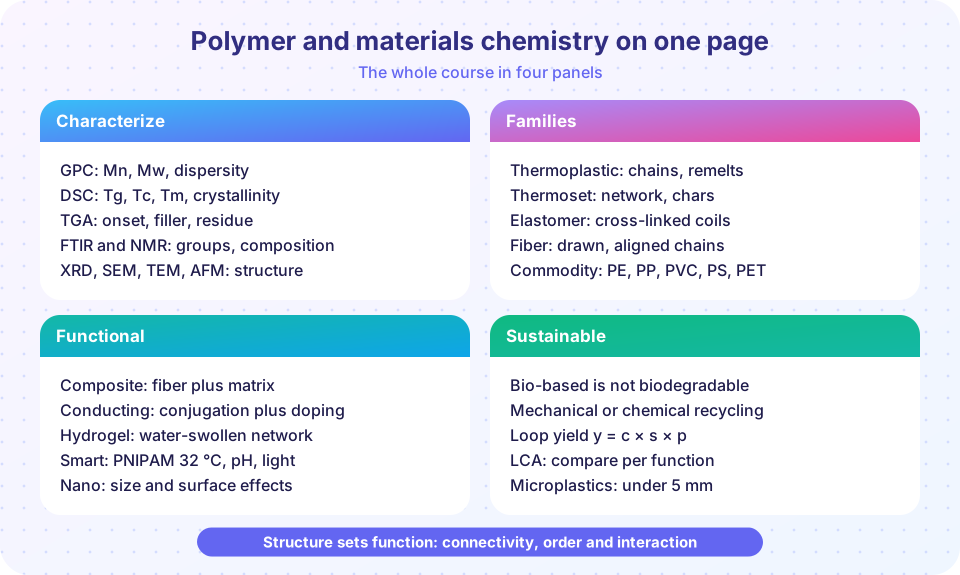
Everything here repeats ideas from earlier lessons; nothing new is introduced. The poster shows the four big panels, and the sections below give the numbers to remember for each.
What you will learn
- Retrieve the main methods, families, formulas and facts quickly.
- See how characterization, materials and sustainability connect.
- Spot which topics to revisit before an exam or project.
Key terms
Structure sets function: the properties of a polymer follow from connectivity (chains or network), order (random or aligned) and interactions (forces between chains and with the surroundings).
Cheat sheet: a compact reference of facts and formulas.
Characterize: which method answers which question
| Question | Method | You get |
|---|---|---|
| How long are the chains? | GPC / SEC | Mn, Mw, Mz, Đ (relative to the calibration unless absolute detectors are used) |
| When does it soften or melt? | DSC | Tg (step), Tc (exotherm), Tm (endotherm), ΔHm |
| How stable is it, what is in it? | TGA | Onset, steps, residue (fillers); atmosphere matters |
| Which groups are present? | FTIR | C=O about 1730, C–H about 2900, O–H or N–H above 3200 cm⁻¹ |
| What is the composition? | NMR | Integrals divided by protons per unit give mole ratios |
| How are chains packed? | XRD | nλ = 2d sin θ; crystallinity from peaks versus halo |
| What does it look like? | Optical, SEM, TEM, AFM | Images from micrometers to nanometers |
Families: what changes with structure
| Family | Structure | On heating | Examples |
|---|---|---|---|
| Thermoplastic | Separate chains | Softens, remelts | PE, PP, PVC, PS, PET, nylon |
| Thermoset | Covalent network | Chars | Epoxy, phenolic, polyester resin |
| Elastomer | Lightly cross-linked coils | No melt when vulcanized | NR, SBR, silicone; TPEs melt |
| Fiber | Drawn, aligned chains | Many melt | Nylon, polyester, aramid, UHMWPE |
Quick facts: LDPE branched (about 110 °C Tm), HDPE linear (about 130 °C), isotactic PP (about 165 °C), PVC (56.7 % Cl, loses HCl above about 150 °C), PS atactic and brittle (Tg about 100 °C), PET (Tg about 75 °C, Tm about 255 °C; clear preform, strain-crystallized bottle).
Functional materials: how structure becomes function
- Composites: fiber carries load, matrix transfers it.
E∥ = Vf Ef + (1−Vf) Em,1/E⊥ = Vf/Ef + (1−Vf)/Em; anisotropic. - Conducting polymers: conjugation gives a path, doping gives carriers,
σ = n q μ; filled composites conduct above the percolation threshold. - Hydrogels and smart polymers: swelling ratio
Q = Ws/Wd; PNIPAM collapses above about 32 °C (entropy); polyacids swell with rising pH (α = 1/(1 + 10^(pKa − pH))). - Ceramics, glass and nanofillers: hard and heat-proof; sol-gel from liquids; nanoclay lengthens the path for gases.
Sustainability: precise words, simple calculations
- Bio-based (carbon source) is not the same as biodegradable (end-of-life behavior).
- Mechanical recycling melts and reforms (chains shorten:
1/Mn,n = 1/Mn,0 + nk); chemical recycling returns to monomers (energy-intensive). - Loop yield
y = c × s × p; recycled content in a steady state cannot exceedy. - LCA: compare per functional unit; reuse break-even
n > E_r / (E₁ − w). - Microplastics: 1 µm to 5 mm; count scales as
1/d³, area per gram as1/d.
Common misconceptions
"A cheat sheet replaces understanding." It only helps if you can rebuild each line from principles. If you cannot say why HDPE melts higher than LDPE, go back to packing and crystallinity.
"One method is enough." Independent methods that agree (DSC and XRD crystallinity, TGA and ash tests) are the strongest evidence.
Try it
A formula toolbox in Python. Each function is one line of the sheet; run it to confirm that you can call them with numbers from a problem.
Press Run (or Ctrl + Enter) to see the result here.
Program input · what you'd type while the program runs
Type the answers before you press Run, one per line. Each time the program reads a line (with input()), it gets the next line from this box.
Second, a one-minute self-test in the console: for each prompt, say the answer aloud before reading it.
Press Run (or Ctrl + Enter) to see the console output here.
No output.
Check your understanding
Quick check · 5 questions
of 5 answered You scored / 5 · perfect!
-
1. Which method would you use first to find the glass transition temperature?
DSC shows Tg as a step in the baseline. -
2. Which statement about thermosets is correct?
Covalent cross-links prevent flow. -
3. A composite is loaded along its fibers. Which formula applies?
Equal strain: the parallel (Voigt) rule. -
4. Which does NOT depend on temperature in the ideal rubber model σ = G(λ − 1/λ²)?
The functional form in λ is fixed; temperature enters through G. -
5. Which is the best single phrase that unifies the course?
Connectivity, order and interactions determine properties.
Summary
- Match the method to the question: GPC for size, DSC and TGA for heat, FTIR and NMR for chemistry, XRD and microscopy for structure.
- Four families (thermoplastic, thermoset, elastomer, fiber) differ in connectivity and order.
- Functional materials come from combining phases, tuning electronic structure or building responsive networks.
- Sustainability needs precise words and per-function comparisons.
Next: Further study
Track your progress
Create a free account to tick off lessons and pick up where you left off on any device.
of Polymer and Materials Chemistry lessons completed