


















Lesson 31 of 47 · Plastics, Rubbers and Fibers
Chapter Review: Plastics, Rubbers and Fibers
Review thermoplastics, thermosets, elastomers and fibers with a comparison table, key formulas, a self-check calculation and a ten-question quiz.
This chapter sorted the everyday world of polymers into four families and explained what each one is good at and why. Before moving on to advanced and functional materials, use this page to consolidate: one picture, one table of the key facts and a quiz that mixes all the lessons.
A useful way to review is to take any object nearby and say, out loud, which family it belongs to, which polymer it probably is and what structural feature makes it suitable. If you can do that for a few objects, you have the chapter.
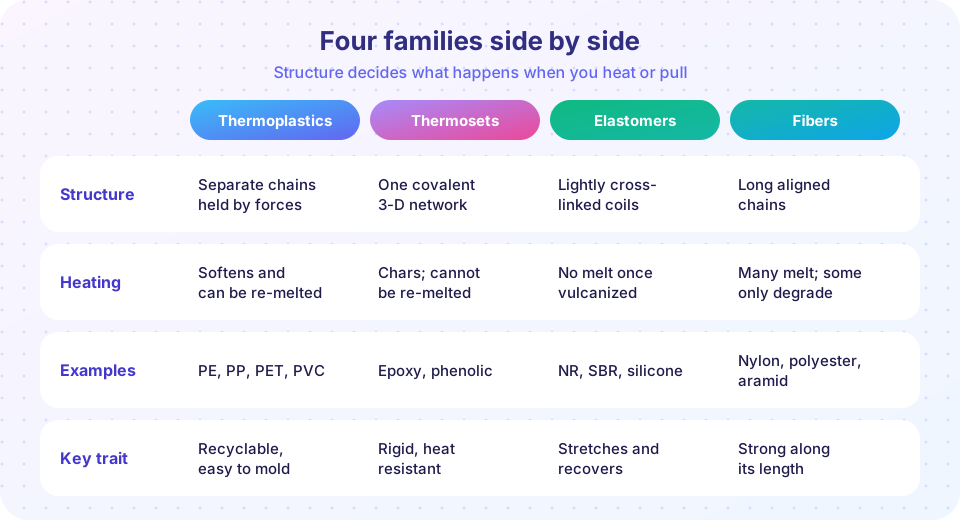
Key facts to remember
| Topic | Fact |
|---|---|
| Resin codes | 1 PET, 2 HDPE, 3 PVC, 4 LDPE, 5 PP, 6 PS, 7 other |
| PE | Same formula for LDPE and HDPE; branching lowers density and Tm (about 110 vs. 130 °C) |
| PP | Isotactic form crystallizes; Tm about 165 °C; density about 0.90 g/cm³ |
| PVC | 56.7 % chlorine; loses HCl above about 150 °C; needs stabilizers |
| PET | Quenched preform is clear; stretch blowing induces small crystals |
| Nylon | Hydrogen-bonded amides; absorbs water, which plasticizes it |
| Thermosets | One covalent network; char instead of melting; gel point p_c = 1/√(f − 1) for A₂ + B_f |
| Rubber | σ = G (λ − 1/λ²), G = ρRT/Mc; entropic; vulcanized with sulfur |
| Fibers | Spun then drawn; σ (GPa) = tenacity (N/tex) × density (g/cm³); denier = 9 × tex |
How the lessons connect
Every lesson in this chapter answered one question: what does the arrangement of chains do to the way a material behaves? In commodity plastics, a methyl group, a chlorine atom or a benzene ring changed packing, polarity and stiffness. In engineering plastics and thermosets, hydrogen bonding and rigid rings added heat resistance, and covalent networks removed flow altogether. In rubbers, light cross-linking kept chains mobile but connected, and in fibers, drawing lined chains up so that covalent bonds carried the load. The same two levers, connectivity and order, explain nearly everything.
It is also worth remembering how processing and structure feed each other. A PET preform is clear because it is cooled before crystals can grow, and the bottle is strong because stretching then aligns the chains. A thermoset is processed while it is still a liquid and becomes a solid only when it cures. Processing is part of the chemistry.
Self-check list
Make sure you can do each of these without notes:
- Name the seven resin codes and say which polymers float in water.
- Explain how branching changes density and Tm in polyethylene.
- Explain why a thermoset chars rather than melts, and compute a gel point.
- Explain rubber elasticity in terms of entropy and predict the effect of heating a stretched band.
- Describe what drawing does to a fiber and convert between tex and denier.
If any of these is shaky, reopen the matching lesson and rerun its Try it cell.
Try it
The cell below re-computes four numbers from the chapter. Change one input (the cross-link spacing, say) and predict what happens to the modulus before running.
Press Run (or Ctrl + Enter) to see the result here.
Program input · what you'd type while the program runs
Type the answers before you press Run, one per line. Each time the program reads a line (with input()), it gets the next line from this box.
Check your understanding
Quick check · 10 questions
of 10 answered You scored / 10 · perfect!
-
1. Which pair is NOT a thermoplastic?
Cured epoxy and phenolic resins are cross-linked thermosets; they char instead of melting. -
2. Why does LDPE have a lower density than HDPE?
Both have the formula (C₂H₄)ₙ; branching reduces packing and crystallinity. -
3. Which resin code identifies polystyrene?
6 is polystyrene (3 PVC, 5 PP, 2 HDPE). -
4. What makes PVC thermally unstable during processing?
Dehydrochlorination begins around 150 °C, so stabilizers are required. -
5. A thermoset's gel point is the moment when:
Gelation marks the appearance of an infinite network; the material stops flowing although cure continues. -
6. For an A₂ + B₄ system with equal group counts, p_c = 1/√(f − 1) with f = 4 gives about:
1/√3 = 0.577. -
7. A stretched rubber band under load is heated. The band:
Entropic elasticity: the restoring force increases with temperature, so the band contracts. -
8. A rubber has G = 0.5 MPa. What is the stress at λ = 2 using σ = G(λ − 1/λ²)?
σ = 0.5 × (2 − 0.25) = 0.875 MPa. -
9. What does drawing do to a spun filament?
Drawing orients chains and crystals, which greatly increases axial properties. -
10. A yarn of 25 tex is how many denier?
denier = 9 × tex = 225.
Summary
- Connectivity (chains or network) and order (random or aligned) explain the four families.
- Commodity plastics differ by a single side group or by branching; engineering plastics add hydrogen bonding, rigid rings or strong bonds.
- Thermosets cure into networks and gel at a predictable conversion; rubbers are lightly cross-linked and entropic; fibers are drawn to align chains.
- You now have the vocabulary for the next chapter: composites, conducting polymers, hydrogels and other functional materials.
Track your progress
Create a free account to tick off lessons and pick up where you left off on any device.
of Polymer and Materials Chemistry lessons completed