


















Lesson 2 of 48 · Getting Started
What is pharmacology? Branches, history and big ideas
Meet the science of drugs: its branches, a short history from willow bark to receptors, Paracelsus and the dose, and the three big ideas that organize the whole subject.
Humans have used plants, minerals and animal products as medicines for thousands of years, but for most of that time nobody knew why they worked, and many did not. Pharmacology turned the folklore of healing into a measurable science. It gave us methods to ask whether a substance acts at all, how much of it is needed, how it travels through the body, and what harm it may do. In this lesson you will see how the subject is organized, how it grew, and which three ideas hold it together.
What you will learn
- The definition of pharmacology and how it differs from pharmacy and therapeutics.
- The four main branches and the question each one answers.
- Key moments in the history of the subject and the people behind them.
- Three big ideas: dose matters, drugs act on targets, and the body handles drugs.
Key terms
- Pharmacology: the study of how chemical substances interact with living systems.
- Pharmacy: the profession and practice of preparing, dispensing and advising on medicines.
- Therapeutics: the use of drugs and other treatments to manage disease in patients.
- Toxicology: the study of the harmful effects of chemicals on living things.
- Pharmacopoeia: an official book of standards for drugs, such as the British, European or US pharmacopoeias.
Definition and scope
The word comes from the Greek pharmakon, which meant a drug, a remedy and a poison all at once, and logos, study. That triple meaning is a good reminder that the same substance can heal or harm depending on how it is used. Pharmacology is a basic science that sits between chemistry, physiology and medicine. It is not the same as pharmacy, which is the practical profession of making and supplying medicines, and not the same as therapeutics, which is the clinical art of choosing treatments for patients. Pharmacology supplies the principles that both of those rely on.
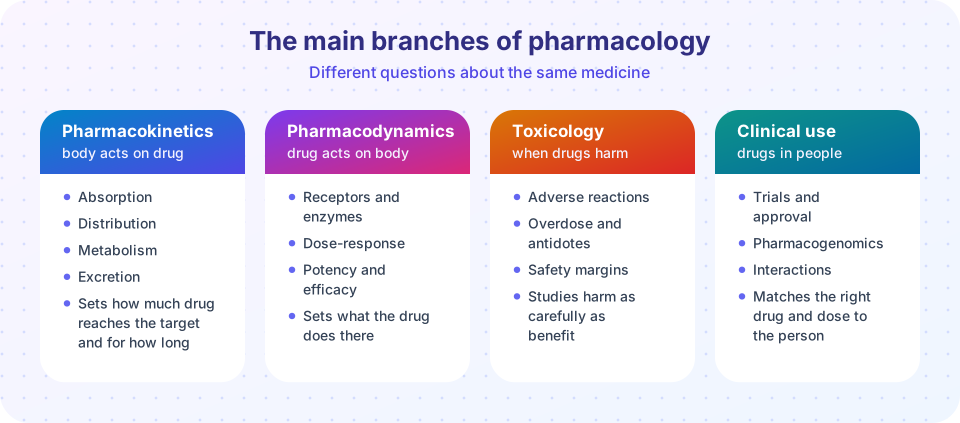
The science is usually split into branches, according to the question being asked:
- Pharmacokinetics (PK) studies what the body does to the drug. How fast does it get into the blood? Where does it go? How is it broken down and removed? PK answers "how much drug is at the target, and for how long?"
- Pharmacodynamics (PD) studies what the drug does to the body: the targets it binds, the signals it changes, and how the size of the effect depends on the concentration. PD answers "what happens when the drug arrives?"
- Toxicology studies harm. It includes side effects at normal doses, overdose, poisoning, antidotes and safety margins. Modern drug safety is the shared territory of pharmacology and toxicology.
- Clinical pharmacology studies drugs in people: clinical trials, dosing in children or older adults, interactions between drugs, and the effect of genes (pharmacogenomics).
Some textbooks add molecular pharmacology (the structure of receptors and enzymes), neuropharmacology (drugs and the nervous system), chemotherapy (drugs against microbes and cancer) and pharmacoepidemiology (what happens when millions of people use a drug). You will meet most of these ideas in later chapters.
A short history
Antiquity to the 1700s. Papyrus records, clay tablets and Chinese and Indian herbals list hundreds of remedies. In the 16th century the physician known as Paracelsus argued that every substance is a poison and that only the dose separates a remedy from a poison. The line often quoted from him, "the dose makes the poison", is still the first rule of toxicology.
Isolating the active ingredient. In the 1700s and 1800s chemists began to ask which part of a plant did the work. In 1763 the English clergyman Edward Stone reported that willow bark could reduce fevers. Later, chemists isolated salicylic acid from it, and in 1897 Felix Hoffmann at Bayer made the better-tolerated acetylsalicylic acid, which became aspirin. In 1785 William Withering published a careful account of the foxglove plant (Digitalis) for heart failure, which led much later to digoxin. Around 1804 the German pharmacist Friedrich Sertürner isolated morphine from opium, the first pure active compound taken from a plant.
A science with laboratories. Rudolf Buchheim founded the first pharmacology institute at the University of Dorpat (now Tartu, in Estonia) in 1847. His student Oswald Schmiedeberg built the discipline in Strasbourg and trained a generation of researchers. Their method was to test a drug on an isolated tissue or an animal under controlled conditions, measure the response, and relate it to the dose.
The receptor idea. In the early 1900s John Newport Langley, studying nicotine and curare, proposed that drugs act on a "receptive substance" on cells. Paul Ehrlich imagined chemicals as "magic bullets" that seek a specific target. In the 1920s and 1930s A. J. Clark put the idea into mathematics by treating drug binding like a chemical equilibrium (you will use this in Chapter 2). Later, James Black designed propranolol and cimetidine on receptor principles, work recognized by the 1988 Nobel Prize in Physiology or Medicine.
Antibiotics, insulin and regulation. Alexander Fleming noticed in 1928 that a mould (Penicillium) killed bacteria. Howard Florey, Ernst Chain and colleagues turned it into a usable drug in the early 1940s. Frederick Banting, Charles Best, James Collip and John Macleod brought insulin to patients in 1921 and 1922. The thalidomide tragedy of the late 1950s and early 1960s, in which a drug given to pregnant women caused severe birth defects, led countries to require much stronger evidence of safety and efficacy before a drug could be sold (Chapter 8).
Three big ideas
- Dose matters. Every effect, wanted or unwanted, depends on how much drug reaches the right place. Dose-response relationships (Chapter 4) are the backbone of safe prescribing.
- Drugs act on targets. Most drugs bind to specific proteins: receptors, enzymes, ion channels or transporters (Chapter 2). The binding is chemical and can be described with numbers.
- The body handles drugs. The body absorbs, distributes, changes and removes foreign molecules. These processes decide the onset, duration and intensity of effect, and they differ between people (Chapter 3).
Whenever you meet a new drug, you can run through the same three prompts: what is the target, how does the dose relate to the effect, and how does the body handle it?
Worked example: why PK and PD are separate questions
Imagine two drugs that block the same receptor with equal strength (the same PD). Drug P is destroyed in the liver within an hour, so its concentration falls fast. Drug Q is eliminated slowly and remains for a day. Both have identical receptor action, yet you would give P several times a day and Q once. The difference is entirely pharmacokinetic. Conversely, two drugs may reach the same blood concentration (identical PK) but one has ten times the effect on the receptor (different PD). Always ask which half of the picture explains what you are seeing.
Common misconceptions
- "Pharmacology is memorizing drug lists." Lists change, principles do not. If you understand targets, dose-response and kinetics, you can predict what a new drug in a familiar class will do.
- "A drug works if it is in the blood." The drug must reach its target tissue at a high enough concentration. Some drugs are in the blood but cannot cross the blood-brain barrier.
- "Side effects are random." Most are predictable: they arise from the same target in another organ, from a different target, or from the metabolites.
Try it
The first demonstration is pure arithmetic. Many doses are calculated from body weight, and mistakes in this step are a real cause of harm. The code below uses a fictional drug, "Examplamine", given at 5 mg per kilogram per dose, supplied as a syrup of 50 mg in each 5 mL. It is practice for the method only.
Press Run (or Ctrl + Enter) to see the result here.
Program input · what you'd type while the program runs
Type the answers before you press Run, one per line. Each time the program reads a line (with input()), it gets the next line from this box.
The second demonstration trains the PK/PD split. Decide which branch each statement belongs to. It is a learning game, not a test of any person's health.
Check your understanding
Quick check · 5 questions
of 5 answered You scored / 5 · perfect!
-
1. What does the Greek root pharmakon suggest about drugs?
Pharmakon meant remedy and poison together, echoing the idea that the dose makes the poison. -
2. A drug is destroyed quickly by the liver, so it must be taken several times a day. Which branch explains this?
Speed of metabolism and elimination is what the body does to the drug, which is pharmacokinetics. -
3. Who first put drug-receptor binding into mathematical form in the 1920s and 1930s?
Clark treated drug binding as a chemical equilibrium and related occupancy to effect. -
4. Which event pushed countries to demand stronger evidence of safety before drugs were sold?
Thalidomide caused severe birth defects and led to much stricter regulation in the 1960s. -
5. Which statement is pharmacodynamic?
Binding a target and changing its activity is the drug's action on the body.
Summary
- Pharmacology studies how substances interact with living systems; pharmacy and therapeutics are the practical professions built on it.
- PK is what the body does to the drug, PD is what the drug does to the body, and toxicology and clinical pharmacology study harm and use in people.
- The field grew from isolating active compounds (morphine, aspirin, digoxin) to the receptor concept and modern regulation.
- Three big ideas organize the subject: dose matters, drugs act on targets, and the body handles drugs.
Track your progress
Create a free account to tick off lessons and pick up where you left off on any device.
of Pharmacology lessons completed