


















Lesson 6 of 48 · Principles of Drug Action
Chapter 2 overview: principles of drug action
Preview chapter 2: how drugs bind receptors, the four families of target, and how agonists and antagonists differ, with a hero illustration, a slide overview and a binding simulation.
Why does a drug work on your heart and not on your hair? Why does a tiny amount of one molecule change your breathing while a hundred times more of another does nothing? The answer is selectivity: drugs act on particular proteins in particular cells, and the rules of that action are the same for aspirin, insulin and anesthetics. Chapter 2 gives you those rules. You will first meet the central idea, the interaction between a drug and its target, then learn to put numbers on it, and finally sort drugs into the types that activate and the types that block.
What you will learn
- The big picture of how a drug produces an effect from binding to response.
- What each lesson in this chapter covers.
- A first quantitative feel for binding by simulating many receptors.
Key terms
- Receptor: a protein that recognizes a signal molecule, such as a hormone, neurotransmitter or drug, and triggers a response.
- Ligand: any molecule that binds to a receptor.
- Affinity: how tightly a ligand binds its receptor.
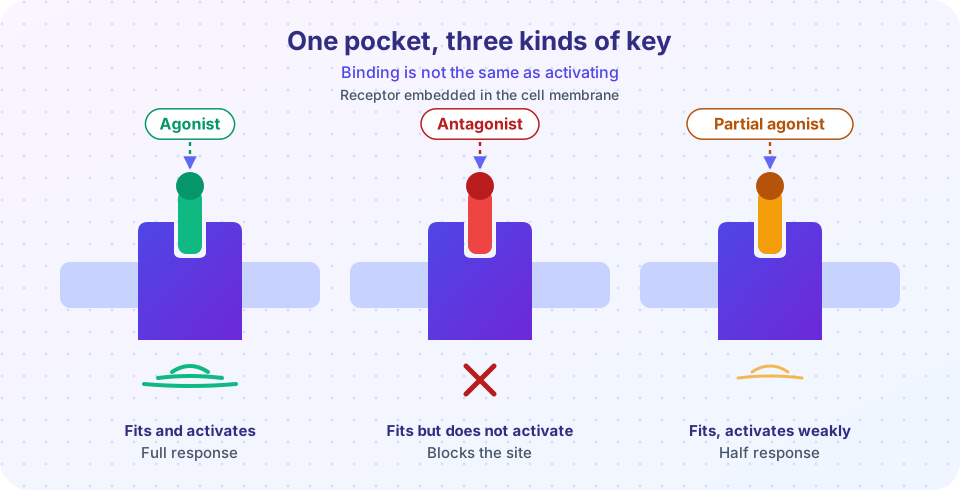
- Efficacy: how well a bound ligand activates the receptor.
- Selectivity: the degree to which a drug acts on one target rather than others.
The big picture
Most drugs begin with binding. A drug molecule collides with a protein, fits into a pocket by shape and charge, and stays for a short time before leaving. While it is there, it can change the protein: open a channel, start a signal inside the cell, block the natural messenger, or stop an enzyme. The cell then responds, and many cells together produce an organ effect, which a patient may notice as a change in heart rate, pain or mood.
From binding to effect
Each step can be measured.
Two properties of a ligand
Antagonists have affinity but no efficacy.
Chapter 2 in four steps
How to use this chapter
Work through the lessons in order, because each builds on the one before: binding first, then the families of target that do the binding, then the kinds of ligand. Keep one question in mind throughout: "if I know the target and the ligand type, what should I expect the dose-response curve to look like?" By the end you should be able to sketch the curve for an agonist, a partial agonist and a competitive antagonist without looking.
What is in this chapter
- Receptors and binding introduces the receptor families and gives the occupancy law,
occupancy = [L] / ([L] + Kd), which links concentration to the fraction of receptors bound. - Drug targets: receptors, channels, enzymes and transporters tours the four main families of target with example drugs, and shows how enzyme inhibitors differ.
- Agonists and antagonists explains full, partial and inverse agonists, competitive and irreversible antagonists, and how to read the shift of a dose-response curve.
- Chapter 2 review pulls it all together with a recap and a longer quiz.
A first simulation: many receptors, one concentration
A drug binds a single receptor by chance: at any instant a given receptor is either occupied or empty. With millions of receptors, the fraction occupied becomes predictable. The simulation below gives each of 10,000 receptors a probability of being occupied equal to [L] / ([L] + Kd), and compares the count with the formula. This is a teaching model of the mathematics, not an experiment.
Press Run (or Ctrl + Enter) to see the result here.
Program input · what you'd type while the program runs
Type the answers before you press Run, one per line. Each time the program reads a line (with input()), it gets the next line from this box.
Common misconceptions
- "A drug that binds a receptor must activate it." Binding and activation are separate. Antagonists bind well and produce nothing.
- "One drug, one receptor." Most drugs bind several targets, with different strengths. That is why side effects exist.
Check your understanding
Quick check · 3 questions
of 3 answered You scored / 3 · perfect!
-
1. What is the difference between affinity and efficacy?
Affinity describes the binding strength; efficacy describes the ability to produce a response once bound. -
2. In the simulation, what happens to the fraction occupied when the concentration equals Kd?
At [L] = Kd, [L] / ([L] + Kd) = 0.5. -
3. Which statement is true of an antagonist?
Antagonists occupy the receptor and block other ligands but produce no response themselves.
Summary
- A drug effect starts with binding to a target, followed by a change in the target, a signal and a cell response.
- Affinity is binding strength and efficacy is the ability to activate; selectivity describes how focused a drug is.
- This chapter covers the occupancy law, the four families of target, and agonists, antagonists and their variants.
Next: Receptors and binding
Track your progress
Create a free account to tick off lessons and pick up where you left off on any device.
of Pharmacology lessons completed