


















Lesson 15 of 48 · Pharmacokinetics
Elimination, clearance, half-life and steady state
Learn how kidneys and liver remove drugs, define clearance, calculate half-life with t1/2 = 0.693 Vd / CL, and see how repeated doses build to steady state, with plots and a dosing simulator.
Every drug that enters the body must eventually leave it, and the speed of that exit controls how often you must take it. A medicine that is cleared in an hour needs dosing several times a day; one that lingers for days may be taken weekly, but can also accumulate and cause harm. In this lesson you will meet the organs that remove drugs, the single most useful pharmacokinetic quantity (clearance), and its close relative the half-life. You will also see how repeated doses build up to a plateau called steady state.
What you will learn
- How the kidney and the liver remove drugs, and how urine pH changes excretion.
- The definition of clearance and how it relates to half-life and volume of distribution.
- How to calculate half-life from data and predict how long a drug takes to wash out.
- How steady state is reached, what the average steady-state concentration depends on, and how to choose a maintenance dose.
Key terms
- Clearance (CL): the volume of plasma completely cleared of drug per unit time (for example L/h).
- Half-life (t½): the time for the plasma concentration to fall by half.
- Elimination rate constant (k): the fraction of drug eliminated per unit time in first-order kinetics; k = 0.693 / t½.
- Steady state: the plateau reached during repeated dosing when the amount given per interval equals the amount eliminated.
- Maintenance dose: the regular dose that keeps the concentration in the therapeutic window.
How the kidney removes drugs
The kidney is the main organ for removing water-soluble drugs and metabolites. Three processes decide the outcome.
- Glomerular filtration. About 120 mL of plasma per minute (the glomerular filtration rate, GFR, in a healthy adult) is filtered into the nephron. Free drug filters freely; drug bound to protein or too large does not. Filtration alone gives a clearance of at most the GFR for a drug that is neither secreted nor reabsorbed.
- Tubular secretion. Transporters in the proximal tubule actively move drugs from blood into the urine, including many acids (penicillins, diuretics) via organic anion transporters and bases via organic cation transporters. Secretion can raise renal clearance above GFR, and it can be blocked: probenecid inhibits the secretion of penicillin, which prolongs penicillin's action.
- Passive reabsorption. As water is reabsorbed along the tubule, a concentration gradient builds up, and lipid-soluble unionized molecules diffuse back into the blood. This is pH dependent: a weak acid is more ionized (so trapped in urine) when the urine is alkaline. Giving sodium bicarbonate to make the urine alkaline speeds the removal of salicylate in aspirin poisoning. Acidifying the urine does the opposite.
Kidney function falls with age and with kidney disease. For drugs cleared mainly by the kidney (digoxin, gentamicin, many antibiotics, lithium), reduced GFR means lower clearance, a longer half-life and accumulation unless the dose is reduced. Clinicians estimate kidney function from the serum creatinine, using equations such as the Cockcroft-Gault formula (you will use it in the review lesson).
Other routes of elimination
- Bile and the enterohepatic cycle. The liver can secrete drugs and their conjugates into bile, which enters the gut. Gut bacteria may cleave a conjugate and release the drug, which is reabsorbed. This enterohepatic recirculation produces a second peak in some concentration curves and prolongs the effect.
- Lungs. Volatile anesthetics and alcohol are excreted in expired air.
- Others. Small amounts leave in sweat, saliva, tears and breast milk. They are minor for the mother's elimination but matter for the infant.
Clearance
Clearance describes the efficiency of elimination. If the plasma contains drug at concentration C and the body eliminates drug at a rate R (mg/h), then:
CL = R / C (volume per time, for example L/h)
It does not represent a real flow. It is the volume of plasma that would be wholly cleared per hour. Total clearance is the sum of organ clearances: CL = CLrenal + CLhepatic + CLother. Clearance is the property that determines the maintenance dose rate required to keep a target concentration:
Dose rate = CL × Ctarget / F
A liver or kidney can clear a drug at most as fast as blood flows to it multiplied by how efficiently the organ extracts the drug. The extraction ratio E gives CL = Q × E for the organ, where Q is the blood flow (the liver, about 1.5 L/min). For a drug with a high extraction ratio, clearance depends on blood flow; for a drug with low extraction it depends on enzyme activity and protein binding.
Half-life
For a drug cleared by first-order processes, the concentration falls exponentially: C(t) = C0 × e^(-k t), with k = CL / Vd. The time to fall by half is the half-life. Setting C = C0 / 2 gives:
t½ = 0.693 / k = 0.693 × Vd / CL
The number 0.693 is the natural logarithm of 2. Two things follow. Half-life depends on both volume of distribution and clearance, so it is a derived quantity, not a measure of the body's handling alone. A drug can have a long half-life because it is cleared slowly, or because it has a huge Vd (so that little drug is in the blood available for clearance). And clearance and volume are the more fundamental quantities. If a patient's kidney function falls, the clearance falls and the half-life rises; if the fat of an obese patient enlarges the Vd of a lipid-soluble drug, the half-life also rises.
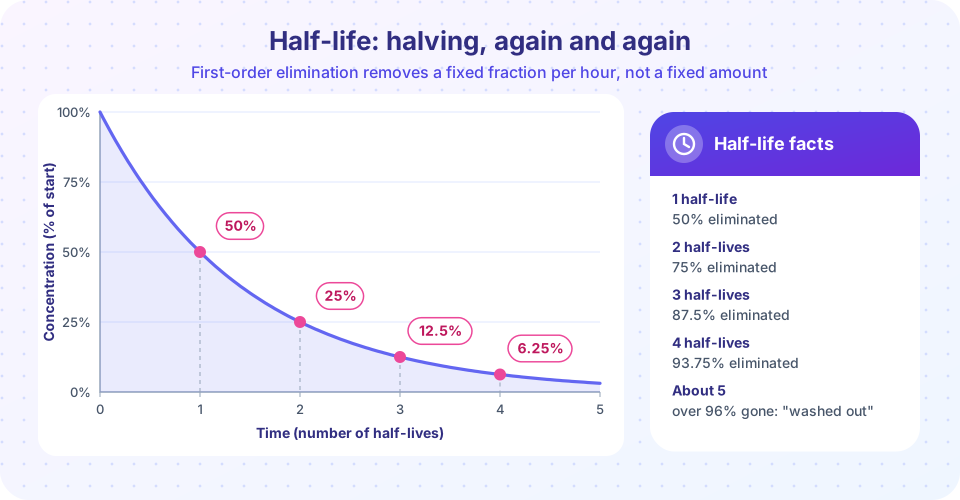
After one half-life, 50% has gone; after two, 75%; after three, 87.5%; after four, 93.75%; after five, 96.9%. A common rule is that a drug is "washed out" in about five half-lives. Typical half-lives vary widely. Many commonly used drugs are measured in hours: paracetamol about two hours, ibuprofen about two hours, amoxicillin about an hour. Others take longer: digoxin and warfarin are measured in a day or two, fluoxetine (with its active metabolite) in days, and amiodarone in weeks. Treat these figures as approximate, because they vary between people and conditions.
Repeated doses and steady state
When a drug is given repeatedly at an interval τ (tau) shorter than it takes to be eliminated, each dose is added to the remainder of the last, and concentrations rise. They rise until the amount eliminated in one interval equals the amount given. This plateau is steady state. At steady state:
average Css = F × Dose / (CL × τ)
Three consequences are worth memorising.
- Time to steady state depends only on half-life. After one half-life you are at about 50% of steady state, after 3.3 half-lives about 90%, after 4.3 half-lives about 95%. In practice, "about 4 to 5 half-lives". Changing the dose does not change how long steady state takes, only the level at which it settles.
- Level depends on dose rate and clearance. Doubling the dose rate doubles the average Css (for first-order drugs). Halving the clearance doubles it too.
- Fluctuation depends on the interval. At steady state the concentration swings between a peak and a trough. Giving the same total daily dose in smaller, more frequent doses narrows the swings.
The accumulation factor is R = 1 / (1 - e^(-k τ)). If τ equals one half-life, R = 2: the steady-state peak is twice the single-dose peak. If τ is much shorter than the half-life, R is large; if τ is much longer, R approaches 1 and there is no accumulation.
A loading dose (previous lesson) brings the patient to the target quickly. Then maintenance doses keep it there. Without a loading dose, a long half-life drug needs days to reach steady state.
Common misconceptions
- "Half-life tells you when a drug stops working." Effect depends on the concentration relative to the dose-response curve. A drug can stop working long before it is gone, or continue beyond its half-life if it has an active metabolite or an irreversible action.
- "Doubling the dose doubles the half-life." For first-order drugs, half-life is independent of dose. A higher dose raises concentrations but not the half-life.
- "Steady state is reached sooner with a larger dose." It takes the same time. A loading dose can bring the level up faster.
Try it
First, estimate half-life and clearance from three "measured" concentrations after an IV dose of 400 mg. The code fits a straight line to the logarithm of concentration against time.
Press Run (or Ctrl + Enter) to see the result here.
Program input · what you'd type while the program runs
Type the answers before you press Run, one per line. Each time the program reads a line (with input()), it gets the next line from this box.
Second, plot repeated IV bolus doses of 200 mg into a 50 L volume with a half-life of 8 hours, given every 4, 8 or 16 hours, and compare with the predicted average steady-state concentration.
Press Run (or Ctrl + Enter) to see the result here.
Program input · what you'd type while the program runs
Type the answers before you press Run, one per line. Each time the program reads a line (with input()), it gets the next line from this box.
Third, a simulator. Change the dose, the interval and the half-life, and watch steady state emerge. It models repeated IV boluses into 50 L; use it to see the shape of accumulation, not to plan treatment.
Check your understanding
Quick check · 6 questions
of 6 answered You scored / 6 · perfect!
-
1. A drug has Vd = 70 L and CL = 7 L/h. What is its half-life?
t1/2 = 0.693 x 70 / 7 = 6.93 h. -
2. How long does it take to reach about 95% of steady state?
After 4.3 half-lives the concentration is about 95% of its plateau. -
3. A drug has CL = 5 L/h, F = 1, and is given as 100 mg every 8 h. What is the average steady-state concentration?
Css = F x Dose / (CL x tau) = 100 / (5 x 8) = 2.5 mg/L. -
4. Why is alkaline urine used in aspirin (salicylate) poisoning?
Ionized molecules are not reabsorbed, so a weak acid is excreted faster in alkaline urine. -
5. If kidney function halves and a drug is cleared mainly by the kidney, which change is expected?
Half-life is inversely related to clearance: t1/2 = 0.693 x Vd / CL. -
6. What happens to the time to reach steady state if you double the dose?
For first-order drugs it depends only on half-life. A larger dose changes the level, not the time.
Summary
- Kidneys remove drugs by filtration, secretion and (pH-dependent) reabsorption; the liver clears by metabolism and bile.
- CL = rate of elimination / concentration; k = CL / Vd; t½ = 0.693 x Vd / CL.
- About five half-lives are needed to wash out a drug or to reach steady state.
- Average Css = F x Dose / (CL x tau); a longer interval means larger swings, and dose changes do not change the time to steady state.
Track your progress
Create a free account to tick off lessons and pick up where you left off on any device.
of Pharmacology lessons completed