


















Lesson 41 of 48 · Drug Development, Safety and Ethics
Regulation, ethics and access to medicines
How regulators approve drugs, how generics are shown to be equivalent, the ethical rules of research from Nuremberg to Belmont, and why access to medicines is unequal.
A medicine is a product that people take on trust. They cannot taste whether it will work, inspect its purity or judge its risk. Societies therefore appoint regulators to review the evidence, and they write ethical codes to govern the research that produces it. Both systems are largely the product of disasters. Understanding what happened, and what was learned, explains why trials look the way they do. It also exposes the questions that remain open: who pays for research, who benefits from it and who is left out.
Educational information only. This lesson describes institutions, history and ethical principles. It is not legal advice, and rules differ by country.
What you will learn
- Describe the disasters that shaped drug regulation, especially thalidomide.
- Explain how regulators evaluate a new drug and how generics are approved.
- State the principles of the Nuremberg Code, the Declaration of Helsinki and the Belmont Report.
- Discuss the causes of unequal access to medicines and some responses.
Key terms
Regulator: a government agency that decides whether a medicine can be sold, such as the FDA in the United States, the EMA in the European Union and the MHRA in the United Kingdom.
Informed consent: a participant's voluntary agreement after understanding the purpose, risks and alternatives.
Bioequivalence: showing that a generic gives the same drug exposure as the original product.
Equipoise: genuine uncertainty about which treatment is better, which justifies randomizing patients between them.
QALY: a quality-adjusted life year, a measure that combines length and quality of life for cost-effectiveness analysis.
Disasters that built the rules
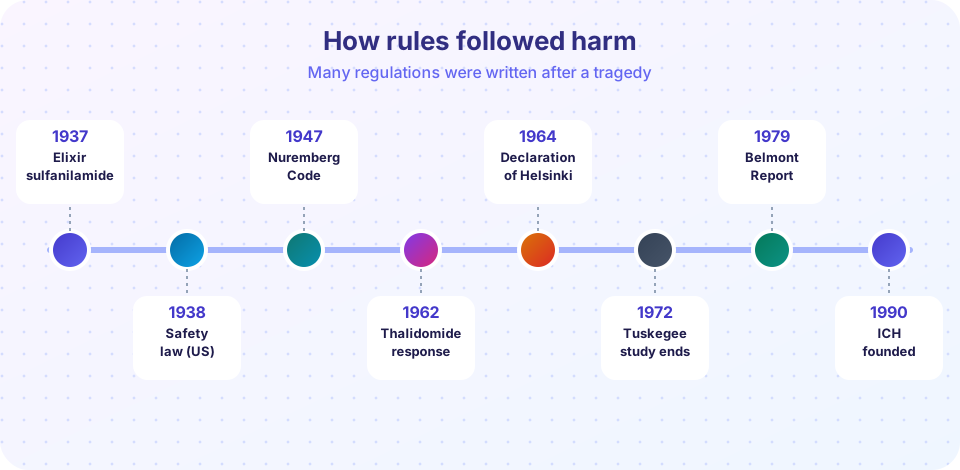
In 1937 a Tennessee company sold a liquid form of the antibacterial sulfanilamide dissolved in diethylene glycol, a toxic solvent related to antifreeze. More than 100 people died, many of them children. The existing American law did not require that drugs be shown safe, so the 1938 Federal Food, Drug and Cosmetic Act was passed to require safety evidence before sale.
The thalidomide disaster had greater effect. Thalidomide was introduced in West Germany in 1957 as a sedative and as a treatment for morning sickness, and it was sold in dozens of countries. In 1961 the German pediatrician Widukind Lenz and the Australian obstetrician William McBride independently linked it to babies born with shortened or absent limbs (phocomelia) and other defects. About 10,000 children were affected worldwide before it was withdrawn. The United States was largely spared because the FDA reviewer Frances Kelsey had refused to approve it, asking for more safety data. The 1962 Kefauver-Harris Amendments in the United States then required that drugs be shown to be effective as well as safe, through "adequate and well-controlled" trials, and many other countries strengthened their own systems. The UK's Yellow Card Scheme, which you met in lesson 3, was created in 1964.
Thalidomide's story did not end there. Under tight control, including pregnancy prevention programs, it and its derivatives are now used to treat multiple myeloma and complications of leprosy.
How regulators decide
Each major regulator has a similar sequence. Before a first trial, the sponsor submits preclinical data and a trial plan for approval (in the US, an Investigational New Drug application, in Europe a clinical trial application). After phase III, the sponsor submits a marketing application, a dossier containing the manufacturing details, the preclinical and clinical data and a proposed label. Expert reviewers analyze it, advisory committees may be consulted, and the regulator decides whether the benefits outweigh the risks for the stated use, and what conditions or warnings must accompany it. Approval is tied to a particular indication, and doctors may legally prescribe outside it ("off-label"), which is common, for example in children, but does not have the same evidence behind it.
Regulators have expedited pathways for serious conditions with unmet need: accelerated approval on a surrogate endpoint, conditional marketing authorizations, priority review and breakthrough designations. These speed access but carry more uncertainty, and the follow-up trials they require are sometimes slow to appear. National bodies increasingly follow shared technical standards written by the International Council for Harmonisation (ICH), founded in 1990, so a single set of studies can serve several regions. Many low-income countries rely on WHO prequalification and on the decisions of stricter regulators.
Generics and biosimilars
Developers hold patents for about twenty years from filing, which includes the long development time, so the effective period of market exclusivity is often shorter. When a patent expires, other companies can sell generic versions. A generic does not repeat the clinical trials. It must contain the same active ingredient and be shown to be bioequivalent: in a study of volunteers, the 90 percent confidence interval for the ratio of its exposure (AUC) and peak concentration (Cmax) to those of the original must lie between 80 and 125 percent. Generics typically cost far less, and widespread use of them is a major way health systems save money. Biosimilars are the equivalent for biologics. Because these are made in living cells and cannot be copied exactly, they are shown to be highly similar and to have no clinically meaningful difference.
Ethics of research
The first modern ethical code came out of the Nuremberg trial of Nazi doctors who had performed cruel experiments on prisoners. The Nuremberg Code (1947) opens with the statement that the voluntary consent of the human subject is absolutely essential. The World Medical Association's Declaration of Helsinki (1964, revised many times) builds on this for medical research: the interests of the participant take precedence over those of science and society, trials must be reviewed by an independent ethics committee, and participants must be informed and free to withdraw.
In the United States, the Tuskegee Study of Untreated Syphilis in Black Men ran from 1932 to 1972. Researchers from the Public Health Service followed 600 Black men, 399 of whom had syphilis, without telling them the diagnosis and without offering penicillin once it became the standard cure. Public exposure in 1972 led to legislation and to the Belmont Report (1979), which sets out three principles that still anchor research ethics:
- Respect for persons: participants are autonomous and must give informed consent; people with reduced autonomy deserve protection.
- Beneficence: minimize harm and maximize benefit, which means risks must be justified by the expected benefits.
- Justice: the burdens and benefits of research should be shared fairly, so that vulnerable groups are not used as convenient subjects and are not excluded from the benefits.
In practice these principles are carried out through institutional review boards or research ethics committees that approve every study, through the process of informed consent, through independent data monitoring committees that can stop a trial, and through registration and publication of results. Contested questions remain. When is a placebo acceptable? When can children or people with dementia take part, and who may consent for them? What must the sponsor provide to the community after a trial in a low-income country? How should human challenge trials, which deliberately expose volunteers to an infection to test a vaccine, be judged? Conflicts of interest are also a concern: industry-funded trials more often report results favorable to the sponsor, so independent replication, open data and registration are important.
Who gets medicines? Access and cost
An approved drug helps only people who can obtain it. The reasons for unequal access include price, patent protection, weak health systems, lack of research on diseases that mainly affect poor countries (the so-called neglected tropical diseases), and in some places counterfeit or substandard products.
HIV treatment shows both the problem and what can change it. In the late 1990s, combination therapy cost about ten thousand dollars per patient per year, far out of reach for most people in sub-Saharan Africa where the epidemic was worst. Generic manufacturers, activists, and changes in international trade rules that allowed countries to use flexibilities in patent law, brought the price down to a few hundred dollars by the early 2000s and later below one hundred, and the number of people on treatment rose from under a million to tens of millions. The WHO Model List of Essential Medicines, first published in 1977, gives countries a guide to a core set of drugs that a health system should be able to supply.
Economic and policy questions follow. Health technology assessment bodies such as the UK's NICE ask whether a drug gives enough health benefit for its cost, often by estimating the cost per quality-adjusted life year gained, and comparing it with a threshold. Critics point out that the approach is imperfect, but it makes the trade-offs explicit. New antibiotics show a market failure: they are used sparingly to slow resistance, so sales are low and fewer companies invest, which has led to proposals for "pull incentives", payments that reward development independent of sales. The unequal distribution of COVID-19 vaccines in 2021 is a recent reminder that scientific success does not automatically become global benefit.
Common misconceptions
"Generics are weaker copies." They must contain the same active ingredient and deliver the same exposure within strict limits. Differences in inactive ingredients rarely matter, though some patients may react to them.
"Ethics review slows science for no reason." Review began because of harm. It catches problems in design and consent, and many studies are improved by it.
"A drug that is approved is available to everyone who needs it." Price, supply, insurance and the capacity of health systems decide who gets it.
Try it
First, a bioequivalence check. The code models the blood concentration after a single oral dose of a reference product and a test product with a slightly different absorption rate. It computes the ratio of AUC and Cmax and checks the 80 to 125 percent rule. It uses a simple one-compartment model and point estimates, whereas a real study uses a 90 percent confidence interval across many volunteers.
Press Run (or Ctrl + Enter) to see the result here.
Program input · what you'd type while the program runs
Type the answers before you press Run, one per line. Each time the program reads a line (with input()), it gets the next line from this box.
Second, a cost-effectiveness calculator. The incremental cost-effectiveness ratio (ICER) is the extra cost divided by the extra QALYs of a new treatment over the existing one. Change the inputs and compare the result with a willingness-to-pay threshold. The numbers are illustrative and the calculator shows only the arithmetic.
Check your understanding
Quick check · 5 questions
of 5 answered You scored / 5 · perfect!
-
1. Which event led to the 1962 Kefauver-Harris Amendments requiring proof of efficacy?
Thalidomide made clear that safety review alone was not enough and that drug evidence standards needed to rise. -
2. A generic is considered bioequivalent when the 90 percent confidence interval of its AUC and Cmax ratios lies within:
The standard limits are 80 to 125 percent for the ratio of the test to the reference product. -
3. Which is one of the three Belmont principles?
The principles are respect for persons, beneficence and justice. -
4. What is the key feature of the Nuremberg Code?
It was the first modern statement that consent must be free and informed. -
5. Why might few companies develop new antibiotics?
The market rewards volume, but good stewardship reduces volume, which discourages investment.
Summary
- Rules grew from disasters: elixir sulfanilamide (1937) led to safety review, thalidomide to proof of efficacy and pharmacovigilance.
- Regulators approve for a specific indication, with expedited pathways for serious unmet need; ICH harmonizes standards.
- Generics are approved by bioequivalence (AUC and Cmax within 80 to 125 percent), not by repeating clinical trials.
- Nuremberg, Helsinki and Belmont set the ethical rules for research; access to medicines is limited by price, patents and health systems.
Next: Chapter 8 review
Track your progress
Create a free account to tick off lessons and pick up where you left off on any device.
of Pharmacology lessons completed