


















Lesson 19 of 48 · Pharmacodynamics and Dose-Response
Potency, efficacy and safety: therapeutic index and window
Tell potency from efficacy, compare drugs on a dose-response plot, and measure safety with ED50, TD50, therapeutic index, certain safety factor and the therapeutic window, with plots and a dose explorer.
"Which drug is stronger?" is a question that hides two different questions. One is how much drug you need to produce an effect. The other is how large an effect the drug can produce at all. These are potency and efficacy, and mixing them up leads to poor decisions. A third question is just as important: how far apart are the doses that help and the doses that harm? That is the question of safety, and it is measured with the therapeutic index and its relatives.
What you will learn
- The difference between potency and efficacy, and why efficacy usually matters more clinically.
- How to compare drugs from their dose-response curves.
- How ED50, TD50, LD50, the therapeutic index and the certain safety factor are defined.
- Why a narrow therapeutic window needs monitoring, and which drugs have one.
Key terms
- Potency: the amount of drug needed to produce a given effect; a more potent drug has a lower EC50 or ED50.
- Efficacy (Emax): the maximum effect a drug can produce.
- Therapeutic index (TI): the ratio TD50 / ED50, the toxic dose for half of the population over the effective dose for half.
- Certain safety factor (CSF): the ratio TD1 / ED99, comparing the dose that is toxic in 1% with the dose effective in 99%.
- Therapeutic window: the range of dose or concentration with acceptable benefit and harm.
Potency: where the curve sits
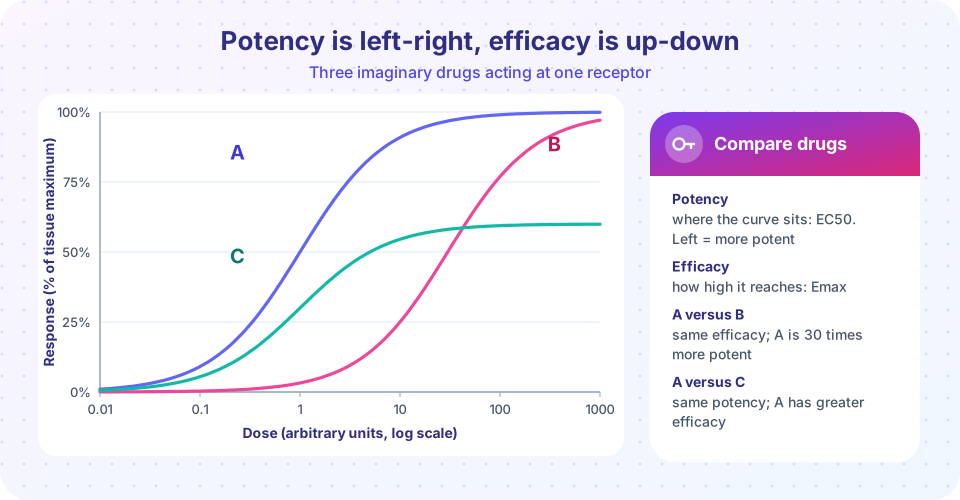
Potency is read from the left-right position of a dose-response curve. In the picture, drug A and drug B both reach a ceiling of 100%, but A reaches 50% at a dose of 1 unit and B at 30 units. A is 30 times more potent than B. The consequence is a smaller dose for A: if you want the same effect, you use one thirtieth of the amount. That is all potency means.
A higher potency is not by itself a medical advantage. If a drug is potent but its effects and side effects are no different, the only practical difference is the dose size: a few micrograms rather than a few hundred milligrams. Potency matters for formulation (a potent drug fits into a patch, an inhaler or a tiny tablet) and for the cost of manufacturing, but it does not make the drug more effective or safer. For example, fentanyl is roughly 50 to 100 times more potent than morphine as an analgesic, yet it does not relieve a larger maximum amount of pain; it is simply active at a much smaller dose. That also means that errors in a dose of fentanyl are less forgiving.
Potency depends on the affinity of the drug for its receptor, on the efficacy at that receptor, on the number of receptors and on the amplification in the tissue, and also on the pharmacokinetics (how much of the dose reaches the target).
Efficacy: how high the curve goes
Efficacy is the ceiling of the curve, Emax. In the picture, drug C sits at the same place as A, so it is equally potent, but it only reaches 60%. No increase in dose will lift it beyond that ceiling. A partial agonist has a lower efficacy than a full agonist at the same receptor; a drug acting on a different mechanism may reach a different ceiling altogether.
Efficacy is usually more important than potency in practice. Consider the loop diuretics (such as furosemide) and the thiazide diuretics. A high dose of a thiazide cannot match the maximum salt and water loss that a loop diuretic can produce. Loop diuretics are called "high-ceiling" diuretics for that reason, which is why they are used when a large effect is needed, as in pulmonary oedema. Likewise, mild analgesics such as paracetamol have a ceiling effect on pain, and a severe pain needs a drug with a higher ceiling, such as an opioid.
Two cautions. First, the efficacy of a drug in a laboratory preparation (sometimes called "intrinsic efficacy") may not match the clinical efficacy measured in patients, which also reflects pharmacokinetics, adherence and side effects that stop you from using enough. Second, "efficacy" in a clinical trial means the effect under ideal conditions, whereas "effectiveness" means the effect in routine care.
Comparing three drugs
Drugs A, B and C in the picture show how to read a plot. A versus B: same efficacy, different potency, so they could be interchanged by adjusting the dose. A versus C: same potency, different efficacy, so they cannot be interchanged; C is a poorer choice if a large effect is required, but might be preferred when a ceiling is desirable for safety (as with buprenorphine's ceiling on respiratory depression).
Safety: the therapeutic index
Every drug has a dose-response curve for its wanted effect and another for an unwanted effect. Using quantal data across a population, the median effective dose is ED50 and the median toxic dose is TD50. In animal experiments the median lethal dose, LD50, was historically used for toxicity. The therapeutic index is:
TI = TD50 / ED50 (in animals: LD50 / ED50)
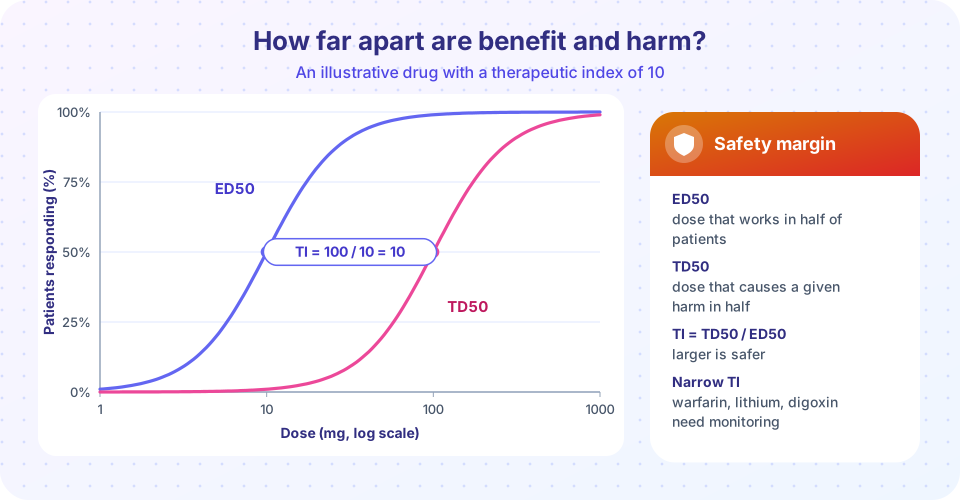
A large TI means a wide gap between the dose that helps and the dose that harms, so a dose error is less likely to cause trouble. A small TI means a narrow margin. In the picture, a drug with an ED50 of 10 mg and a TD50 of 100 mg has a TI of 10.
The therapeutic index has real limits.
- It uses medians, which say nothing about the tails of the distributions. At the dose that helps 99% of patients, some patients could already be harmed.
- It depends on which toxic effect is chosen, and on the population studied.
- The LD50 comes from animal experiments and does not transfer cleanly to humans, and modern practice avoids lethal end points.
- It ignores the slopes of the curves: a steep curve for harm is better than a shallow one for the same TD50.
A stricter measure is the certain safety factor, CSF = TD1 / ED99: the dose that harms 1% of the population divided by the dose that helps 99%. If CSF is below 1, there is an overlap, so some patients will be harmed before others are helped. In the code below, a drug with a pleasant-looking TI of 10 has a CSF less than 1 once the slopes are included.
Therapeutic window and drugs with narrow margins
In practice, clinicians often work with a therapeutic window of plasma concentration rather than dose: a minimum effective concentration at the lower edge and a minimum toxic concentration at the upper edge. Because the same dose gives different concentrations in different people, the window is more useful when you can measure the concentration. Therapeutic drug monitoring (TDM) does this for drugs with narrow windows, such as lithium, digoxin, phenytoin, theophylline, ciclosporin and tacrolimus, and the aminoglycoside antibiotics (such as gentamicin). The anticoagulant warfarin is monitored not by its concentration but by its effect, the INR (international normalized ratio) of blood clotting. Reference ranges depend on the laboratory and on the indication, so always use the local one.
Narrow-window drugs also need extra care with interactions, kidney or liver disease, and changes of brand or formulation, because small changes in exposure can move the patient out of the window.
Common misconceptions
- "A more potent drug is a better drug." Potency only changes the dose size. Efficacy and safety decide how useful a drug is.
- "A therapeutic index of 10 is safe." It depends on the slopes of the curves. Overlap between the tails can mean harm in some patients at doses that help others.
- "LD50 describes safety in people." It comes from animal experiments and was designed for comparing toxicity of chemicals, not for guiding treatment.
Try it
First, compare three drugs and calculate the dose for a given target effect. The numbers come from the picture: A has an EC50 of 1 and an Emax of 100%, B an EC50 of 30 and Emax 100%, and C an EC50 of 1 and an Emax of 60%. For drug C, a response above 60% can never be reached.
Press Run (or Ctrl + Enter) to see the result here.
Program input · what you'd type while the program runs
Type the answers before you press Run, one per line. Each time the program reads a line (with input()), it gets the next line from this box.
Second, compute a therapeutic index and a certain safety factor from log-normal quantal curves. The drug has an ED50 of 10 mg and a TD50 of 100 mg, so TI = 10, but the toxic curve is shallower than the effective one.
Press Run (or Ctrl + Enter) to see the result here.
Program input · what you'd type while the program runs
Type the answers before you press Run, one per line. Each time the program reads a line (with input()), it gets the next line from this box.
Third, an interactive dose explorer using the same curves. Move the dose and see the share of patients helped and harmed.
Check your understanding
Quick check · 6 questions
of 6 answered You scored / 6 · perfect!
-
1. Drug X has an EC50 of 2 mg and drug Y an EC50 of 20 mg, and both reach the same maximum. Which statement is correct?
A lower EC50 means higher potency. The maximum is the same, so efficacy is equal. -
2. Which property does a loop diuretic have that a thiazide lacks?
Loop diuretics can produce a larger maximum diuresis. -
3. A drug has ED50 = 5 mg and TD50 = 200 mg. What is the therapeutic index?
TI = TD50 / ED50 = 200 / 5 = 40. -
4. Why can a certain safety factor below 1 occur with a large TI?
TI compares medians; the CSF compares the 1% toxic dose with the 99% effective dose, so slopes matter. -
5. Which drug is monitored using plasma concentration because of a narrow therapeutic window?
Lithium has a narrow window and is monitored by serum level. -
6. Fentanyl is far more potent than morphine as an analgesic. This means
Potency affects dose size, not the ceiling or the safety margin.
Summary
- Potency is where the dose-response curve sits (EC50); efficacy is how high it goes (Emax). Efficacy usually matters more clinically.
- TI = TD50 / ED50; the CSF = TD1 / ED99 is stricter and shows when benefit and harm overlap.
- The therapeutic window can be defined by concentration; narrow-window drugs (lithium, digoxin, phenytoin, warfarin, aminoglycosides) need monitoring.
- A more potent drug is not necessarily better or safer; it just needs a smaller dose.
Track your progress
Create a free account to tick off lessons and pick up where you left off on any device.
of Pharmacology lessons completed