


















Lesson 37 of 48 · Anti-Infective and Cancer Drugs
Chapter 7 review: anti-infective and cancer drugs
Review chapter 7 with a one-picture summary, a table of antibacterial, antiviral, antifungal and cancer drug targets, drug-name stems and ten mixed questions.
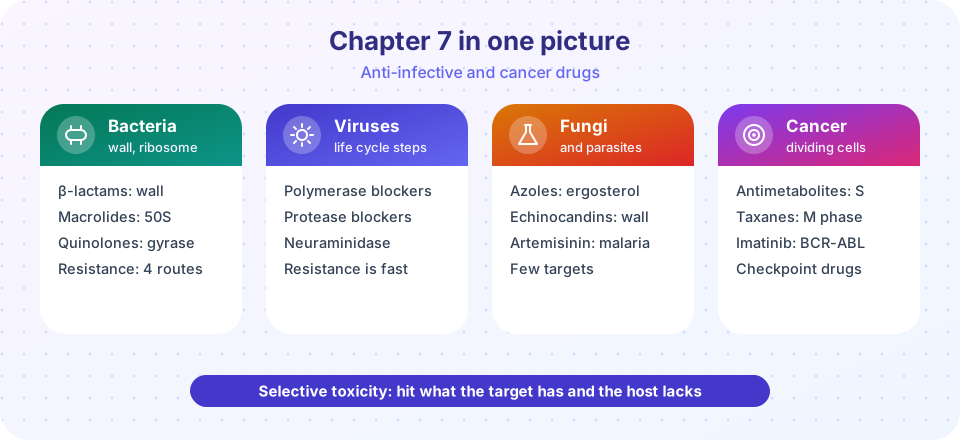
This chapter had one theme with many variations: find something the enemy has and the host lacks, and aim a drug at it, then expect the enemy to evolve. This review collects the targets into one table, adds a tool for decoding drug names, and tests you on all three lessons.
What you will learn
- Recall the target, a typical drug and a key risk for each class of anti-infective and cancer drug.
- Use drug-name stems to guess the class of a drug.
- Explain how resistance links the three lessons of the chapter.
The chapter in a table
| Enemy | Target | Example drugs | Key risk or limit |
|---|---|---|---|
| Bacteria | cell wall (PBPs) | penicillins, cephalosporins, vancomycin | allergy; vancomycin kidney injury |
| Bacteria | 30S ribosome | gentamicin, doxycycline | kidney and ear toxicity; teeth in children |
| Bacteria | 50S ribosome | azithromycin, linezolid | QT prolongation, interactions |
| Bacteria | DNA gyrase | ciprofloxacin | tendon, nerve, aorta warnings |
| Bacteria | folate synthesis | co-trimoxazole | rash, high potassium |
| Bacteria | RNA polymerase | rifampicin | enzyme induction, orange body fluids |
| Viruses | polymerase | acyclovir, tenofovir, sofosbuvir | resistance (HIV) |
| Viruses | protease | nirmatrelvir with ritonavir | CYP3A4 interactions |
| Viruses | neuraminidase | oseltamivir | modest benefit |
| Fungi | ergosterol or wall | fluconazole, amphotericin B, caspofungin | interactions; kidney toxicity |
| Parasites | many | artemisinin combinations, ivermectin | resistance |
| Cancer | DNA or spindle | cisplatin, methotrexate, paclitaxel | marrow, gut, nerve toxicity |
| Cancer | specific driver | imatinib, trastuzumab, olaparib | needs a biomarker |
| Cancer | immune brake | pembrolizumab | immune-related adverse events |
Three ideas that tie it together
Selective toxicity decides the safety margin. Penicillin acts on a structure human cells lack, so the margin is wide. Chemotherapy acts on a process humans share, division, so the margin is narrow and blood counts, kidney function and heart function are monitored.
Dosing follows the way a drug kills. Time-dependent antibiotics need frequent dosing, concentration-dependent ones need high peaks, and cancer drugs are given in cycles because each cycle kills a fraction.
Resistance is selection. Whether the enemy is a bacterium, a virus or a tumor, exposure to the drug removes the sensitive cells and favors rare variants. Combinations (TB, HIV, malaria, many cancers), stewardship and genotype-guided choices slow this down but do not stop it.
Questions to ask about any anti-infective or cancer drug
When you meet an unfamiliar drug, four questions give you most of what you need. First, what is the target, and does the host have it? If the target is absent from human cells, expect a wide margin; if the target is shared, expect monitoring. Second, how does it kill: by time above a threshold, by peak concentration, or by a fixed fraction of cells per cycle? That decides how it is dosed. Third, what does it do to other drugs: enzyme inducers such as rifampicin and enzyme inhibitors such as clarithromycin, azoles and ritonavir change the levels of statins, anticoagulants, contraceptives and many others. Fourth, how will the enemy escape, and what combination, test or stewardship rule slows that down? Applying these questions to a drug you have not seen before is the best way to check that you understand the chapter, and they will come back in chapter 8 when we look at how new drugs are tested.
The same logic extends beyond this chapter. A new antibiotic, antiviral or cancer drug will have a target, a way of killing or blocking, a kinetic profile that sets its dosing, a pattern of interactions and a way the enemy will try to escape. If you can fill in those five slots, you can read about a drug you have never met and understand why it is used the way it is.
Common misconceptions
"A stronger antibiotic is always better." The best antibiotic is the narrowest one that covers the germ, given at the right dose for the right time.
"A cure and a remission are the same." Many antivirals and cancer drugs suppress disease without eradicating it. Hepatitis C drugs and some chemotherapy regimens can cure, but HIV drugs control and imatinib suppresses.
"Drug interactions only matter for old drugs." Boosted protease inhibitors, azoles and rifampicin are modern drugs with some of the largest interaction effects.
Try it
First, a drug-name stem decoder for this chapter. The stems are standardized worldwide, so they are a quick clue to a drug's class.
Press Run (or Ctrl + Enter) to see the result here.
Program input · what you'd type while the program runs
Type the answers before you press Run, one per line. Each time the program reads a line (with input()), it gets the next line from this box.
Second, flashcards. Flip a card to see the answer.
Check your understanding
Quick check · 10 questions
of 10 answered You scored / 10 · perfect!
-
1. Which statement best describes selective toxicity?
Selective toxicity is the gap between harm to the target and harm to the host. -
2. Which antibiotic class is typically dosed as a large once-daily dose to exploit concentration-dependent killing?
High peaks kill faster, and the drug-free interval reduces toxicity. -
3. Rifampicin lowers the effect of many other drugs because it:
Enzyme induction speeds up the clearance of warfarin, contraceptives and others. -
4. Which pair is correct?
Oseltamivir blocks the viral enzyme that releases new particles. Azoles act on ergosterol and echinocandins on beta-glucan. -
5. Why is a combination of several antiretrovirals used for HIV?
Combination therapy reduces the chance of selecting resistant virus. -
6. In the fractional kill model, why are cycles repeated?
A cycle that kills 99.9 percent of 10^9 cells leaves 10^6, and survivors regrow between cycles. -
7. Which cancer drug depends on a biomarker such as HER2 overexpression?
Trastuzumab is given to patients whose tumors overexpress HER2. -
8. Which resistance mechanism does MRSA use?
The mecA gene encodes PBP2a, which beta-lactams bind poorly. -
9. Why does artemisinin come with a partner drug?
Combination therapy for malaria pairs a fast drug with a longer-acting one. -
10. A drug blocks a checkpoint called PD-1. Which side effect is most characteristic?
By releasing T cells, PD-1 inhibitors can cause immune attacks on normal tissues.
Summary
- Targets: bacterial wall, ribosome, gyrase and folate; viral polymerase, protease and neuraminidase; fungal ergosterol and wall; cancer division, drivers and immune brakes.
- Selective toxicity sets the safety margin; dosing follows how the drug kills.
- Resistance is selection, slowed by combinations, stewardship and biomarkers.
Next: Chapter 8 overview: drug development, safety and ethics
Track your progress
Create a free account to tick off lessons and pick up where you left off on any device.
of Pharmacology lessons completed