


















Lesson 38 of 48 · Drug Development, Safety and Ethics
Chapter 8 overview: drug development, safety and ethics
A tour of how medicines are discovered, tested, approved and monitored, why most candidates fail, and the ethical rules that protect trial participants and patients.
Every drug in earlier chapters, from aspirin to imatinib, began as an idea, a plant extract or an accident. Before it reached a patient it went through years of testing meant to answer three questions: does it work, is it safe enough, and can it be made reliably? This chapter looks at how those questions are asked and who decides the answers. It also looks at the part of the story that begins after approval, when thousands or millions of people take the drug and rare problems appear that no trial could have found.
The subject sits at the meeting point of science, statistics, law and ethics. A good trial is a piece of experimental design. A good regulator is a referee between hope and caution. And the rules of research ethics exist because some people in the past were harmed in the name of science, and because the history of drug disasters, thalidomide above all, taught the world to demand evidence before sale.
Educational information only. This chapter explains how drug evidence is produced and judged. It is not advice about any medicine or any trial. Anyone considering joining a clinical trial should discuss it with their own doctor and read the consent information carefully.
What you will learn
- Describe the stages of drug development and what each stage asks.
- Explain why attrition is high and what that means for cost and price.
- Recognize the main types of adverse reactions and how they are monitored after approval.
- Name the ethical principles and regulatory bodies that govern drug research.
The chapter at a glance
The pipeline
Lesson 2
Fair tests
Lesson 2
After approval
Lesson 3
Rules and access
Lesson 4
Where each lesson fits
- From laboratory to approval: the pipeline and clinical trials: preclinical studies, the four phases, trial design, endpoints and how to read risk numbers.
- Adverse reactions, interactions and pharmacovigilance: the types of harm, pharmacogenomics, drug interactions and the systems that detect problems after approval.
- Regulation, ethics and access to medicines: how regulators decide, how generics are approved, the ethics of research, and who can afford drugs.
- Chapter 8 review: a summary picture and ten questions.
Why so many candidates fail
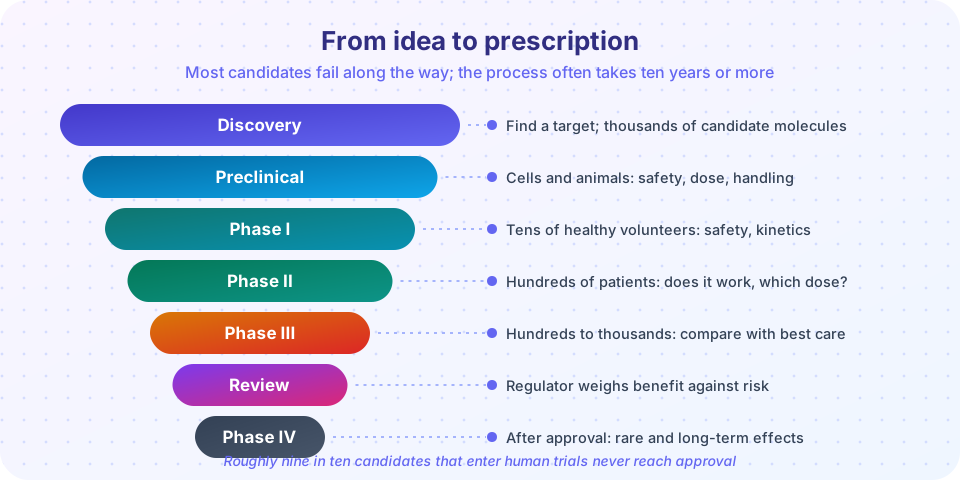
Imagine a thousand promising molecules entering human trials. Based on industry-wide analyses of trials started in the 2010s, only around 8 percent of drugs that enter phase I eventually win approval, with large differences between disease areas (cancer and brain disorders have lower success rates than infectious disease). Most failures are for lack of efficacy: the drug works in a dish or a mouse and not in people. Others fail for safety or for commercial reasons.
This has two consequences. The first is cost. The money spent on failures has to be recovered from the few successes, so estimates of the cost of developing one approved drug run from several hundred million to well over a billion dollars depending on the method and on how failures are counted. The second is that early failure is good news when it saves patients from an ineffective or harmful drug. The pipeline is a series of filters, and each filter is designed to remove a bad drug as cheaply and as early as possible.
Not every drug is found by design. Sildenafil was tested as a heart drug, and the effect that made it famous was noticed in volunteers. Thalidomide, withdrawn in 1961 after causing birth defects, was later found to treat leprosy complications and multiple myeloma under strict controls. Repurposing drugs for new uses is a major source of treatments. Most new medicines now belong to two families, small molecules that are chemically synthesized and taken by mouth, and biologics such as antibodies, which are made in living cells, usually injected, and are much harder to copy.
Common misconceptions
"Approval means a drug is completely safe." Approval means the benefits are judged to outweigh the known risks for the approved use. Rare and long-term harms may only appear after many people have taken the drug, which is why monitoring continues.
"A drug that works in animals will work in people." Animal studies predict some toxicities well and efficacy poorly. Most drugs that look promising in animals fail in humans.
"Placebo-controlled trials are unethical because some patients get nothing." When no proven treatment exists, or when the uncertainty is genuine, placebo controls are acceptable. When a proven treatment exists, the comparator is usually that treatment and not placebo.
Try it
First, a simulation of attrition. The success rates below are approximate industry-wide averages for each stage and are used only to show how small percentages multiply. Change them and re-run to see how a better phase II rate would change the result.
Press Run (or Ctrl + Enter) to see the result here.
Program input · what you'd type while the program runs
Type the answers before you press Run, one per line. Each time the program reads a line (with input()), it gets the next line from this box.
Second, an interactive version. Move the sliders to set the success rate of each stage and read off the expected number of approved drugs out of 100 candidates. Notice how much phase II matters. This is a toy model with fixed rates, not a forecast for any company.
Check your understanding
Quick check · 5 questions
of 5 answered You scored / 5 · perfect!
-
1. Roughly what share of drugs entering phase I eventually win approval?
Industry-wide analyses put the likelihood of approval from phase I at under one in ten. -
2. What is the most common reason candidates fail in phases II and III?
Many drugs that work in cells or animals do not work well enough in people. -
3. A biologic differs from a small molecule drug mainly because it is:
Antibodies and similar products are made in cell cultures and are hard to copy exactly. -
4. Why is early failure in the pipeline sometimes good news?
Each stage is a filter intended to catch problems before large numbers of people are exposed. -
5. Which statement about approval is correct?
Post-marketing surveillance continues because rare harms appear only with wide use.
Summary
- Development moves from discovery and preclinical studies through phases I to III to regulatory review and phase IV monitoring.
- Only about one in twelve drugs entering human trials is approved, mostly because they do not work well enough.
- Safety does not end at approval; rare and long-term harms are found through surveillance.
- Ethics and regulation grew out of past harms and now shape how every trial is run.
Next: From laboratory to approval: the pipeline and clinical trials
Track your progress
Create a free account to tick off lessons and pick up where you left off on any device.
of Pharmacology lessons completed