


















Lesson 35 of 48 · Anti-Infective and Cancer Drugs
Antivirals, antifungals and antiparasitics
How acyclovir, oseltamivir, HIV and hepatitis C drugs, azoles, amphotericin B, artemisinin and ivermectin work, and why combination therapy and resistance matter.
Antibiotics are the best-known anti-infective drugs, but bacteria are only one of four groups of microbes that cause disease. Viruses cause everything from colds to AIDS, fungi cause infections from athlete's foot to life-threatening bloodstream disease, and parasites, from single-celled malaria organisms to intestinal worms, affect billions of people worldwide. Each group is biologically different, so each needs its own drugs. This lesson tours the main targets for viruses, fungi and parasites and explains why some of these infections are curable while others are only held back.
Educational information only. Treatment of viral, fungal and parasitic infections depends on the specific organism, the patient's health and local conditions. This lesson explains mechanisms and does not guide treatment decisions.
What you will learn
- Explain why viruses are harder to target than bacteria and give examples of the viral enzymes that drugs block.
- Describe how combination therapy turned HIV into a manageable condition.
- Describe the main antifungal classes and why they interact with so many other drugs.
- Explain the roles of artemisinin, ivermectin and albendazole against parasites.
Key terms
Nucleoside analog: a molecule that looks like a DNA or RNA building block; viral polymerases insert it and the chain stops growing.
Prodrug: an inactive drug converted into its active form in the body, as acyclovir is by a viral enzyme.
Viral load: the amount of virus in the blood, measured in copies per milliliter.
Ergosterol: the main sterol in fungal membranes, in place of the cholesterol in human cells.
Artemisinin combination therapy (ACT): malaria treatment pairing a fast-acting artemisinin with a longer-acting partner drug.
Antivirals
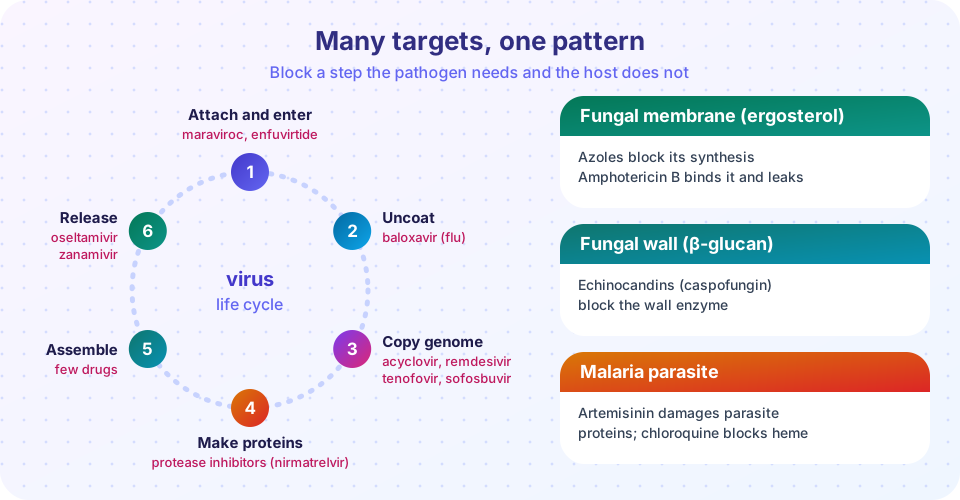
A virus is not a cell. It carries a genome in a protein coat and relies on the host cell's ribosomes and energy. A drug that damaged these host components would harm us, so antivirals must hit viral proteins, and there are few of them. The successful drugs are directed at viral enzymes:
- Polymerase inhibitors. Viral polymerases copy the genome, and they are less picky than human ones. Acyclovir, for herpes viruses, is a guanosine analog that is only activated (phosphorylated) by a viral enzyme, thymidine kinase. It is therefore concentrated in infected cells, which is why it is so safe. Once the active form is built into viral DNA, the chain terminates. Valaciclovir is a prodrug of acyclovir with better absorption. Remdesivir (a nucleotide analog that stops RNA copying) is used against SARS-CoV-2, while tenofovir (HIV and hepatitis B) and sofosbuvir (hepatitis C) are nucleotide analogs.
- Protease inhibitors. Many viruses make one long protein that a viral protease cuts into working pieces. Blocking the protease leaves immature, non-infectious particles. HIV protease inhibitors have been used for decades. Nirmatrelvir blocks the SARS-CoV-2 main protease and is given with ritonavir, a drug whose purpose is to inhibit CYP3A4 and slow the breakdown of nirmatrelvir. The same inhibition makes many interactions possible, for example with some statins and anticoagulants from chapter 5.
- Neuraminidase inhibitors. Influenza particles use a surface enzyme, neuraminidase, to cut themselves free from the infected cell. Oseltamivir and zanamivir block it. Started within about two days of symptoms, they shorten the illness modestly, about a day on average in healthy adults; assessments of their benefit have been debated, and vaccines remain the main protection.
- Entry and integrase inhibitors. Maraviroc blocks a receptor that some HIV strains use to get into cells, and integrase inhibitors such as dolutegravir stop HIV inserting its DNA into the host genome. Baloxavir blocks an influenza enzyme needed to start the production of viral RNA.
HIV is the clearest example of how combination therapy changes an outcome. HIV mutates rapidly, so a single drug fails within weeks. Combination antiretroviral therapy uses three or more drugs from at least two classes, usually in a single daily tablet. After the start of treatment the viral load falls quickly, in the first days with a half-life of about a day or two, and then more slowly, usually reaching levels too low to detect within months. People who take treatment reliably and keep the virus undetectable do not transmit HIV sexually, which is the basis of the public health message "undetectable equals untransmittable". The same drugs, taken before exposure, are used for pre-exposure prophylaxis. HIV remains a lifelong infection because the virus hides in long-lived cells, so treatment must continue.
In contrast, hepatitis C can be cured. The direct-acting antivirals, including sofosbuvir, block viral proteins and cure over 95 percent of patients within 8 to 12 weeks, a major advance over earlier interferon-based treatment. Hepatitis B can usually be suppressed but not cured with tenofovir or entecavir.
Antifungals
Fungal infections range from superficial (skin, nails, mouth, vagina) to invasive, which mostly affects people with weak immunity. Fungal cells are eukaryotic like ours, so the differences available are few, and the key ones are in the membrane and wall.
- Azoles (fluconazole, itraconazole, voriconazole) inhibit the fungal enzyme lanosterol 14-alpha-demethylase, which is needed to make ergosterol. They also inhibit human CYP enzymes to varying degrees, so they interact with many drugs and the extent depends on the azole.
- Polyenes (amphotericin B) bind ergosterol and form pores in the membrane, so the cell leaks. They also bind cholesterol a little, which explains the kidney toxicity of the older form. Lipid formulations reduce it.
- Echinocandins (caspofungin) block the enzyme that makes beta-glucan, a wall component that human cells do not have. They are a notably safe class.
- Terbinafine blocks squalene epoxidase earlier in the ergosterol pathway and is used for fungal infection of nails and skin.
Fungal infections often need weeks to months of treatment, and resistance, for example in Candida auris, is growing.
Antiparasitics
Malaria is caused by Plasmodium parasites carried by mosquitoes. For decades chloroquine was the mainstay until resistance spread. In 1972 Tu Youyou, a Chinese pharmacologist who searched traditional remedies, isolated artemisinin from the sweet wormwood plant, work for which she shared the 2015 Nobel Prize in Physiology or Medicine. Artemisinins are activated by heme iron inside the parasite and are very fast acting, but they are cleared quickly from the body. To prevent resistance and to clear remaining parasites, they are given as artemisinin combination therapy, paired with a slower-acting partner drug. Partial resistance to artemisinin has been reported in parts of Southeast Asia and Africa, and monitoring continues.
Ivermectin, derived from a soil bacterium found by William Campbell and Satoshi Ōmura (who shared the same 2015 Nobel Prize), opens glutamate-gated chloride channels in many invertebrates, paralyzing worms and mites. Humans lack this particular channel in muscle, and the drug is kept out of the brain by a pump, which explains its safety. It is used against river blindness, strongyloidiasis and scabies. Albendazole blocks the polymerization of tubulin in worms, preventing glucose uptake. Praziquantel, for schistosomiasis, causes a fast influx of calcium and paralysis of the worm. Mass drug administration with these drugs has reduced river blindness and other neglected tropical diseases in many countries.
A recurring pattern
Look back over this chapter, and a pattern emerges. For each pathogen the drugs exploit something the pathogen needs and we do not, or something we need but the pathogen has in different form. The best drugs, such as penicillin and acyclovir, depend on a very sharp difference. The more similar the enemy is to us, the narrower the margin and the more side effects and interactions we see. And whenever the enemy mutates fast and exists in large numbers, such as HIV and bacteria, resistance forces us into combinations.
Common misconceptions
"Antivirals cure viral infections." A few, such as hepatitis C drugs, can cure. Most, such as drugs for HIV, herpes and flu, hold the virus back or shorten the illness.
"Antifungal cream and tablets are interchangeable." Surface infections respond to creams, but nail and deep infections need tablets, with the associated liver and interaction risks.
"Ivermectin is a general antiviral." Ivermectin kills certain parasites. Well-run trials did not show a benefit against COVID-19.
Try it
First, a model of how HIV viral load falls on treatment. A fast first phase (half-life about 1.5 days) is followed by a slower second phase (about 14 days), the pattern reported in studies of treated patients. The numbers are illustrative and the model is simple.
Press Run (or Ctrl + Enter) to see the result here.
Program input · what you'd type while the program runs
Type the answers before you press Run, one per line. Each time the program reads a line (with input()), it gets the next line from this box.
Second, why combinations work. If resistance to each drug arises independently with probability p per virus, the chance that one virus resists all k drugs is p^k. Multiply by the number of viruses to get the expected number of fully resistant ones. It is a simplified idea (real viruses often share cross-resistance), but it shows why single drugs fail and combinations succeed.
Check your understanding
Quick check · 5 questions
of 5 answered You scored / 5 · perfect!
-
1. Why is acyclovir selective for herpes-infected cells?
The viral kinase converts it to the active form, so it accumulates in infected cells. -
2. Why is nirmatrelvir given with ritonavir?
Ritonavir is a booster and also causes many drug interactions. -
3. Which antifungal class blocks the synthesis of the wall component beta-glucan?
Echinocandins such as caspofungin inhibit beta-glucan synthase. -
4. Artemisinin is given with a partner drug mainly to:
Artemisinin is fast but short-lived, so a slower partner drug clears the rest and reduces the chance of resistance. -
5. Which infection can be cured with a short course of direct-acting antivirals?
Hepatitis C cure rates exceed 95 percent after 8 to 12 weeks of treatment.
Summary
- Antivirals block viral enzymes: polymerases, proteases, neuraminidase, integrase. HIV needs combination therapy; hepatitis C can be cured.
- Azoles, polyenes and echinocandins hit fungal ergosterol or the wall; azoles interact with many drugs.
- Artemisinin combinations treat malaria; ivermectin, albendazole and praziquantel treat worms.
- The closer a pathogen is to us, the narrower the safety margin.
Track your progress
Create a free account to tick off lessons and pick up where you left off on any device.
of Pharmacology lessons completed