


















Lesson 12 of 48 · Pharmacokinetics
Absorption and bioavailability
How drugs cross membranes, why pH and ionization matter, what the first-pass effect does, and how bioavailability F is calculated, with plots, a calculator and a pH widget.
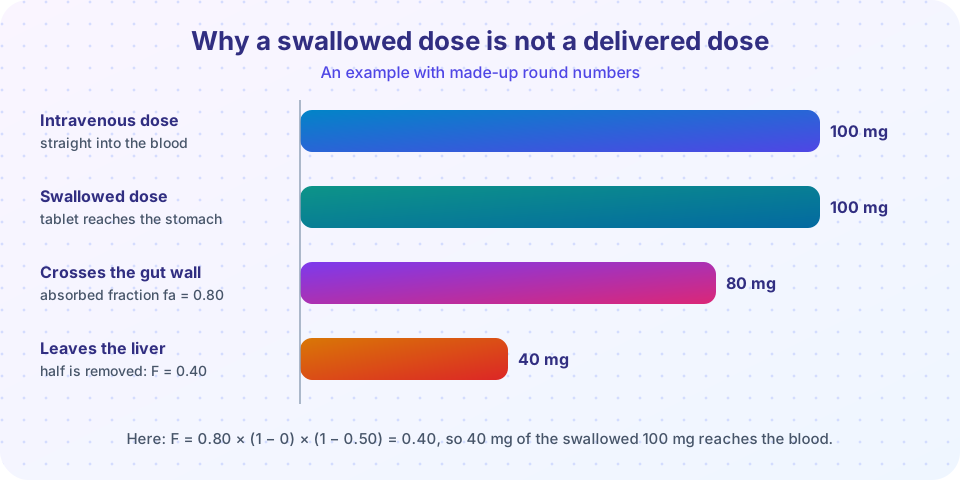
A tablet that leaves the stomach is not yet "in" the body. To act, the drug must cross the lining of the gut, enter the blood and survive a first trip through the liver. Each of these steps removes some of the dose. The fraction that makes it, called the bioavailability, decides why the same milligram dose of two drugs can have very different effects, and why a drug that works in a syringe may not work in a tablet.
What you will learn
- How drugs cross cell membranes, and what role pH and ionization play.
- What limits absorption from the gut and what speeds it up.
- What the first-pass effect is and how it reduces bioavailability.
- How to calculate and use bioavailability (F) and the concepts Cmax, Tmax and AUC.
Key terms
- Passive diffusion: movement across a membrane down a concentration gradient, with no energy; the route for most drugs.
- Ionized and unionized: a charged form of a molecule and its uncharged form; only the unionized form crosses lipid membranes easily.
- pKa: the pH at which half of a weak acid or base is ionized.
- Bioavailability (F): the fraction of a dose that reaches the systemic circulation unchanged.
- Extraction ratio (E): the fraction of drug removed in one pass through an organ such as the liver.
Crossing membranes
Cell membranes are a double layer of lipids with proteins embedded in it. Four mechanisms move drugs across.
- Passive diffusion. Small, uncharged, lipid-soluble molecules dissolve in the membrane and move down their concentration gradient. The rate is proportional to the gradient and to lipid solubility. Most drugs enter the body this way.
- Facilitated diffusion. A carrier protein helps a molecule cross, still down its gradient, and without energy. It can be saturated.
- Active transport. A pump uses energy (ATP or an ion gradient) to move a molecule against its gradient. It is saturable and can be blocked. Examples are the transporters that take up amino acids and some drugs such as levodopa.
- Endocytosis and pinocytosis. The membrane engulfs a particle. This is rare for drugs.
Cells also have efflux pumps that push drugs back out. The best known is P-glycoprotein (P-gp), found in the gut lining, liver, kidney and the blood-brain barrier. It limits absorption of its substrates, such as digoxin, and is a reason that some drugs interact when one blocks the pump.
pH, ionization and the weak electrolyte
Most drugs are weak acids or weak bases. In solution they exist in two forms, an ionized (charged) form and an unionized (neutral) form, in a ratio set by the pH of the surroundings and the drug's pKa. This follows the Henderson-Hasselbalch equation:
weak acid:   fraction unionized = 1 / (1 + 10^(pH - pKa))
weak base:   fraction unionized = 1 / (1 + 10^(pKa - pH))
Only the unionized form crosses membranes easily, so the fraction unionized is the key. Aspirin is a weak acid with a pKa near 3.5. In the stomach (pH about 1 to 3) most of it is unionized, which favors passage through the stomach lining. In the intestine (pH about 6 to 7.5) it is mostly ionized. A weak base such as a drug with a pKa near 9 is ionized in the stomach and has a larger unionized fraction at higher pH.
Two consequences follow. First, ion trapping: a weak base that diffuses into a compartment more acidic than blood becomes ionized there and is trapped. A similar principle is used to speed up the removal of drugs in the urine (Chapter 3, elimination). Second, pH alone does not decide where absorption occurs. Although aspirin is more unionized in the stomach, most of it is absorbed in the small intestine because the intestine has a vastly larger surface area, from villi and microvilli, and a longer contact time. Surface area and blood flow often outweigh pH.
Factors that change oral absorption
- Dissolution and formulation. A tablet must disintegrate and dissolve before it can be absorbed. Particle size, coatings and excipients change the speed. Modified-release formulations purposely slow it.
- Gastric emptying. The small intestine does most of the absorbing, so a drug leaves the stomach before absorption. Food, some drugs and illness slow emptying and delay Tmax.
- Food. It may delay absorption, reduce it (some antibiotics bind calcium in milk), or increase it (a fatty meal helps some lipid-soluble drugs).
- Gut motility and disease. Diarrhea shortens contact time; surgery or inflammation can reduce absorptive area.
- Gut metabolism and efflux. Enzymes in the gut wall (such as intestinal CYP3A4) and P-gp remove some drug before it enters the blood.
- Drug interactions in the gut. Antacids, iron and calcium form complexes with some drugs such as tetracyclines and fluoroquinolones.
The first-pass effect
Blood from the gut does not go directly to the heart. It flows through the portal vein to the liver first. Liver enzymes can remove a large fraction of an absorbed drug before it ever reaches the rest of the body. This is the first-pass effect (or presystemic metabolism). The liver's removal in a single pass is measured by the hepatic extraction ratio, Eh, the fraction removed. With fa the fraction absorbed through the gut wall and Fg the fraction escaping gut-wall metabolism, the bioavailability is:
F = fa × Fg × (1 - Eh)
For example, if 80% of a dose crosses the gut wall (fa = 0.8), the gut wall destroys none (Fg = 1) and the liver removes half (Eh = 0.5), then F = 0.8 × 1 × 0.5 = 0.4, as in the picture. High first-pass drugs include glyceryl trinitrate, lidocaine, propranolol and morphine. For such drugs the oral dose must be much higher than the IV dose, or another route is used. Sublingual glyceryl trinitrate bypasses the liver. Lidocaine is not given by mouth for heart rhythm problems, because it is largely removed on the first pass.
Liver blood flow is about 1.5 L per minute. A drug that is removed very efficiently, almost every molecule that arrives, has an extraction ratio near 1, and its clearance is limited by the blood flow, not by the enzymes. Drugs with low extraction are limited by enzyme activity.
Measuring bioavailability
To measure F, give the same dose by IV and by mouth in the same person (or a comparable group), measure plasma concentrations over time, and compare the AUC values:
F = AUC(oral) / AUC(IV) (for equal doses)
For different doses, scale by dose: F = (AUC_oral × Dose_IV) / (AUC_IV × Dose_oral). Two products with the same active ingredient are bioequivalent if their AUC and Cmax fall within agreed limits of each other (conventionally a 90% confidence interval for the ratio inside 80 to 125%). That is how generic medicines are shown to match the originals.
Common misconceptions
- "All of a swallowed dose is absorbed." Often a large part is lost to incomplete dissolution, gut-wall metabolism or the liver.
- "Bioavailability only depends on the drug." It also depends on the formulation, the meal, the patient's gut and the dose, so bioavailability is a property of a product and a situation.
- "A low F means a weak drug." It means a larger oral dose is needed to achieve the same exposure. The drug may be highly potent.
Try it
First, plot how the unionized fraction of a weak acid and a weak base change with pH. The curves are the Henderson-Hasselbalch equation with pKa 3.5 (an acid like aspirin) and pKa 9 (a typical weak base). The shaded bands show the approximate pH of the stomach, small intestine and blood.
Press Run (or Ctrl + Enter) to see the result here.
Program input · what you'd type while the program runs
Type the answers before you press Run, one per line. Each time the program reads a line (with input()), it gets the next line from this box.
Second, calculate bioavailability for some illustrative scenarios. The numbers are chosen to show the pattern, not to quote real values for named drugs.
Press Run (or Ctrl + Enter) to see the result here.
Program input · what you'd type while the program runs
Type the answers before you press Run, one per line. Each time the program reads a line (with input()), it gets the next line from this box.
Third, slide the pH to watch the unionized fraction of an acid and a base trade places.
Check your understanding
Quick check · 6 questions
of 6 answered You scored / 6 · perfect!
-
1. A weak acid has a pKa of 4.5. What fraction is unionized at pH 4.5?
At pH = pKa, a weak acid or base is half ionized and half unionized. -
2. Which form of a drug crosses lipid membranes most easily?
Charged molecules are poorly soluble in the lipid membrane. -
3. A drug has fa = 0.9, Fg = 1 and a hepatic extraction ratio of 0.6. What is F?
F = 0.9 x 1 x (1 - 0.6) = 0.36. -
4. Which route bypasses the first-pass effect?
The mouth's veins drain into the systemic circulation, so the liver is skipped on the first pass. -
5. Most aspirin is absorbed in the small intestine even though it is more unionized in the stomach. Why?
Surface area and contact time often matter more than the unionized fraction. -
6. How is F measured from concentration data for equal oral and IV doses?
An IV dose is fully available, so the ratio of AUC values gives the fraction absorbed.
Summary
- Most drugs cross membranes by passive diffusion of the unionized form; pH and pKa set the unionized fraction.
- Oral absorption depends on dissolution, gastric emptying, food, surface area, gut-wall enzymes and efflux pumps.
- The first-pass effect in the liver removes part of an oral dose; F = fa x Fg x (1 - Eh).
- F is measured by comparing AUC after oral and IV doses; bioequivalence compares formulations.
Next: Distribution
Track your progress
Create a free account to tick off lessons and pick up where you left off on any device.
of Pharmacology lessons completed