


















Lesson 31 of 48 · Central Nervous System Drugs
Drugs for epilepsy and Parkinson disease
How sodium channel blockers, GABA enhancers and levetiracetam control seizures, and how levodopa, carbidopa and MAO-B inhibitors restore dopamine in Parkinson disease.
Epilepsy and Parkinson disease sit at opposite ends of a balance. In epilepsy, groups of neurons fire too much and too synchronously, and the aim of treatment is to quiet them. In Parkinson disease, the neurons that make dopamine die, and the aim is to put dopamine back. Both conditions are long-term, both are treated with drugs that must be taken every day, and both show clearly how pharmacokinetics decides whether a drug works: how fast a drug is cleared, whether the liver enzymes that handle it can be saturated, and whether it can cross the blood-brain barrier.
Educational information only. Drugs for epilepsy and Parkinson disease must never be stopped or changed suddenly, and the choice of drug depends on seizure type, age, sex, pregnancy plans and other medicines. This lesson describes the pharmacology and is not a guide to treatment.
What you will learn
- Explain the main mechanisms of antiseizure drugs and give an example of each.
- Describe why phenytoin and valproate need special care.
- Explain why levodopa is given with carbidopa and what the other Parkinson drugs add.
- Recognize important interactions, including those that involve liver enzyme induction.
Key terms
Seizure: a burst of abnormal, synchronized electrical activity in the brain; epilepsy is a tendency to recurrent seizures.
Use-dependent block: a drug effect that grows with the rate of firing, because the drug binds channels that are open or recently active.
Enzyme inducer: a drug that increases the amount of liver enzyme, so other drugs are cleared faster.
Saturable (zero-order) kinetics: elimination that reaches a maximum rate, so a small dose increase can produce a large rise in blood level.
Wearing-off: the return of Parkinson symptoms before the next levodopa dose is due.
Antiseizure drugs
Roughly one in a hundred people has epilepsy. Seizures are classified as focal (starting in one area) or generalized (involving both sides of the brain from the start), and the drug choice depends on the type. Few drugs treat every type. In long-term follow-up studies of newly diagnosed patients, about half became seizure-free on the first drug, and about two thirds became seizure-free overall after trying further drugs, so finding the right drug often takes patience.
Antiseizure drugs work through a small number of mechanisms.
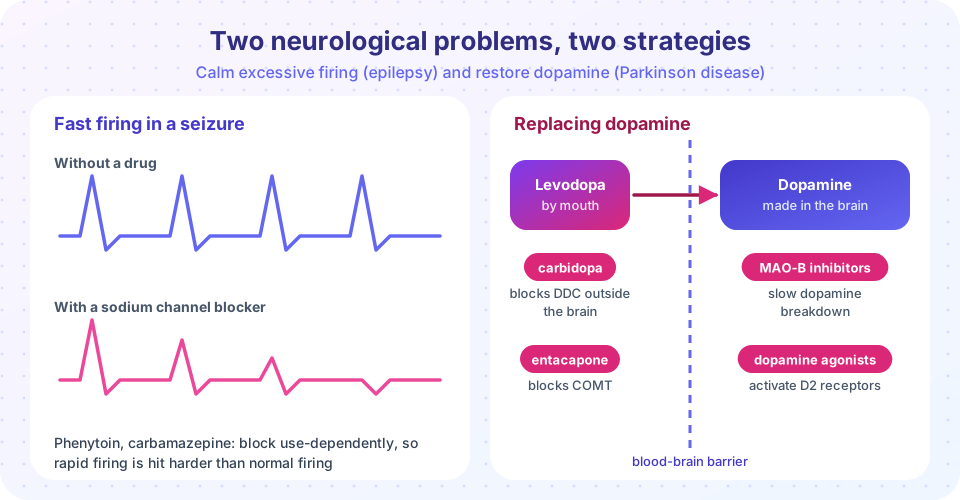
Sodium channel blockade. Phenytoin, carbamazepine, oxcarbazepine, lamotrigine and lacosamide bind to voltage-gated sodium channels in their inactivated state and stop them from recovering quickly. Because the block builds up with fast firing, a seizure's rapid train of discharges is suppressed while normal, slower activity is largely spared. This is use-dependent block, and the same principle is used by local anesthetics and by class I antiarrhythmics from chapter 5.
Enhancing GABA. Benzodiazepines (clonazepam, and lorazepam or midazolam for an ongoing seizure called status epilepticus) increase how often the GABA-A channel opens. Phenobarbital, a barbiturate introduced in 1912, increases how long the channel stays open. Vigabatrin blocks the enzyme that breaks down GABA.
Calcium channels. Ethosuximide blocks T-type calcium channels in the thalamus and is first choice for childhood absence seizures, which cause short staring spells. Gabapentin and pregabalin bind the α2δ subunit of calcium channels and are used for focal seizures and nerve pain.
SV2A binding. Levetiracetam binds a protein found on synaptic vesicles and is effective across many seizure types with few interactions, though it can cause irritability and low mood in some people.
Several mechanisms. Valproate and topiramate act at more than one target, which gives valproate a broad spectrum.
Each drug has a signature problem that follows from its pharmacology.
- Phenytoin shows saturable kinetics. Its liver enzymes work near their maximum even at ordinary doses, so a small increase in dose can cause a large rise in blood level, with toxicity (nystagmus, unsteady gait, confusion). Levels are measured. Long-term use can cause gum overgrowth.
- Carbamazepine induces the liver enzyme CYP3A4, even speeding up its own metabolism over the first weeks. In people of Han Chinese and some other Southeast Asian ancestry, the gene variant HLA-B*1502 greatly raises the risk of a severe skin reaction, Stevens-Johnson syndrome, so genetic testing is advised before starting.
- Lamotrigine can cause a rash that is occasionally serious, so doses are raised very slowly. Valproate slows the breakdown of lamotrigine, which doubles its level, so the dose must be reduced when the two are combined.
- Valproate is highly effective but can harm the liver and pancreas and cause weight gain and tremor. It is strongly teratogenic: it raises the risk of neural tube defects and of lasting developmental problems in children exposed in the womb. Regulators in Europe and the United Kingdom restricted its use in girls and women of childbearing potential, to cases where no other drug works and with a pregnancy prevention plan.
- Enzyme inducers (carbamazepine, phenytoin, phenobarbital) speed the clearance of other drugs. They can reduce the effectiveness of hormonal contraceptives, warfarin and DOACs from chapter 5.
Two general rules apply. Stopping any antiseizure drug suddenly can trigger seizures, even status epilepticus, so withdrawal is gradual and supervised. And people who may become pregnant are usually advised to take folic acid and to plan pregnancy with their specialist, because seizure control and drug choice both matter for the baby.
Parkinson disease
Parkinson disease is caused by the loss of dopamine-making neurons in a brainstem structure called the substantia nigra. Dopamine from these neurons normally travels to the striatum, a movement-control center, and helps to start and smooth movement. When the striatum loses most of its dopamine, the classic motor features appear: slowness of movement (bradykinesia), stiffness, a resting tremor and impaired balance. Many people also have non-motor symptoms such as constipation, poor sleep and mood changes. The disease is progressive, and current drugs treat symptoms but do not stop the loss of neurons.
Levodopa is the most effective drug. As the overview of this chapter explained, dopamine cannot cross the blood-brain barrier, but its precursor levodopa is carried across by an amino acid transporter and then converted to dopamine by the enzyme DOPA decarboxylase (DDC). George Cotzias showed in 1967 that high doses of levodopa produced dramatic improvement, and the story later became famous through Oliver Sacks's book Awakenings.
The first problem was that most of the levodopa was converted to dopamine outside the brain, causing severe nausea and low blood pressure while little reached its goal. Carbidopa solves this: it inhibits DDC but cannot enter the brain. Given together, much more levodopa reaches the brain and a far smaller dose is needed. Combination tablets are therefore the standard.
Levodopa has a short half-life of about one to two hours. After some years of treatment many people notice wearing-off, where symptoms return before the next dose, and abnormal writhing movements called dyskinesias at peak levels. Additional drugs smooth the curve:
- COMT inhibitors (entacapone, opicapone) block another enzyme that destroys levodopa, extending its effect.
- MAO-B inhibitors (selegiline, rasagiline, safinamide) reduce the breakdown of dopamine in the brain and give modest symptom relief.
- Dopamine agonists (pramipexole, ropinirole, rotigotine patch) activate D2 receptors directly and last longer than levodopa. They can cause sleepiness, hallucinations and impulse control disorders, such as compulsive gambling or shopping, which patients and families should know about.
- Amantadine can reduce dyskinesias. It is thought to act through NMDA receptors.
- Anticholinergics such as benzatropine can help tremor, but their side effects on thinking and memory limit their use, especially in older adults.
A clinically important point links back to the last lesson. Antipsychotics and the antiemetic metoclopramide block D2 receptors, so they can cause or worsen parkinsonism, and are avoided or chosen with care in Parkinson disease. Deep brain stimulation, a surgical option, is considered when drugs no longer give smooth control.
Common misconceptions
"Antiseizure drugs cure epilepsy." They suppress seizures while they are taken. For many people they provide long seizure-free periods, and some may later stop treatment under supervision, but they are not a cure.
"Levodopa stops working or becomes toxic if started early." The idea that it should be delayed comes from old fears. Current thinking is that it is started when symptoms affect function, and the timing is balanced against dyskinesias that relate more to disease duration and dose than to simple 'wearing out'.
"All antiseizure drugs are interchangeable." Some seizure types are made worse by certain drugs, for example carbamazepine can worsen absence and myoclonic seizures.
Try it
First, an interactive model of use-dependent block. A neuron fires ten spikes at the rate you choose. Each spike blocks a fraction of the sodium channels that are still available, and the channels recover between spikes. At low rates they recover fully, and at high rates the blocker accumulates. The model is simplified and only shows the principle.
Second, why phenytoin is tricky. Elimination follows Michaelis-Menten kinetics: at steady state the blood level is Km × R / (Vmax - R), where R is the dosing rate. The values below are textbook-style population estimates and vary a lot between individuals, so the plot is only an illustration.
Press Run (or Ctrl + Enter) to see the result here.
Program input · what you'd type while the program runs
Type the answers before you press Run, one per line. Each time the program reads a line (with input()), it gets the next line from this box.
Third, levodopa blood levels and wearing-off. The code sums the curves from repeated doses with simple absorption and elimination. Prolonging the half-life with a COMT inhibitor keeps the level above an illustrative threshold for longer. The numbers are invented to show the pattern.
Press Run (or Ctrl + Enter) to see the result here.
Program input · what you'd type while the program runs
Type the answers before you press Run, one per line. Each time the program reads a line (with input()), it gets the next line from this box.
Check your understanding
Quick check · 5 questions
of 5 answered You scored / 5 · perfect!
-
1. Why is phenytoin dose adjustment tricky?
Its liver enzymes work near maximum capacity, so elimination is not proportional to dose. -
2. Which drug is first choice for childhood absence seizures through T-type calcium channel block?
Ethosuximide blocks T-type calcium channels in the thalamus. Carbamazepine can make absence seizures worse. -
3. Why is levodopa combined with carbidopa?
Carbidopa cannot cross the blood-brain barrier, so it prevents peripheral conversion without blocking dopamine production in the brain. -
4. What is the main concern with valproate in women of childbearing age?
Valproate is strongly teratogenic, so regulators restrict its use in this group. -
5. Why might carbamazepine reduce the effectiveness of a hormonal contraceptive?
Enzyme induction speeds the breakdown of many drugs, including contraceptive hormones and warfarin.
Summary
- Antiseizure drugs block sodium channels (use-dependent), enhance GABA, block T-type calcium channels, or bind SV2A.
- Phenytoin has saturable kinetics, carbamazepine induces liver enzymes and carries a genetic skin-reaction risk, and valproate is strongly teratogenic.
- Levodopa crosses the barrier and becomes dopamine; carbidopa stops peripheral conversion; COMT inhibitors, MAO-B inhibitors and dopamine agonists extend or imitate its effect.
- Wearing-off, dyskinesias and impulse control disorders are the main long-term problems in Parkinson treatment.
Next: Chapter 6 review
Track your progress
Create a free account to tick off lessons and pick up where you left off on any device.
of Pharmacology lessons completed