


















Lesson 13 of 48 · Pharmacokinetics
Distribution: volume, protein binding and barriers
How drugs spread through the body: compartments, volume of distribution (Vd), plasma protein binding, the blood-brain barrier, redistribution and the loading dose, with plots and a calculator.
Once a drug is in the blood, it does not stay there. Blood vessels leak, membranes can be crossed, tissues bind drug, and fat soaks up lipid-soluble molecules. Distribution decides how much drug is at the target and how much is "parked" elsewhere. It also gives rise to one of the most useful numbers in pharmacokinetics, the volume of distribution, which links the amount of drug in the body to the concentration you can measure in blood.
What you will learn
- The main fluid compartments of the body and what a drug needs to reach each.
- What the volume of distribution (Vd) means, how to calculate it, and what a large or small Vd tells you.
- How plasma protein binding works and why only free drug is active.
- How barriers, redistribution and tissue binding change where a drug ends up, and how to compute a loading dose.
Key terms
- Volume of distribution (Vd): the apparent volume in which the drug would have to be dissolved to give the observed plasma concentration: Vd = amount of drug in the body / plasma concentration.
- Plasma protein binding: reversible attachment of drug to proteins in blood, mainly albumin.
- Free (unbound) fraction, fu: the fraction of the plasma drug that is not bound.
- Blood-brain barrier (BBB): a tight layer of capillary cells that restricts what enters the brain.
- Loading dose: a larger first dose given to reach the target concentration quickly.
Compartments of the body
For an adult of 70 kg, textbooks use these round numbers, which are a useful frame for thinking about distribution:
| Compartment | Approximate volume |
|---|---|
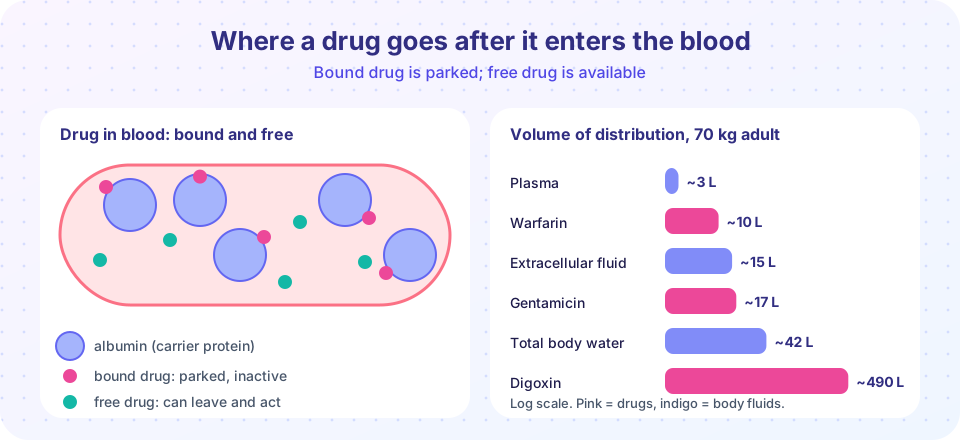
| Plasma | 3 L |
| Interstitial fluid (between cells) | about 11 to 12 L |
| Extracellular fluid (plasma + interstitial) | about 15 L |
| Total body water (also inside cells) | about 42 L (60% of body weight) |
A large, charged, or protein-like drug stays mostly in the plasma. A smaller, water-soluble drug leaves the vessels and spreads through the extracellular fluid. A lipid-soluble drug can cross cell membranes and enter all of the body water, and may also dissolve into fat. The capillaries in most tissues have gaps between cells that let drug pass, but those in the brain, testis and parts of the eye do not.
The volume of distribution
Suppose you inject a dose D into a vein and the drug mixes instantly. The concentration measured in the plasma at that moment is C0. The volume of distribution is defined as:
Vd = D / C0
It is called "apparent" because it is rarely a real volume. It is the size of the container that would be needed to give the concentration observed.
- A small Vd (3 to 15 L) means the drug stays in plasma or extracellular fluid. Examples: heparin and many large or highly bound drugs. Warfarin has a Vd of about 0.14 L per kg, roughly 10 L in a 70 kg adult, because it is more than 99% bound to albumin.
- A medium Vd (about 40 L) means the drug spreads through total body water. Paracetamol, with a Vd near 0.9 L/kg, is an example.
- A large Vd (hundreds of litres, many times the body volume) means the drug is concentrated in tissues, leaving little in plasma. Digoxin binds heart and skeletal muscle and has a Vd of about 7 L/kg, near 500 L in an adult. Some drugs such as chloroquine and amiodarone have still larger values.
Vd tells you where the drug goes, but also how to use it. A drug with a large Vd cannot be removed by dialysis, because most of it is in tissue, not blood. It also has a long half-life if clearance is not large, because t½ = 0.693 × Vd / CL (Chapter 3, elimination).
Loading dose
To reach a target plasma concentration Ctarget straight away, give a loading dose:
Loading dose = Vd × Ctarget / F
For an IV dose F = 1. For a fictional drug with Vd = 100 L and a target of 2 mg/L given IV, the loading dose is 200 mg. Loading doses are used when waiting for steady state would take too long, as with digoxin or some antibiotics. They are then followed by lower maintenance doses that replace what is eliminated.
Plasma protein binding
Many drugs bind reversibly to proteins in plasma. Albumin (concentration about 35 to 50 g/L) binds mostly weak acids such as warfarin, many NSAIDs and phenytoin. Alpha-1 acid glycoprotein binds mostly weak bases, such as propranolol and lidocaine. Bound drug is too large to leave the vessels or be filtered, and it cannot bind the target or be metabolized, so it is a reservoir. Only the free fraction is active. As free drug is used or removed, bound drug dissociates and replaces it.
The picture shows pink bound drug on large albumin molecules and teal free drug. For a drug 99% bound, the free fraction fu is 0.01. Binding rarely matters when the drug is only moderately bound, because small changes in a small bound fraction do little to the free level. It matters when binding is very high: a fall from 99% to 98% bound doubles the free fraction from 1% to 2%. In theory, a second drug that displaces the first from albumin could cause toxicity this way. In practice the effect is usually temporary, because the extra free drug is distributed and eliminated, so most protein-binding displacement interactions are less important than they once seemed. Still, low albumin in liver disease, kidney disease or malnutrition raises free levels of highly bound drugs, and total concentration measurements can then be misleading.
Barriers and special compartments
- Blood-brain barrier. Capillaries in the brain have tight junctions, few pores and efflux pumps such as P-gp. Lipid-soluble, small, uncharged molecules enter easily (general anesthetics, benzodiazepines, caffeine). Charged or polar drugs do not (many penicillins at normal doses). Disease such as meningitis can make the barrier leaky. Drugs for brain disease must be able to cross it, and drugs that should not cause drowsiness are designed so that they do not. For example, some second-generation antihistamines are pumped out by P-gp and are less sedating.
- Placenta. It allows many drugs to cross from mother to fetus, especially small, lipid-soluble molecules. That is why drug choice in pregnancy needs great care.
- Breast milk. Lipid-soluble weak bases and small molecules can enter milk, usually at a small fraction of the maternal dose.
- Tissue binding and depots. Some drugs concentrate in specific tissues: tetracyclines in bone and teeth, lipid-soluble drugs in fat, digoxin in muscle. These depots release drug slowly and can prolong effects.
Redistribution
Some drugs stop acting before they are eliminated because they leave the target tissue for another. The classic example is the intravenous anesthetic thiopental. After an injection, a lipid-soluble drug flows with the blood to the brain, which has a large blood supply, and acts within seconds. Minutes later it moves out into muscle and then slowly into fat, and the brain concentration falls below the effective level, so the patient wakes up even though most of the drug is still in the body. Repeated doses can fill the depots and cause prolonged sedation.
Common misconceptions
- "Vd is a real volume." A Vd of 500 L is much larger than a person. It means the drug is concentrated in tissues, not that it fills a 500-litre tank.
- "Protein binding makes a drug weaker." It reduces the free concentration at any instant, but bound drug is a reservoir. At equilibrium, the free concentration, not the total, determines the effect.
- "A drug that crosses the placenta is always dangerous." Crossing is a risk factor; the harm depends on the drug, the dose and the stage of pregnancy.
Try it
First, compare the starting concentration produced by the same 100 mg dose for drugs with different Vd values taken from the fluid compartments above and typical drugs. The y axis is logarithmic.
Press Run (or Ctrl + Enter) to see the result here.
Program input · what you'd type while the program runs
Type the answers before you press Run, one per line. Each time the program reads a line (with input()), it gets the next line from this box.
Second, explore how a small change in protein binding changes the free fraction of a highly bound drug.
Press Run (or Ctrl + Enter) to see the result here.
Program input · what you'd type while the program runs
Type the answers before you press Run, one per line. Each time the program reads a line (with input()), it gets the next line from this box.
Third, a loading-dose calculator for a fictional drug. It demonstrates the formula only.
Check your understanding
Quick check · 6 questions
of 6 answered You scored / 6 · perfect!
-
1. An IV dose of 300 mg gives an initial plasma concentration of 6 mg/L. What is Vd?
Vd = dose / C0 = 300 / 6 = 50 L. -
2. A drug has a very large Vd, such as 500 L. What does this suggest?
A large apparent volume means most of the drug is outside plasma, bound or dissolved in tissues. -
3. A drug is 99% bound to albumin. If binding falls to 98%, the free fraction
Free fraction goes from 1% to 2%. -
4. Which drug property helps a molecule enter the brain?
Small, lipid-soluble, uncharged molecules cross the blood-brain barrier most easily. -
5. What explains the short action of a single dose of thiopental?
The drug leaves the brain for other tissues, so brain levels fall even though much drug remains in the body. -
6. For an IV drug with Vd = 40 L and a target of 5 mg/L, the loading dose is
Loading dose = Vd x C / F = 40 x 5 / 1 = 200 mg.
Summary
- Vd = amount in body / concentration; small Vd means the drug stays in plasma, large Vd means tissue accumulation.
- Only free drug is active; high protein binding makes a reservoir and makes free levels sensitive to small changes in binding.
- The blood-brain barrier, placenta and tissue depots shape where a drug goes; redistribution can end an effect before elimination.
- Loading dose = Vd x Ctarget / F.
Next: Drug metabolism
Track your progress
Create a free account to tick off lessons and pick up where you left off on any device.
of Pharmacology lessons completed