


















Lesson 34 of 48 · Anti-Infective and Cancer Drugs
Antibiotics: mechanisms and resistance
Learn how penicillins, aminoglycosides, macrolides, quinolones and other antibiotics work, how dosing follows PK/PD, and how bacteria become resistant.
Before antibiotics, a scratch that became infected, a burn, childbirth or pneumonia could kill a healthy young adult. Within a few decades of penicillin's introduction, these became routine to treat. Yet today the same drugs are losing ground, and the World Health Organization lists antimicrobial resistance as one of the greatest threats to global health. To understand both the triumph and the threat you need three ideas: what each class of antibiotic does to a bacterium, how the dose and timing of a drug are matched to how it kills, and how bacteria evolve around it.
Educational information only. Choosing an antibiotic depends on the likely germ, the site of infection, local resistance patterns, allergies, kidney function and pregnancy. Only a clinician can make that choice, and antibiotics should be taken exactly as prescribed.
What you will learn
- Match the major antibiotic classes to their targets.
- Explain bactericidal versus bacteriostatic action and what MIC means.
- Distinguish time-dependent from concentration-dependent killing and how it shapes dosing.
- Describe the four main resistance mechanisms and the role of stewardship.
Key terms
Bactericidal: kills bacteria. Bacteriostatic: stops growth and relies on the immune system to clear the rest.
MIC: the minimum inhibitory concentration, the lowest drug concentration that prevents visible growth in a laboratory test.
Spectrum: the range of bacteria a drug works against; narrow-spectrum drugs are targeted, broad-spectrum drugs cover many species.
Plasmid: a small circle of DNA that bacteria can copy and pass to others, often carrying resistance genes.
Stewardship: programs that make sure antibiotics are used only when needed, with the right drug, dose and duration.
The main classes and what they hit
Beta-lactams (penicillins, cephalosporins, carbapenems) contain a four-membered beta-lactam ring that mimics a piece of the building blocks of the cell wall. They bind to penicillin-binding proteins, the enzymes that cross-link peptidoglycan, and so stop wall synthesis. A growing bacterium with a weak wall absorbs water and bursts. They are bactericidal against dividing cells. They are usually very safe. The main risk is allergy, from mild rash to anaphylaxis. Many people report a penicillin allergy, but when tested a large majority turn out not to be allergic, and a mislabeled allergy pushes patients toward broader, less effective antibiotics.
Vancomycin also blocks wall building, but by binding the D-Ala-D-Ala end of the wall precursor rather than an enzyme. It is too large to cross the outer membrane of Gram-negative bacteria, so it works against Gram-positive ones such as MRSA. It can injure the kidney, and blood levels are monitored.
Aminoglycosides (gentamicin, amikacin) bind the 30S ribosomal subunit and cause misreading of the genetic code, which makes them bactericidal. They are used for serious Gram-negative infections. Their toxicity, to the kidney and the inner ear, is dose-related, so levels are measured.
Tetracyclines (doxycycline) block the 30S subunit too, but are bacteriostatic. They bind calcium in teeth and bone, so they are avoided in pregnancy and in young children, and they should not be taken with milk or calcium supplements, which bind the drug.
Macrolides (azithromycin, clarithromycin) and clindamycin bind the 50S subunit. Macrolides can prolong the QT interval and, clarithromycin especially, inhibit CYP3A4, which links to chapter 5: it can raise simvastatin levels and cause muscle injury.
Fluoroquinolones (ciprofloxacin, levofloxacin) inhibit DNA gyrase and topoisomerase IV, the enzymes that coil and separate bacterial DNA. They are well absorbed and active against many species, but carry warnings about tendon rupture, nerve damage, mental effects and aortic problems, so they are reserved for situations where safer drugs are not suitable.
Sulfonamides and trimethoprim block two steps in the bacterial folate pathway. Used together as co-trimoxazole they are more effective than either alone. Humans take folate from food, so we do not have the pathway.
Rifampicin blocks bacterial RNA polymerase and is a pillar of tuberculosis therapy. It also strongly induces liver enzymes, so it lowers the levels of warfarin, hormonal contraceptives and many other drugs, and it colors urine and tears orange. Linezolid blocks the 50S subunit and weakly inhibits MAO, so combining it with serotonergic antidepressants can cause serotonin syndrome, a link to chapter 6.
Killing patterns decide the dosing
A laboratory test gives the MIC of a drug for a particular bacterium. In the patient, what matters is how the drug concentration compares to the MIC over time, and this depends on the class.
- Time-dependent killing (beta-lactams, vancomycin): the key number is how long the concentration stays above the MIC. Because the kill rate saturates at modest concentrations, extra peak does little, and frequent dosing or prolonged infusion is more useful than a bigger dose.
- Concentration-dependent killing (aminoglycosides, fluoroquinolones): higher peaks kill faster and further. For aminoglycosides, a large dose once a day gives a high peak, and also a long drug-free interval that reduces toxicity. The key numbers are the peak or the area under the curve compared with the MIC.
The first of these is why a short-acting penicillin may be given every 6 hours, while a large aminoglycoside dose is given once a day. The model in the Try it section lets you compare the two patterns.
Resistance
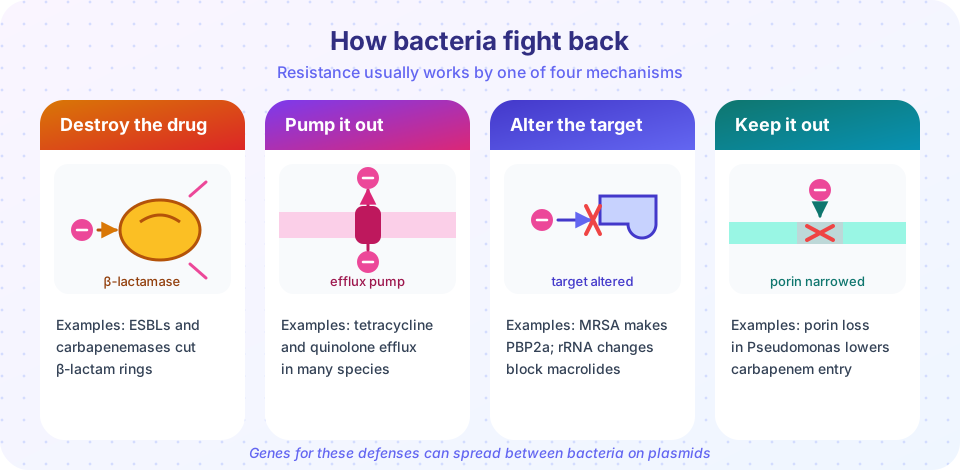
Bacteria multiply in minutes to hours, and a population of billions contains rare mutants. In the presence of a drug, the sensitive cells die and the mutant with a protective change survives and multiplies. Bacteria also acquire resistance genes from other bacteria by horizontal gene transfer, through plasmids, viruses and direct uptake of DNA. The four main mechanisms are shown in the figure:
- Destroying the drug. Beta-lactamase enzymes cut the beta-lactam ring. Extended-spectrum beta-lactamases (ESBLs) and carbapenemases destroy even the powerful carbapenems.
- Pumping it out. Efflux pumps in the membrane eject tetracyclines, quinolones and macrolides before they reach their target.
- Altering the target. Methicillin-resistant Staphylococcus aureus (MRSA) makes a different penicillin-binding protein, PBP2a, coded by the mecA gene, which beta-lactams bind poorly. Changes in ribosomal RNA stop macrolides binding, and mutations in gyrase stop quinolones.
- Reducing entry. Gram-negative bacteria can lose or narrow the porin channels through which hydrophilic drugs enter.
The scale of the problem is large. A 2022 analysis in The Lancet (the Global Research on Antimicrobial Resistance, or GRAM, study) estimated that in 2019 bacterial resistance was directly responsible for about 1.27 million deaths and was associated with nearly 5 million. These are modeled estimates with real uncertainty, but the order of magnitude is not in doubt.
Every use of an antibiotic selects for resistance, whether or not it is needed. The main levers are therefore stewardship: avoid antibiotics for viral infections, use narrow-spectrum drugs where possible, choose the right dose, and keep treatment as short as the evidence allows. Older advice always to "finish the course" has been refined: for many common infections, evidence shows shorter courses are as effective, but patients should follow their prescriber's instructions. Taking antibiotics also disturbs gut bacteria, and one result is infection with Clostridioides difficile, a bacterium that causes severe diarrhea.
Combining drugs is the other lever. Tuberculosis is treated for months with several drugs at once (typically isoniazid, rifampicin, pyrazinamide and ethambutol at first) because a mutant resistant to all of them is vanishingly rare, while one resistant to a single drug is not. Chapter 8 will return to this when it covers how new antibiotics are developed and why so few reach the market.
Common misconceptions
"A broader-spectrum antibiotic is a better antibiotic." Broad drugs disturb the normal gut flora, promote resistance and C. difficile infection, and are not more effective when a narrow drug covers the germ.
"Bacteriostatic drugs are weaker." They work well in people with a normal immune system. Bactericidal drugs are preferred in some settings, such as endocarditis or severe infection in people with a weak immune system.
"You should always save leftover antibiotics." Leftover drugs may be the wrong drug, in the wrong dose, and using them is a route to resistance and side effects.
Try it
First, a model of time above MIC. A drug is given by injection, concentration falls exponentially with a half-life of 1 hour, and the MIC of the bacterium is 2 mg/L. The same daily dose is split into different intervals. The numbers are illustrative.
Press Run (or Ctrl + Enter) to see the result here.
Program input · what you'd type while the program runs
Type the answers before you press Run, one per line. Each time the program reads a line (with input()), it gets the next line from this box.
Second, a toy simulation of how resistance takes over. A drug kills sensitive bacteria quickly and resistant ones slowly, while resistant mutants grow a little more slowly in the absence of the drug. The parameters are invented to show the pattern, not to represent a real infection.
Press Run (or Ctrl + Enter) to see the result here.
Program input · what you'd type while the program runs
Type the answers before you press Run, one per line. Each time the program reads a line (with input()), it gets the next line from this box.
Check your understanding
Quick check · 5 questions
of 5 answered You scored / 5 · perfect!
-
1. Beta-lactam antibiotics kill bacteria by:
The weakened wall cannot withstand osmotic pressure and the cell bursts. -
2. Why are aminoglycosides often given as one large daily dose?
High peaks give better killing, and the long trough lets the kidney and ear recover. -
3. How does MRSA resist methicillin?
The mecA gene encodes PBP2a, so the drug target is changed. -
4. Which drug combination carries a risk of serotonin syndrome?
Linezolid inhibits MAO weakly, so serotonergic drugs can build up. -
5. Why is tuberculosis treated with several drugs at the same time?
Combination therapy reduces the chance of selecting a resistant mutant.
Summary
- Beta-lactams and vancomycin block wall building; aminoglycosides, tetracyclines and macrolides block ribosomes; quinolones block DNA gyrase; sulfonamides and trimethoprim block folate; rifampicin blocks RNA polymerase.
- Time-dependent drugs (beta-lactams) are dosed for time above MIC; concentration-dependent drugs (aminoglycosides, quinolones) for high peaks.
- Resistance arises by drug destruction, efflux, target alteration or reduced entry, and spreads through plasmids.
- Stewardship and combination therapy slow resistance.
Track your progress
Create a free account to tick off lessons and pick up where you left off on any device.
of Pharmacology lessons completed