


















Lesson 3 of 48 · Getting Started
Drug names, sources and classes
Learn the chemical, generic and brand name of a drug, how name stems reveal a class, where medicines come from, and how the ATC system and other schemes classify them.
A single tablet can have three or four names, and a single class of medicines can contain dozens of drugs. If you cannot navigate names and classes you will drown in vocabulary, and, more seriously, you may confuse two drugs that sound alike. This lesson gives you the system behind the labels: the three kinds of drug name, the hidden meaning in name endings, the places medicines come from, and the main ways to group drugs.
What you will learn
- The difference between chemical, generic (nonproprietary) and brand names, and why the generic name is safest.
- How common name stems such as -olol and -prazole reveal a drug's class.
- The main sources of drugs: plants, microbes, animals, synthesis and biotechnology.
- How drugs are classified by use, by mechanism and by the WHO ATC code.
Key terms
- Generic name (INN): the official nonproprietary name shared worldwide, assigned under the World Health Organization's International Nonproprietary Names programme.
- Brand name: a trade name owned by a company, for example Panadol or Tylenol.
- Stem: a syllable at the end (or start) of a generic name that signals the drug's class.
- Biologic: a medicine made from living cells, such as an antibody or insulin made in culture.
- ATC: the Anatomical Therapeutic Chemical classification, which gives every drug a code of up to seven characters.
Three names for one molecule
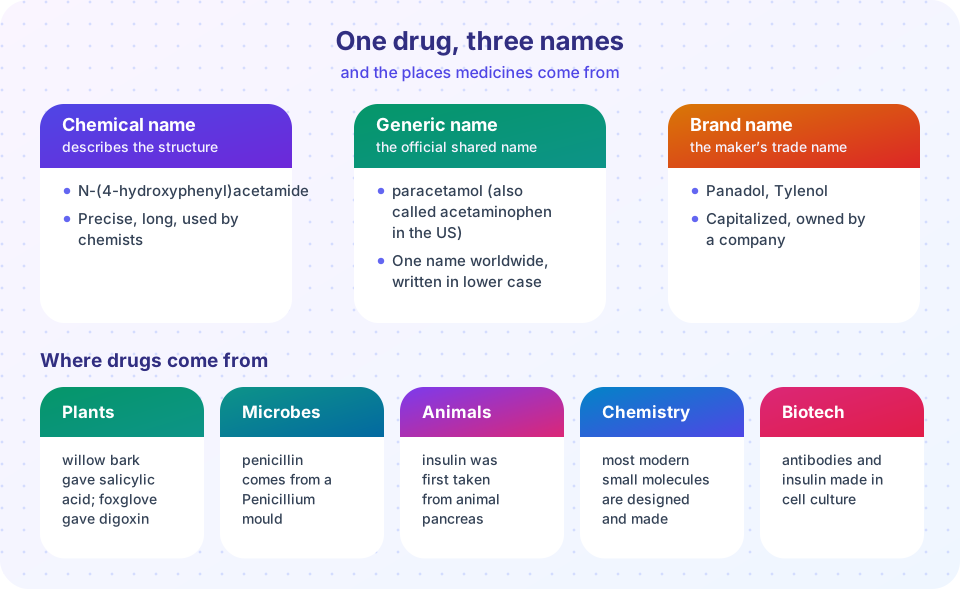
Take the common painkiller shown in the picture. A chemist describes its structure with a chemical name, here N-(4-hydroxyphenyl)acetamide. That name is exact but too long for a label. The generic name is paracetamol, the International Nonproprietary Name (INN) chosen by the WHO so that doctors anywhere refer to the same molecule. In the United States the same drug carries the USAN name acetaminophen. A company then sells it under brand names such as Panadol or Tylenol. A brand is a trade mark owned by its maker, written with a capital letter, and the same molecule may be sold under dozens of brands in different countries.
A few drugs have differing INN and US names. Adrenaline is epinephrine in the US, salbutamol is albuterol, and paracetamol is acetaminophen. When you read a research paper or an international guideline, the INN is usually used. Learn to recognize both forms of the same drug.
Why prefer generic names? First, they are stable: a brand may be withdrawn or change its look, but the molecule's name stays. Second, they prevent duplication. If a patient takes a cold remedy under one brand and a headache tablet under another and both contain paracetamol, the generic name on the label reveals the overlap, whereas two brand names hide it. Third, once a patent expires, many companies can make generic medicines with the same active ingredient, usually at lower cost, after showing they perform equivalently.
Look-alike, sound-alike names are a known source of medication error. Hospitals sometimes use "tall man lettering" (such as predniSONE and predniSOLONE) to make similar names stand out. The lesson is simple: when in doubt, check the full generic name and the strength.
Stems: the hidden grammar of drug names
The INN programme builds names around stems, short groups of letters that mark a pharmacological family. If you learn a few dozen stems you can recognize the class of a drug you have never met.
| Stem | Class | Examples |
|---|---|---|
| -olol | beta-blockers | propranolol, atenolol |
| -prazole | proton pump inhibitors | omeprazole |
| -statin | HMG-CoA reductase inhibitors | atorvastatin |
| -pril | ACE inhibitors | ramipril, captopril |
| -sartan | angiotensin receptor blockers | losartan |
| -cillin | penicillin antibiotics | amoxicillin |
| -azepam | benzodiazepines | diazepam |
| -caine | local anesthetics | lidocaine |
| -mab | monoclonal antibodies | adalimumab |
| -vir | antivirals | aciclovir |
Stems are strong hints, not guarantees. Always confirm a drug's class in a reference before relying on it. Some names look like stems by accident, and many classes (for example the opioids) have no single shared ending.
Where drugs come from
- Plants. Many classic drugs were first found in plants: morphine from the opium poppy, digoxin from foxglove, quinine from cinchona bark, and the salicylates from willow bark. Plant compounds often serve as templates that chemists then modify. Aspirin is a modified salicylate.
- Microbes. Penicillin comes from a Penicillium mould, and many other antibiotics from soil bacteria called actinomycetes. Microbes are still screened for new antibiotics and cancer drugs.
- Animals and humans. Insulin was first extracted from the pancreas of animals. Some enzymes and hormones are still taken from natural sources, but most are now made in other ways.
- Chemical synthesis. Most modern small-molecule drugs are designed by chemists, often starting from a screening hit or a known target structure, and manufactured in a factory.
- Biotechnology. Living cells engineered to make a protein produce human insulin, growth hormone, clotting factors and monoclonal antibodies. These large molecules cannot be swallowed, because the gut digests them, so they are usually injected.
A useful divide is between small molecules (a few dozen atoms, often taken by mouth, such as aspirin) and biologics (large proteins, usually injected, such as adalimumab). The two have different manufacturing, storage and kinetic properties, and later chapters treat them accordingly.
Ways to classify drugs
There is no single "correct" classification. The right one depends on the question.
- By therapeutic use. For example "antihypertensives", "analgesics" or "antibiotics". This is how clinicians think, but one use can involve very different mechanisms. Antihypertensives include beta-blockers, ACE inhibitors and diuretics.
- By mechanism of action. For example "beta-adrenoceptor antagonists" or "HMG-CoA reductase inhibitors". This is how pharmacologists think, and it predicts side effects, because the same target occurs in several organs.
- By chemical structure. For example penicillins, benzodiazepines or steroids. Structural families usually share targets, though a small change in structure can change selectivity.
- By body system. For example "cardiovascular drugs" or "drugs acting on the nervous system". Textbooks, including this course, are organized this way.
- By the ATC code. The WHO Anatomical Therapeutic Chemical system gives every drug a code in five levels: the anatomical main group (a letter), therapeutic subgroup, pharmacological subgroup, chemical subgroup, and the individual substance. There are 14 main groups, from A (alimentary tract and metabolism) to V (various). For example, paracetamol is N02BE01: N is the nervous system, N02 analgesics, N02B other analgesics and antipyretics, N02BE anilides, and N02BE01 paracetamol.
Prescription status
Legal categories differ by country, but a common pattern is: over-the-counter (OTC) medicines that anyone may buy, pharmacy-only medicines sold under a pharmacist's supervision, prescription-only medicines that need a prescriber, and controlled drugs (such as strong opioids) with extra legal restrictions on prescribing, storage and records. These categories reflect the balance of risk and benefit and the need for supervision. They are not a measure of a drug's usefulness.
Common misconceptions
- "A generic medicine is a weaker copy." An approved generic contains the same active ingredient in the same strength and must show comparable absorption (bioequivalence) to the original. Differences in tablet color, inactive ingredients or price do not mean a different drug.
- "The brand name tells you what the drug is." Brand names are marketing choices. Two brands may share an ingredient, and one brand name can cover different ingredients in different countries.
- "A stem always identifies the class." Stems are good clues but not proof.
Try it
This code reads the name stems from the table above and guesses a class from a drug name. It also shows why guessing needs care. The function is a teaching tool, not a clinical one.
Press Run (or Ctrl + Enter) to see the result here.
Program input · what you'd type while the program runs
Type the answers before you press Run, one per line. Each time the program reads a line (with input()), it gets the next line from this box.
The ATC code is a small hierarchy: you can split it into levels and read them one at a time. The decoder below knows only the entries listed in its dictionaries.
Press Run (or Ctrl + Enter) to see the result here.
Program input · what you'd type while the program runs
Type the answers before you press Run, one per line. Each time the program reads a line (with input()), it gets the next line from this box.
Check your understanding
Quick check · 5 questions
of 5 answered You scored / 5 · perfect!
-
1. Which name is shared worldwide and is safest to use on records?
The INN is chosen so that the same molecule has the same name everywhere. Brand names change and are company-owned. -
2. A drug named bisoprolol most likely belongs to which class?
The stem -olol marks beta-blockers. -
3. Which source gives penicillin?
Penicillin is made by a Penicillium mould; it was found by Fleming in 1928. -
4. Why are monoclonal antibodies usually injected?
Large proteins are broken down by digestive enzymes and are poorly absorbed, so they are generally given by injection. -
5. In the ATC code N02BE01, what does the letter N stand for?
N is the main group for the nervous system. N02 analgesics, N02B other analgesics and antipyretics, and so on.
Summary
- Every drug has a chemical name, a generic (INN) name and one or more brand names; use the generic name to avoid duplication and error.
- Name stems such as -olol and -statin hint at the class, but must be verified.
- Drugs come from plants, microbes, animals, chemical synthesis and biotechnology; small molecules and biologics behave differently.
- Drugs can be classified by use, mechanism, chemistry, body system or the WHO ATC code.
Next: Routes of administration
Track your progress
Create a free account to tick off lessons and pick up where you left off on any device.
of Pharmacology lessons completed