


















Lesson 21 of 48 · Pharmacodynamics and Dose-Response
Drug interactions: pharmacokinetic and pharmacodynamic
Learn how drugs interact: absorption, metabolism and excretion effects, additive, synergistic and antagonistic combinations, food and herbal interactions, and how to estimate an inhibition effect on AUC.
A single drug rarely acts alone. People take several medicines at once, plus foods, herbal products and alcohol, and each addition creates the chance that one agent changes another. Most combinations are harmless. A few are dangerous, and the dangerous ones are usually predictable from the principles in Chapters 2 to 4. In this lesson you will learn to sort interactions into two families, to recognize the high-risk situations, and to estimate the size of an enzyme-inhibition effect.
What you will learn
- The two families of drug interaction and how to tell them apart.
- Mechanisms and examples of pharmacokinetic interactions at each ADME step.
- Additive, synergistic and antagonistic pharmacodynamic interactions, with real examples.
- Food, herbal and disease interactions, and a practical way to reduce risk.
Key terms
- Drug interaction: a change in the effect or the concentration of one drug caused by another drug, a food, a herbal product or a disease.
- Additive effect: the combined effect equals the sum of the individual effects.
- Synergism: the combined effect is greater than the sum of the individual effects.
- Antagonism: the combined effect is less than expected from the individual effects.
- Polypharmacy: the use of several medicines at the same time, usually five or more.
Two families
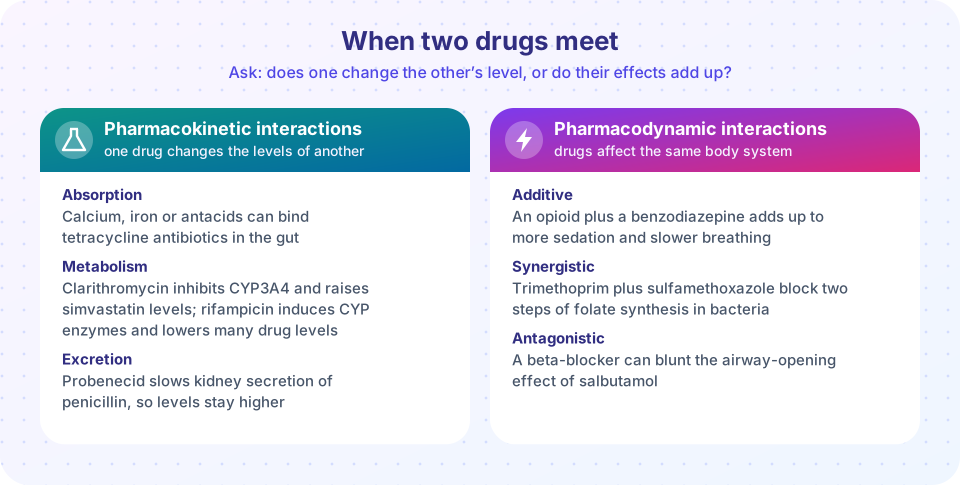
Pharmacokinetic (PK) interactions change how much drug reaches the target: one drug alters the absorption, distribution, metabolism or excretion of another. You detect them by changes in concentration. Pharmacodynamic (PD) interactions change the effect at a given concentration: the drugs act at the same receptor or on the same physiological system. The concentrations may be unchanged. The clinical picture is the same in both: too much effect (toxicity), too little (treatment failure), or sometimes a new effect.
Pharmacokinetic interactions
Absorption. Drugs can bind each other in the gut. Calcium, iron, magnesium and aluminium in antacids and supplements bind tetracyclines and fluoroquinolone antibiotics, so less is absorbed. The practical fix is to separate the doses by a few hours. Drugs that change stomach pH can change the absorption of others that need acid to dissolve. Drugs that slow gut movement delay absorption, and others speed it up.
Distribution. Displacement from plasma proteins was once feared as a major cause of interactions, but in practice it is usually short-lived, because the displaced drug is redistributed or eliminated. It becomes important only when it comes with another effect, for example a drug that both displaces and inhibits the metabolism of warfarin.
Metabolism. This is the most important source of PK interactions (Chapter 3). Inhibition raises the level of the affected "victim" drug, within hours. Clarithromycin inhibits CYP3A4 and raises levels of simvastatin, increasing the risk of serious muscle damage. Grapefruit juice inhibits CYP3A4 in the gut wall and raises levels of some statins and calcium channel blockers. Induction lowers the level, over days. Rifampicin induces CYP enzymes and lowers the level of many drugs; St John's wort lowers levels of ciclosporin (risking transplant rejection) and some contraceptives. When an inducer is stopped, the victim drug's level rises again over one to two weeks.
Excretion. Drugs can compete for renal secretion: probenecid reduces the tubular secretion of penicillin and raises its level, a use made deliberately. Changes in urine pH alter the excretion of weak acids and bases. Reduced kidney perfusion from some drugs can raise levels of renally cleared drugs, such as lithium. A well-known example is a combination of an anti-inflammatory (NSAID) with an ACE inhibitor and a diuretic, sometimes called the "triple whammy", which together can harm the kidney.
Pharmacodynamic interactions
Additive. Two drugs with the same type of effect sum their actions. An opioid plus a benzodiazepine, or either with alcohol, adds up to more sedation and slower breathing. Regulators warn against prescribing the opioid-benzodiazepine combination together unless there is no alternative, because of the risk of respiratory depression. Two blood-pressure drugs of different classes may be deliberately combined for the additive effect.
Synergistic. The combined effect is more than the sum. Trimethoprim and sulfamethoxazole (co-trimoxazole) block two sequential steps in bacterial folate synthesis, so the combination is more effective than either alone. In chemotherapy, combinations are chosen for synergy and different toxicities.
Antagonistic. One drug reduces the effect of another. A beta-blocker can blunt the airway-opening effect of salbutamol. Vitamin K reverses warfarin because it restores the clotting factors that warfarin depletes. NSAIDs can reduce the blood-pressure lowering effect of ACE inhibitors.
Same system, same side effect. Combining two drugs that each prolong the QT interval of the heart can add up to a risk of dangerous arrhythmia. Combining two serotonergic drugs (an SSRI with tramadol, a monoamine oxidase inhibitor or linezolid) risks serotonin syndrome: agitation, fever, rapid heart rate and tremor. Adding a potassium-sparing diuretic to an ACE inhibitor risks high potassium. A nitrate with sildenafil produces severe hypotension and is contraindicated.
Receptor-level interactions are simply the agonist-antagonist relationships from Chapter 2. Naloxone and opioids, or atropine and acetylcholine-like drugs, are examples.
Food, herbal and disease interactions
- Food. Tyramine-rich foods (aged cheese, cured meats, some fermented products) can cause a dangerous rise in blood pressure in people on older monoamine oxidase inhibitors. Vitamin K-rich vegetables change warfarin's effect if intake swings widely. Grapefruit juice affects CYP3A4 substrates.
- Herbal products. "Natural" does not mean inert. St John's wort induces CYP3A4 and P-gp. Ginkgo and garlic supplements may increase bleeding tendency in people on anticoagulants.
- Alcohol. It adds to CNS depression and alters liver metabolism.
- Drug-disease interactions. Beta-blockers can worsen asthma, NSAIDs can worsen heart failure and kidney disease, and anticholinergics can worsen glaucoma or urinary retention. The disease changes the way the drug acts.
Reducing risk
Interactions are predictable, which makes them preventable. Useful habits are:
- Keep a complete list of everything the patient takes, including over-the-counter drugs, herbal products and supplements.
- Check combinations in a reliable reference or with a pharmacist when starting, stopping or changing a drug. Remember that stopping an inducer is as important as starting one.
- Watch high-risk drugs: narrow therapeutic window drugs (warfarin, digoxin, lithium, phenytoin, ciclosporin), and medicines for older adults who often take many drugs. Lists such as the Beers criteria help flag potentially inappropriate drugs in older people.
- Separate the timing when two drugs bind in the gut, and monitor levels or effects when a significant interaction cannot be avoided.
- Weigh the risk. Many listed interactions are minor, and the response is monitoring, not prohibition. Too many alerts lead to "alert fatigue", so clinicians learn to focus on the severe ones.
Common misconceptions
- "If the drugs are from different classes they cannot interact." Interactions arise from shared enzymes, transporters or physiological systems, regardless of class.
- "An interaction means the drugs must never be combined." Many combinations are useful and standard (such as two antihypertensives), and others are managed with a dose change or monitoring.
- "Herbal products are safe with everything." Several have strong effects on drug-metabolizing enzymes and on blood clotting.
Try it
First, estimate how strongly an inhibitor raises the AUC of a drug. For a victim drug whose clearance goes through the affected enzyme with fraction fm, and an inhibitor concentration [I] relative to its inhibition constant Ki, the simplified AUC ratio is AUCR = 1 / (fm / (1 + [I]/Ki) + (1 - fm)). The more the drug depends on the enzyme, the larger the effect. This is a screening estimate used in drug development, not a clinical prediction.
Press Run (or Ctrl + Enter) to see the result here.
Program input · what you'd type while the program runs
Type the answers before you press Run, one per line. Each time the program reads a line (with input()), it gets the next line from this box.
Second, classify a combination by comparing the observed effect with the expectation. Under Bliss independence, if drug A alone gives a fractional effect a and B gives b, independent actions would give a + b - a*b. A larger observed effect suggests synergy, and a smaller one suggests antagonism. This is one of several reference models, and the choice of model matters.
Press Run (or Ctrl + Enter) to see the result here.
Program input · what you'd type while the program runs
Type the answers before you press Run, one per line. Each time the program reads a line (with input()), it gets the next line from this box.
Third, a lookup of common examples. It is a teaching list for recognizing patterns, not a substitute for an interaction checker.
Check your understanding
Quick check · 6 questions
of 6 answered You scored / 6 · perfect!
-
1. Clarithromycin raises simvastatin levels. What kind of interaction is this?
Clarithromycin inhibits CYP3A4, which metabolizes simvastatin, so levels rise. -
2. An opioid plus a benzodiazepine causes more sedation than either alone. This is
Both depress the central nervous system, so effects add up. -
3. What happens when a patient stops taking an enzyme inducer such as rifampicin?
Enzyme levels return to baseline gradually, so clearance falls and levels rise. -
4. For a drug where fm = 1 and [I]/Ki = 9, the simplified AUC ratio is
AUCR = 1 / (1 / (1 + 9) + 0) = 10. -
5. Which pair is best described as synergistic?
They block two steps of folate synthesis, so the combined effect exceeds the sum. -
6. A tetracycline is taken with a calcium supplement. A sensible response is to
Calcium binds the antibiotic in the gut. Spacing the doses prevents the complex forming.
Summary
- Interactions are pharmacokinetic (one drug changes the other's level) or pharmacodynamic (effects add up, multiply or oppose).
- Metabolic inhibition raises levels within hours; induction lowers them over days and reverses slowly when stopped.
- Additive, synergistic and antagonistic combinations, as well as foods, herbs and diseases, all matter.
- Keep a full medicine list, check combinations, separate timing where drugs bind, and monitor high-risk drugs.
Track your progress
Create a free account to tick off lessons and pick up where you left off on any device.
of Pharmacology lessons completed