


















Lesson 43 of 48 · Projects and Practice
Chapter 9 overview: projects and practice
Move from reading to doing: a five-step method for reasoning about any drug, plus an overview of the case studies, the dosing project, glossary and cheat sheet in chapter 9.
Knowing facts about drugs is not the same as being able to think with them. A pharmacist, a nurse or a doctor does not simply remember that "warfarin is a blood thinner". They reason: what does it act on, what follows from that, how long does it take, what could go wrong and how will we know it is working? This final chapter helps you build that habit. It gives you a short method to apply to any drug, a set of worked cases, a programming project in which you simulate a dosing regimen, and the reference pages you will want to keep: a glossary, a one-page cheat sheet and a guide to what to study next.
Educational information only. The cases in this chapter are invented composites made for learning. They are not advice about any real person, and no part of this course can tell you whether to take, stop or change a medicine. Clinical decisions need a qualified professional who can see the whole person.
What you will learn
- Apply a five-step method to reason about a drug you have not met before.
- Explain how the case studies, the dosing project and the reference pages fit together.
- Practice with calculations that use half-life, volume of distribution and clearance.
The chapter at a glance
The method
Then: how do we monitor it?
Case studies
Lesson 2
Project
Lesson 3
Reference
Lessons 4 to 6
Where each lesson fits
- Case studies and practice problems: six invented scenarios that you reason through with the five questions, and a set of numerical problems with worked answers.
- Project: a dosing regimen simulator: build a Python model of drug levels, test regimens against a therapeutic window and add kidney disease and an interacting drug.
- Glossary: the terms used in the course, in plain language.
- Cheat sheet: formulas, drug families and rules of thumb on one page.
- Further study: how to read a drug label, how to read a paper critically, and which subjects to study next.
The five-step method
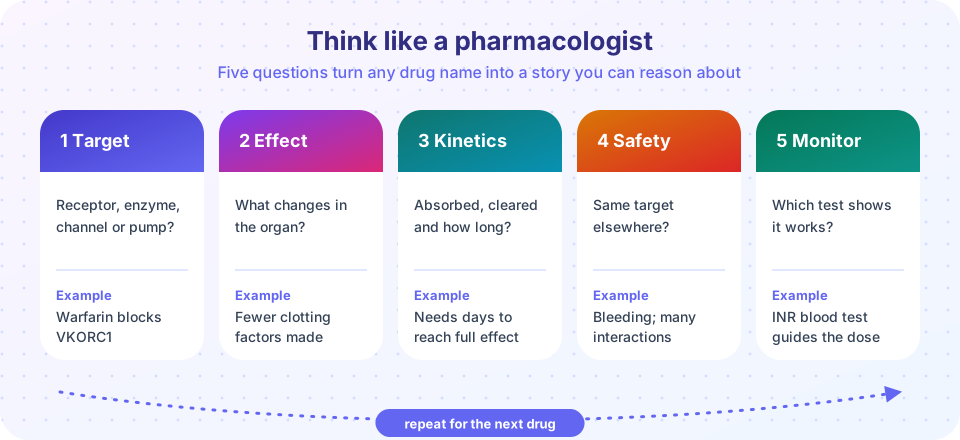
The method has five questions, and the figure shows them applied to warfarin.
1. Target. What does the drug bind: a receptor, an enzyme, a channel, a transporter, or a structure in a pathogen? Chapters 2 and 4 gave you the language of agonists, antagonists and inhibitors. Naming the target is often enough to predict the main effect.
2. Effect. What does that binding change in the cell and in the organ? Blocking VKORC1 reduces the making of clotting factors. Blocking β1 receptors slows the heart. The effect should follow logically from the target and the physiology.
3. Kinetics. How is the drug absorbed, how widely does it distribute, how is it cleared, and how long does it last? Chapter 3 gave you the half-life, clearance and volume of distribution. Kinetics explains why warfarin takes days to work, why lithium levels shift when a person is dehydrated and why some drugs are given once a day and others every six hours.
4. Safety. What follows from the same target in other places, from the metabolism of the drug, and from the combinations in which it will be used? Interactions, special groups and narrow margins belong here. The side effects of a drug are often the effects of its target, in the wrong place.
5. Monitoring. How will we know it is working and not harming? An INR for warfarin, a blood level for lithium or phenytoin, blood pressure for antihypertensives, a viral load for HIV drugs, a blood count for clozapine and chemotherapy. If there is no good marker, you may need symptoms and time.
None of these questions needs a drug name to be memorized. They need understanding, and that is what makes the method transferable to the drugs of the future.
Why practice matters
Reading a worked example feels like understanding, but it is not the same as being able to produce the reasoning yourself. Education research consistently finds that retrieving information and applying it to a new problem leads to better long-term learning than rereading. The lessons in this chapter are therefore designed to be done, not read. Try to answer each case in your own words before looking at the model answer, and attempt each calculation by hand before running the code.
Common misconceptions
"If I know the drug class, I know the drug." Members of a class differ in selectivity, kinetics and interactions. The class gives you a starting hypothesis, and the details decide.
"Calculations are for the pharmacist, not for me." Even a rough mental estimate, such as five half-lives to reach a steady state, protects against surprises and makes advice from health professionals easier to follow.
"A project in code is not real pharmacology." Models are a standard tool of the field, used from drug discovery to dose selection. Writing one forces you to state your assumptions.
Try it
First, a small interactive application of the method. Choose a drug and see its five answers. The entries are brief summaries from earlier chapters and are meant for revision, not for decisions about treatment.
Second, a first look at kinetics in code, which you will extend in the project. When a drug is given at intervals equal to its half-life, the level climbs and settles after about five half-lives. The code adds up the contributions of each dose, using a simple model with an intravenous bolus.
Press Run (or Ctrl + Enter) to see the result here.
Program input · what you'd type while the program runs
Type the answers before you press Run, one per line. Each time the program reads a line (with input()), it gets the next line from this box.
Check your understanding
Quick check · 4 questions
of 4 answered You scored / 4 · perfect!
-
1. In the five-step method, which step asks about interactions and special groups?
Safety covers what could go wrong, including the same target elsewhere, interactions and special populations. -
2. Why is a drug class only a starting hypothesis?
Details such as which receptor subtype, which enzyme or how long the half-life is can change the clinical picture. -
3. Dosing at intervals equal to the half-life, how many doses are needed to reach about 97 percent of the steady-state peak?
After n doses, the peak is 1 - 0.5^n of its limit, so five doses give about 97 percent. -
4. Which is the best marker for monitoring warfarin?
The INR measures clotting time, which reflects the drug's effect.
Summary
- The five questions, target, effect, kinetics, safety and monitoring, turn a drug name into a reasoning chain.
- Chapter 9 gives you six cases, a dosing simulator project, a glossary, a cheat sheet and guidance for further study.
- Practice by retrieval and application beats rereading.
Track your progress
Create a free account to tick off lessons and pick up where you left off on any device.
of Pharmacology lessons completed