


















Lesson 48 of 48 · Projects and Practice
Further study: where to go after pharmacology
How to read a drug label and a clinical trial critically, which advanced topics and careers grow out of pharmacology, and which related tutorials on this site to study next.
You have now covered the central ideas of pharmacology: how drugs bind their targets, how the body handles them, how dose relates to effect, how the main drug families work and how medicines are tested and made safe. The subject is large, and no single course can cover it all. This last lesson points beyond the course. It shows two practical skills worth building straight away, reading a drug label and reading a clinical trial. Then it lists advanced topics and careers that grow out of pharmacology and the neighboring subjects on this site that deepen each part of the story.
Educational information only. Studying pharmacology does not qualify anyone to prescribe or advise on treatment. Anyone with a medical question should ask a pharmacist, doctor or other qualified clinician, who can see the whole person.
What you will learn
- Read the main sections of a drug label and know what each is for.
- Apply a short checklist to a clinical trial report.
- Name the advanced topics and career paths that grow out of pharmacology.
- Choose which related subjects to study next.
Skill 1: reading a drug label
A drug label, often called a summary of product characteristics, a package insert or a data sheet, is the official, regulator-approved description of a drug. It is dense, but it is organized in the same way for most drugs, and once you know the layout you can find what you need.
- Indications. What the drug is approved for. Use outside these is "off-label".
- Dosage and administration. Usual doses, adjustments for kidney or liver disease, and timing.
- Contraindications. Situations in which the drug should not be used.
- Warnings and precautions. Serious risks and who is most at risk, such as boxed warnings.
- Adverse reactions. Usually listed by frequency, from very common to rare, and often derived from trials.
- Drug interactions. Which other drugs, foods and herbal products matter, with the mechanism, often a CYP enzyme or transporter.
- Use in specific populations. Pregnancy, breastfeeding, children, older adults and organ impairment.
- Clinical pharmacology. The mechanism of action and the pharmacokinetics: bioavailability, half-life, protein binding, metabolism and excretion.
- Clinical studies. The trials that supported approval, with their size and design.
Try this on a drug you know. Find the target in the mechanism section, the half-life in the pharmacokinetics, and match the common adverse reactions to the target and kinetics. Often a label lets you rebuild the five questions in a few minutes. Patient information leaflets are shorter and use simpler language, but they list every reported event without always showing how common it is, so look for the frequency categories.
Skill 2: reading a clinical trial
Headlines about trials are often misleading, and a short checklist helps you judge them. A widely used way to start is the PICO framework: the Population studied, the Intervention, the Comparator and the Outcome. Then ask:
- Was it randomized, and how was the sequence hidden? Poor allocation concealment can bias a trial.
- Was it blinded? Who did not know: participants, clinicians, assessors?
- What was the comparator? Placebo, usual care, an active drug at the right dose?
- What was the primary outcome, and was it pre-registered? Check the registry entry.
- Is the outcome a clinical event or a surrogate?
- What are the absolute numbers? Convert relative risk to absolute risk reduction and NNT.
- How many people dropped out, and was the analysis intention-to-treat?
- Who funded it, and could the sponsor have shaped the result?
- Does the population match the people the finding is applied to? Trials often exclude older people, children, pregnant women and people with several conditions.
- Has it been replicated, and is it consistent with other trials? Systematic reviews and meta-analyses combine trials and are usually more reliable than any single study.
No trial is perfect. The aim is not to dismiss evidence but to know how much weight it can bear.
Advanced topics that grow out of this course
- Receptor theory and molecular pharmacology. Quantitative models of binding, efficacy, biased agonism and allosteric modulation.
- Pharmacometrics and PBPK modelling. Population pharmacokinetic models and physiologically based models that predict drug levels in children, pregnancy and organ failure; the project in chapter 9 was a small first step.
- Pharmacogenomics and precision medicine. Using genetic tests to choose drugs and doses, and tumor genetics to select targeted treatments.
- Biologics, gene and cell therapies. Antibodies, mRNA, gene editing and engineered T cells, which have different kinetics and safety questions from small molecules.
- Toxicology. The study of poisons and dose-related harm, from overdose management to environmental chemicals.
- Drug discovery and medicinal chemistry. Finding and improving molecules, including computer-aided design and machine learning to screen candidates.
- Regulatory science and health economics. How evidence is judged and how value is assessed.
- Global health pharmacology. Access, counterfeit medicines, neglected diseases, and antimicrobial resistance.
Careers
Pharmacology leads to many roles. Pharmacists dispense medicines, check interactions and advise patients and prescribers. Clinical pharmacologists are doctors who specialize in drug effects and safe prescribing. Nurses and doctors use pharmacology every day. Researchers work in academic and industry laboratories on targets and compounds. Clinical trial professionals design, run and analyze trials. Regulatory and pharmacovigilance specialists work at regulators and companies to review evidence and monitor safety. Toxicologists assess chemical risk. Each path needs further training, and your choice will depend on whether you like patient contact, laboratory work, data or policy.
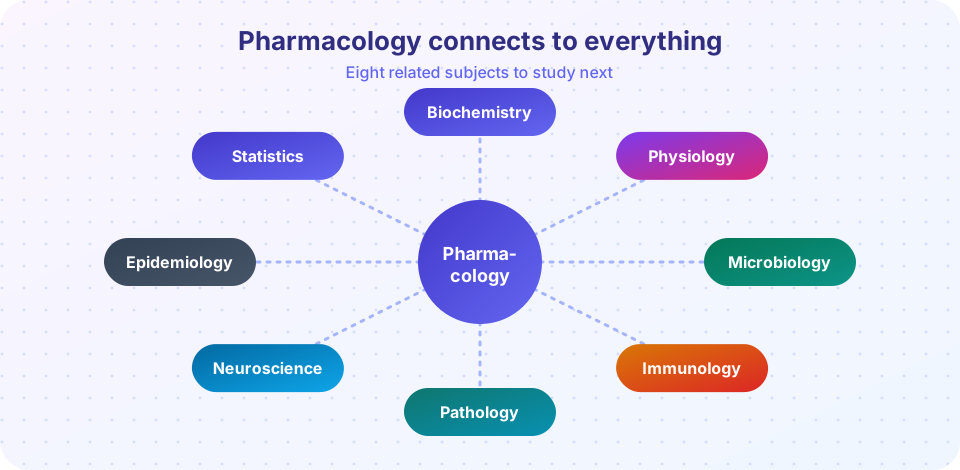
What to study next on this site
If a part of the course made you want to dig deeper, these tutorials extend it:
- Biochemistry explains the enzymes, metabolic pathways and molecules that most drugs target.
- Anatomy and physiology shows the organ systems that drugs change, from the heart to the kidney.
- Microbiology covers the bacteria, viruses and fungi that anti-infective drugs fight and the biology of resistance.
- Immunology explains allergy, vaccines and the immune system that checkpoint inhibitors and biologics act on.
- Pathology describes how diseases arise, which gives the reasons for treating them.
- Neuroscience goes deeper into the brain circuits and transmitters behind chapter 6.
- Public health and epidemiology covers how risks and treatments are studied in populations.
- Statistics and probability gives the mathematical tools behind trials, confidence intervals and risk.
- Nutrition science links diet, supplements and drug interactions.
A last word of advice
Pharmacology rewards curiosity and humility in equal parts. Drugs act on systems that are only partly understood, and evidence changes: yesterday's standard treatment is sometimes tomorrow's warning. The best habit you can take from this course is to keep asking the five questions, to check the numbers behind any claim, and to respect the difference between knowing how a drug works and knowing what is right for a particular person.
Common misconceptions
"A label lists only the dangers, so a long list means a dangerous drug." Labels include events that occurred in trials whether or not the drug caused them, so the frequency matters more than the length.
"One good trial settles a question." Trials can be wrong or limited to a narrow population, and replication and systematic reviews carry more weight.
"Learning pharmacology means I can manage my own medicines." It helps you ask better questions, but decisions should still involve a pharmacist or prescriber.
Try it
First, a critical appraisal scorer. Enter yes or no answers (1 or 0) for each checklist item and see a rough score with suggestions about which items to check. It is a learning aid and not a validated tool.
Press Run (or Ctrl + Enter) to see the result here.
Program input · what you'd type while the program runs
Type the answers before you press Run, one per line. Each time the program reads a line (with input()), it gets the next line from this box.
Second, a study planner. Pick what interests you most and get a suggested next subject from this site.
Check your understanding
Quick check · 4 questions
of 4 answered You scored / 4 · perfect!
-
1. What does PICO stand for?
PICO is a framework for stating the question a trial answers. -
2. In a drug label, where would you find the half-life and the mechanism of action?
The clinical pharmacology section covers mechanism and pharmacokinetics. -
3. Why are systematic reviews usually more reliable than one trial?
Combining well-chosen trials gives a more stable estimate. -
4. Which subject would best deepen your understanding of how risk and treatment effects are studied in populations?
Epidemiology studies the distribution and causes of health outcomes in populations.
Summary
- A drug label has a standard layout; clinical pharmacology gives the mechanism and kinetics, and warnings and interactions give the risks.
- A ten-point checklist built on PICO helps you judge a trial: randomization, blinding, comparator, outcome, absolute numbers, dropout, funding and applicability.
- Advanced paths include pharmacometrics, pharmacogenomics, biologics, toxicology, drug discovery and regulatory science.
- Biochemistry, physiology, microbiology, immunology, pathology, neuroscience, epidemiology and statistics deepen different parts of the course.
Next: back to the Pharmacology course page
Track your progress
Create a free account to tick off lessons and pick up where you left off on any device.
of Pharmacology lessons completed