


















Lesson 7 of 48 · Principles of Drug Action
Receptors and binding: affinity and the occupancy law
Understand receptor families, how a drug binds, what the dissociation constant Kd means, and how to calculate receptor occupancy from concentration, with simulations and a fitting exercise.
A receptor is a protein built to listen for one kind of message. Your nervous system, hormones and immune system all communicate by releasing molecules that receptors detect. Drugs work because they resemble, mimic or block those messages. To use this idea quantitatively, you need a way to say how much of a receptor population is occupied at a given drug concentration. A simple law, derived from the same equilibrium rules as any chemical reaction, does exactly that. It underlies dose-response curves, potency and the design of new drugs.
What you will learn
- The four families of receptor and how quickly each acts.
- How drug binding is described by association and dissociation rates.
- What Kd is, and how to compute the fraction of receptors occupied at any concentration.
- How to estimate Kd from data, and what the limits of the simple law are.
Key terms
- Kd (dissociation constant): the drug concentration at which half of the receptors are occupied at equilibrium. Smaller Kd means higher affinity.
- kon and koff: the rate constants for binding (association) and unbinding (dissociation). Kd = koff / kon.
- Occupancy: the fraction of receptors bound to the drug.
- Bmax: the total number of binding sites in a tissue or preparation.
- Spare receptors (receptor reserve): receptors in excess of those needed for a maximal response.
The four receptor families
Receptors are grouped by how they turn binding into action.
- Ligand-gated ion channels. Binding opens a pore within the receptor, and ions flow in milliseconds. Examples: the nicotinic acetylcholine receptor at the neuromuscular junction, and the GABA-A receptor (the target of benzodiazepines). These are used where speed matters, for example muscle contraction.
- G protein-coupled receptors (GPCRs). A seven-transmembrane protein activates an attached G protein, which starts a chain of intracellular messengers (such as cyclic AMP or calcium). Effects appear in seconds. This family is huge: adrenergic, muscarinic, opioid, dopamine, serotonin and histamine receptors are all GPCRs, and roughly a third of all drugs act on them.
- Kinase-linked and related receptors. Binding activates an enzyme domain, usually a tyrosine kinase, on the inside of the membrane. The insulin receptor and growth factor receptors work this way, with effects over minutes to hours because they change protein activity and gene expression.
- Nuclear receptors. These sit inside the cell (in the cytoplasm or nucleus), and lipid-soluble ligands such as steroid hormones, thyroid hormone and vitamin D must cross the membrane to reach them. The bound receptor changes gene transcription, so effects take hours to days and persist after the drug has gone.
Timescale is a clue to the family. A drug that works within a second is probably acting on an ion channel or a GPCR. One that takes days to reach its full effect may act on a nuclear receptor or change gene expression.
Binding as chemistry
Treat drug binding as a reversible reaction between a ligand L and a receptor R:
L + R <==> LR (rate kon forwards, koff backwards)
At equilibrium the forward and backward rates are equal: kon × [L] × [R] = koff × [LR]. Rearranging gives the dissociation constant:
Kd = koff / kon = [L] × [R] / [LR]
Kd has the units of concentration (for example nM). Now suppose the total receptor number is Rtotal = [R] + [LR]. The fraction occupied is:
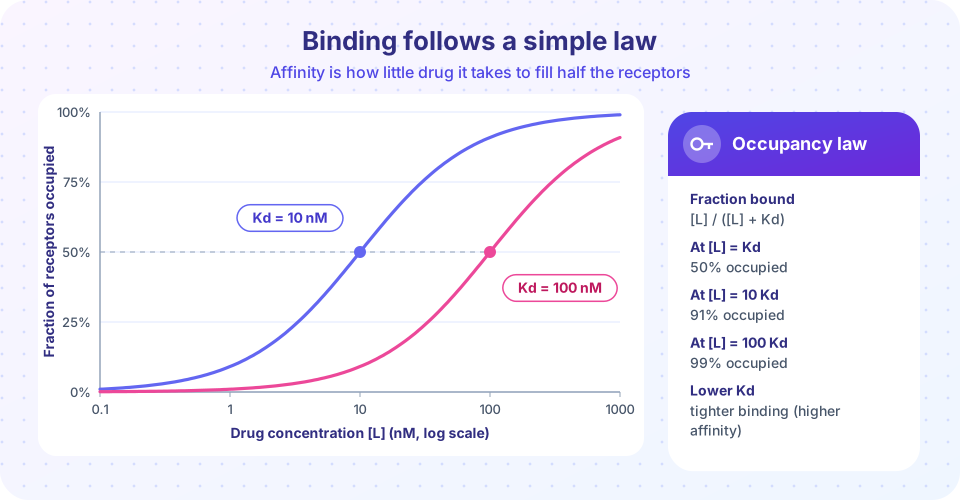
occupancy = [LR] / Rtotal = [L] / ([L] + Kd)
This is the occupancy law (A. J. Clark's idea, in modern notation; the same hyperbola is the Langmuir isotherm in chemistry). Its consequences are worth memorizing:
| Concentration | Occupancy |
|---|---|
| 0.1 × Kd | 9% |
| 1 × Kd | 50% |
| 3 × Kd | 75% |
| 10 × Kd | 91% |
| 100 × Kd | 99% |
Notice the shape: the first doublings of concentration add a lot of occupancy, while the last tenfold increases add almost nothing. To go from 50% to 99% you need a hundredfold increase in concentration. This is why plotting concentration on a logarithmic axis gives the symmetrical S-curve in the picture, and why raising doses rapidly brings more side effects than benefit once receptors are mostly full.
Affinity: what Kd tells you
A drug with a Kd of 1 nM binds roughly ten times more tightly than one with a Kd of 10 nM. It dissociates more slowly (a smaller koff), binds faster (a larger kon), or both. Typical drugs have Kd values from nanomolar to micromolar. A high-affinity drug needs a lower concentration to fill the same number of receptors, so it can be given at a lower dose. But high affinity does not mean high safety, and it says nothing yet about efficacy.
Residence time, 1 / koff, matters too. Two drugs with the same Kd can differ in how long they stay on the receptor, and a long residence time can prolong the effect beyond the time the drug remains in the blood. Some modern drugs are designed for slow dissociation for this reason.
Why occupancy is not always effect
If effect were simply proportional to occupancy, a drug would need 100% occupancy for a maximal effect. In many tissues it does not. A tissue with many receptors may reach a maximal response when only a small fraction is occupied: the rest are spare receptors. In that case the drug's potency for producing an effect is higher than its affinity would suggest, and the effect curve lies to the left of the binding curve. Spare receptors also explain why an irreversible antagonist can remove many receptors before the maximum falls. Chapter 4 returns to this.
Binding itself is also saturable and selective. Saturable: there is a finite number of sites, so occupancy reaches a ceiling. Selective: a drug binds some proteins far better than others. Most drugs are selective only over a range of concentration. At high concentrations they begin to bind other receptors, and new effects, often side effects, appear. A beta-blocker that favours the heart at low doses loses some of that preference at higher doses and may begin to affect the airways.
Common misconceptions
- "High affinity means a better drug." Affinity only describes binding. A tightly binding antagonist is useless as an activator, and a very tight binder may cause toxicity or be hard to reverse.
- "A drug at its Kd concentration gives 50% of the maximal effect." It gives 50% occupancy. The effect may be much higher if there are spare receptors, or lower if the drug is a partial agonist.
- "Receptors are fixed in number." Cells change receptor numbers over time (down-regulation or up-regulation), which is why tolerance and withdrawal rebound occur.
Try it
First, plot the occupancy law with two values of Kd and mark the half-way points. Notice the log axis.
Press Run (or Ctrl + Enter) to see the result here.
Program input · what you'd type while the program runs
Type the answers before you press Run, one per line. Each time the program reads a line (with input()), it gets the next line from this box.
Second, estimate Kd from "measured" data. The numbers here are generated with noise, as a laboratory binding experiment would produce. A curve fit recovers Kd and Bmax. The fitted values will be close to, but not exactly, the values used to make the data.
Press Run (or Ctrl + Enter) to see the result here.
Program input · what you'd type while the program runs
Type the answers before you press Run, one per line. Each time the program reads a line (with input()), it gets the next line from this box.
Third, try the widget: one hundred receptors, a concentration slider and a Kd slider.
Check your understanding
Quick check · 6 questions
of 6 answered You scored / 6 · perfect!
-
1. A drug has Kd = 20 nM. At what concentration are half of the receptors occupied?
By definition, half the receptors are occupied when [L] = Kd. -
2. What fraction of receptors is occupied when [L] = 10 x Kd?
10 / (10 + 1) = 0.909. -
3. Which receptor family typically gives effects within milliseconds?
Ion channel receptors open a pore directly. Nuclear receptors alter gene expression over hours. -
4. Drug A has a Kd of 5 nM and drug B a Kd of 50 nM at the same receptor. Which statement is correct?
A smaller Kd means tighter binding. -
5. Why can a tissue give a maximal response with low occupancy?
When receptors exceed those needed for a full response, the effect saturates before occupancy does. -
6. Which relationship is correct?
Kd is the ratio of the dissociation rate constant to the association rate constant.
Summary
- Receptors are grouped into ion channels, GPCRs, kinase-linked receptors and nuclear receptors, which act on timescales from milliseconds to days.
- Binding is reversible: Kd = koff / kon is the concentration at which half of the receptors are occupied.
- The occupancy law is
[L] / ([L] + Kd): 50% at Kd, 91% at 10 x Kd, 99% at 100 x Kd. - Effect need not be proportional to occupancy; spare receptors and drug type also matter.
Next: Drug targets: receptors, channels, enzymes and transporters
Track your progress
Create a free account to tick off lessons and pick up where you left off on any device.
of Pharmacology lessons completed