


















Lesson 46 of 48 · Projects and Practice
Pharmacology glossary: key terms from the course
A plain-language glossary of the key pharmacology terms in this course, grouped into targets and actions, kinetics, dose and response, safety, drug development and drug classes.
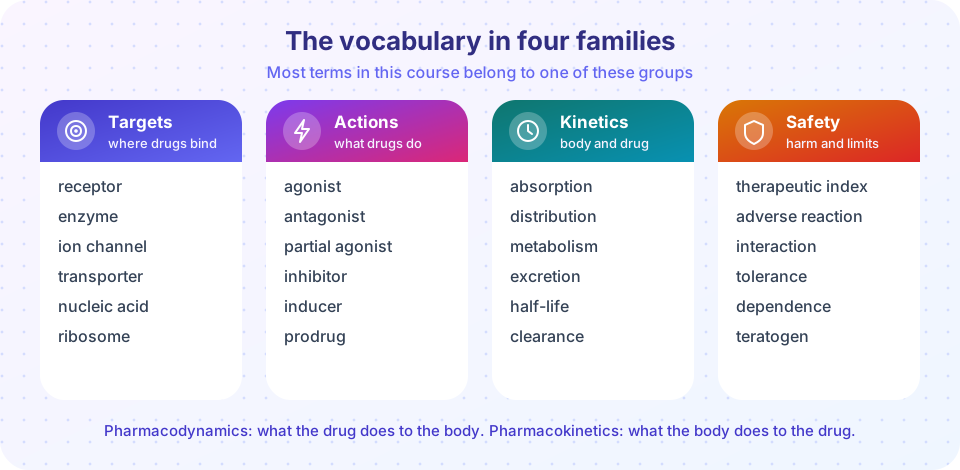
Pharmacology has a reputation for jargon, and some of it is unavoidable. Words such as agonist, clearance and bioequivalence carry precise meanings that save pages of explanation. This glossary collects the vocabulary used across the course, in plain language, grouped by the family each term belongs to. Use it as a reference when a word slips your memory, or read a section straight through as a revision exercise and try to define each term before you read the definition.
What you will learn
- Recall precise definitions for the main pharmacology terms.
- Group terms into families: targets and actions, kinetics, dose and response, safety, development and drug classes.
- Use the glossary as a study tool.
Targets and actions
- Receptor: a protein, usually on or in a cell, that binds a signalling molecule such as a hormone, transmitter or drug and triggers a response.
- Ligand: any molecule that binds to a receptor, whether natural or a drug.
- Agonist: a drug that binds a receptor and activates it.
- Antagonist: a drug that binds a receptor and blocks it without activating it.
- Partial agonist: a drug that activates a receptor but with less than the maximum response, even at full occupancy.
- Inverse agonist: a drug that reduces the activity of a receptor that has some activity of its own.
- Competitive antagonist: an antagonist that can be overcome by more agonist, which moves the dose-response curve to the right.
- Irreversible antagonist: a drug that binds permanently, so recovery needs new receptors to be made.
- Allosteric modulator: a drug that binds a different site from the natural ligand and changes how the receptor responds, as benzodiazepines do at GABA-A.
- G-protein-coupled receptor (GPCR): a receptor that signals through G proteins; beta-adrenergic, muscarinic and opioid receptors are examples.
- Ligand-gated ion channel: a receptor that is also a channel, opening when the ligand binds, as nicotinic and GABA-A receptors do.
- Enzyme inhibitor: a drug that slows an enzyme, such as an ACE inhibitor or a statin.
- Transporter: a membrane protein that moves molecules across; many drugs, such as SSRIs and loop diuretics, block transporters.
- Prodrug: an inactive compound that the body converts into the active drug, as with clopidogrel and codeine.
- Affinity: how tightly a drug binds its target.
- Efficacy: how well a bound drug produces a response.
- Potency: the dose needed for a given effect; a more potent drug needs a smaller dose, which says nothing about how large an effect it can produce.
- Selectivity: the preference of a drug for one target over similar ones.
Kinetics: what the body does to the drug
- Pharmacokinetics: the study of absorption, distribution, metabolism and excretion.
- Absorption: movement of a drug from its site of administration into the blood.
- Bioavailability (F): the fraction of a dose that reaches the circulation unchanged; an intravenous dose has F = 1.
- First-pass effect: removal of part of an oral dose by the gut wall and liver before it reaches the general circulation.
- Distribution: the spread of a drug from the blood into tissues.
- Volume of distribution (Vd): the apparent volume that would hold the drug at the plasma concentration; large for drugs that concentrate in tissues.
- Protein binding: attachment of a drug to plasma proteins such as albumin; only the unbound drug is active.
- Metabolism: chemical change of a drug, mostly in the liver, often making it easier to excrete.
- Cytochrome P450 (CYP): a family of liver enzymes that metabolize many drugs, with CYP3A4, CYP2D6, CYP2C9 and CYP2C19 the most important.
- Enzyme inducer: a drug that increases the amount of a metabolic enzyme and lowers the levels of other drugs.
- Enzyme inhibitor (metabolic): a drug that slows a metabolic enzyme and raises the levels of other drugs.
- Excretion: removal of a drug from the body, mainly by the kidney in urine or by the liver in bile.
- Clearance (CL): the volume of blood cleared of the drug per unit time.
- Half-life (t½): the time for the concentration to fall by half; equal to 0.693 × Vd / CL.
- Steady state: the condition in repeated dosing when the amount going in equals the amount going out; reached after four to five half-lives.
- Loading dose: a larger initial dose to reach the target level quickly, equal to Css × Vd / F.
- Maintenance dose: the repeated dose that holds the level at the target, equal to CL × Css / F per unit time.
- Zero-order (saturable) kinetics: elimination at a fixed maximum rate, as with phenytoin at high levels, so doses and levels are not proportional.
- AUC, Cmax and tmax: the area under the concentration-time curve (total exposure), the peak concentration and the time of the peak.
- Therapeutic drug monitoring: measuring blood levels to keep them in the target range; used for lithium, phenytoin, digoxin and aminoglycosides.
Dose and response: pharmacodynamics
- Pharmacodynamics: the study of what a drug does to the body and how effect relates to concentration.
- Dose-response curve: a graph of effect against dose, usually S-shaped on a log scale.
- ED50 or EC50: the dose or concentration giving half the maximum effect.
- Emax: the maximum effect a drug can produce.
- Therapeutic window: the range of concentrations that gives benefit without unacceptable toxicity.
- Therapeutic index: the ratio of the toxic dose to the effective dose; a small ratio means a narrow margin.
- Tolerance: a decreasing effect of the same dose with repeated use.
- Tachyphylaxis: very rapid tolerance after a few doses.
- Dependence: an adaptation of the body so that stopping the drug causes withdrawal symptoms.
- Addiction: compulsive drug use despite harm, which is different from physical dependence.
- Placebo effect: a real improvement caused by the expectation of treatment, not by the active ingredient.
Safety, interactions and monitoring
- Adverse drug reaction (ADR): a harmful, unintended response to a drug at normal doses.
- Side effect: any effect other than the intended one; may be harmful or harmless.
- Type A reaction: an exaggeration of the drug's known action, dose-related and predictable.
- Type B reaction: an unpredictable, often immune reaction, such as anaphylaxis.
- Idiosyncratic reaction: an unusual reaction that is not explained by the drug's pharmacology, often genetic.
- Hypersensitivity: an immune reaction to a drug.
- Teratogen: a substance that causes birth defects; thalidomide and valproate are examples.
- Contraindication: a condition in which a drug should not be used because the risk is too high.
- Drug interaction: a change in the effect of one drug caused by another, by food or by a herbal product.
- Pharmacokinetic interaction: an interaction that changes drug levels, such as enzyme inhibition.
- Pharmacodynamic interaction: an interaction at the target or in the same system, such as two sedatives adding up.
- Polypharmacy: the use of many drugs together, common in older adults and linked to more interactions.
- Pharmacogenomics: how a person's genes affect their response to drugs.
- Pharmacovigilance: the monitoring of drug safety after marketing.
- Signal: a pattern in reports suggesting a drug may cause a harm, which needs investigation.
- Boxed warning: the strongest warning in a US drug label, for risks that may be serious or life-threatening.
- Off-label use: using an approved drug for an indication, dose or population that its label does not cover.
Development, evidence and regulation
- Preclinical study: laboratory and animal testing before human trials.
- Phase I, II, III, IV: trial stages testing safety and kinetics, early efficacy and dose, confirmation, and post-approval surveillance.
- Randomized controlled trial (RCT): a trial in which chance assigns participants to the treatments being compared.
- Blinding: hiding the treatment assignment from participants, clinicians or assessors.
- Endpoint: the outcome used to judge a treatment; a surrogate endpoint is a stand-in measure such as LDL cholesterol.
- Intention-to-treat analysis: analysis of participants in the groups to which they were randomized.
- Relative risk reduction (RRR): the proportional fall in risk, such as 20 percent.
- Absolute risk reduction (ARR): the difference in risk between groups, in percentage points.
- Number needed to treat (NNT): 1 divided by the ARR; the number treated for one to benefit.
- Equipoise: genuine uncertainty about which treatment is better, which justifies randomization.
- Informed consent: a participant's voluntary agreement after understanding the risks and alternatives.
- Generic drug: a copy of a drug whose patent has expired, shown to be bioequivalent to the original.
- Bioequivalence: AUC and Cmax within 80 to 125 percent of the reference product.
- Biosimilar: a highly similar version of a biologic drug.
- Orphan drug: a drug developed for a rare disease, often with regulatory incentives.
Drug classes and clinical terms
- NSAID: a non-steroidal anti-inflammatory drug that blocks COX enzymes, such as ibuprofen.
- Opioid: a drug that acts on opioid receptors, such as morphine.
- SSRI: a selective serotonin reuptake inhibitor, a class of antidepressant.
- Benzodiazepine: a drug that enhances GABA-A receptors, used for anxiety, seizures and sedation.
- Statin: a drug that inhibits HMG-CoA reductase to lower LDL cholesterol.
- ACE inhibitor and ARB: drugs that reduce the effects of angiotensin II, by blocking the converting enzyme or the receptor.
- Beta-blocker: a drug that blocks beta-adrenergic receptors.
- Anticoagulant and antiplatelet: drugs that prevent clotting through the cascade or through platelets.
- Bactericidal and bacteriostatic: killing bacteria compared with only stopping their growth.
- MIC: the minimum inhibitory concentration of an antibiotic for a given bacterium.
- Antimicrobial stewardship: programs that promote the right antimicrobial, dose and duration.
- Cytotoxic: toxic to cells, as in chemotherapy that kills dividing cells.
- Targeted therapy: a drug aimed at a specific molecular driver of disease, such as a mutant kinase.
- Checkpoint inhibitor: an antibody that releases an immune brake on T cells.
Common misconceptions
"Potency and efficacy mean the same." Potency is about how much drug is needed, and efficacy is about how big an effect can be produced. A weak, potent drug can exist, and so can a strong, impotent one.
"A side effect is always a harm." Some are harmless or even useful, such as sedation from an antihistamine used for sleep.
"Dependence and addiction are the same." Dependence is a physical adaptation, and addiction is a pattern of compulsive use despite harm.
Try it
First, the glossary as data. The code groups a few terms by family and prints an index, then lets you look up a term. Add your own terms to make a personal study list.
Press Run (or Ctrl + Enter) to see the result here.
Program input · what you'd type while the program runs
Type the answers before you press Run, one per line. Each time the program reads a line (with input()), it gets the next line from this box.
Second, a search box over a few key terms. Type part of a word to filter the list.
Check your understanding
Quick check · 4 questions
of 4 answered You scored / 4 · perfect!
-
1. Which term describes the dose needed to produce a given effect?
Potency is about dose; efficacy is about the maximum effect. -
2. Which term means that elimination reaches a fixed maximum rate?
Phenytoin is a classic example, where small dose increases cause large level rises. -
3. A drug that is inactive until the body converts it is called a:
Codeine and clopidogrel are prodrugs. -
4. Which pair of terms are correctly related?
Half-life is 0.693 Vd / CL, and the therapeutic index is the toxic dose divided by the effective dose.
Summary
- Terms fall into families: targets and actions, kinetics, dose and response, safety, development and drug classes.
- Pharmacodynamics is what the drug does to the body; pharmacokinetics is what the body does to the drug.
- Key relationships: t½ = 0.693 Vd / CL, loading dose = Css Vd / F, NNT = 1 / ARR, and therapeutic index = toxic dose / effective dose.
Next: Cheat sheet
Track your progress
Create a free account to tick off lessons and pick up where you left off on any device.
of Pharmacology lessons completed