


















Lesson 14 of 48 · Pharmacokinetics
Drug metabolism: phase I, phase II and cytochrome P450
Learn how the liver changes drugs: phase I and II reactions, cytochrome P450 enzymes, induction and inhibition, prodrugs, saturable zero-order metabolism, with plots and a CYP explorer.
The body treats most drugs as foreign chemicals. Fat-soluble molecules slip through membranes, but a kidney cannot easily remove them, because they are reabsorbed back into the blood. The body's answer is to chemically change them into forms that dissolve in water and leave in urine or bile. This process is drug metabolism or biotransformation. It decides how long most drugs last, it is where many interactions happen, and it varies enormously between people.
What you will learn
- Where drug metabolism happens and why it exists.
- What phase I and phase II reactions do, with examples.
- How cytochrome P450 enzymes are named, which ones matter, and how induction and inhibition change drug levels.
- What prodrugs and active metabolites are, and what saturable (zero-order) metabolism means.
Key terms
- Cytochrome P450 (CYP): a family of liver enzymes that oxidize many drugs; named like CYP3A4 (family, subfamily, gene).
- Phase I reaction: oxidation, reduction or hydrolysis that adds or exposes a reactive group.
- Phase II reaction: conjugation, attaching a polar molecule such as glucuronic acid, sulfate or glutathione.
- Enzyme induction and inhibition: raising or lowering the activity of a metabolizing enzyme.
- Prodrug: an inactive compound that becomes active after metabolism.
Where and why
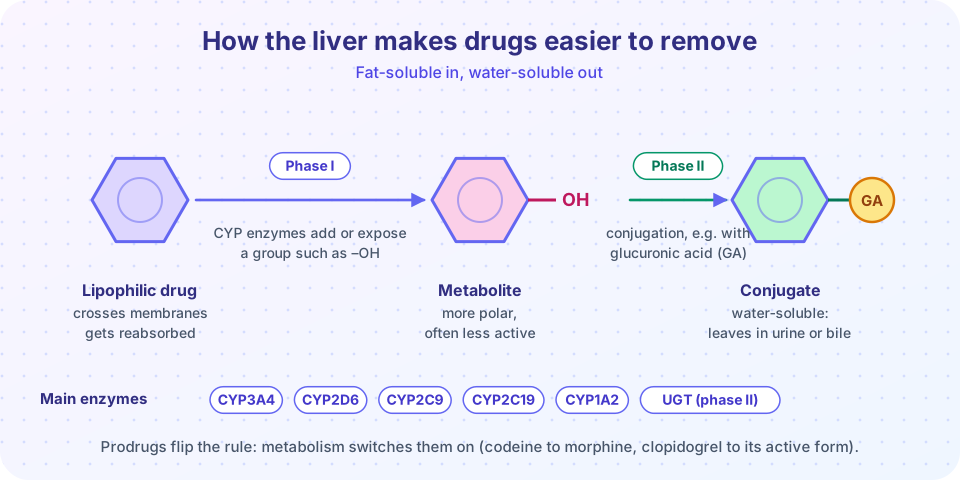
The liver is the main site because it holds the highest concentration of drug-metabolizing enzymes and receives all the blood from the gut. The gut wall, lungs, kidneys, skin and blood also contribute. Metabolism usually makes a molecule more polar (water-soluble), which has three effects: it stops reabsorption in the kidney, it generally lowers the molecule's ability to cross membranes and bind targets, and it makes it easy to excrete. Usually the metabolite is less active than the parent drug. Exceptions exist and they are important: some metabolites are as active as the parent, more active, or toxic.
Phase I: adding a handle
Phase I reactions introduce or expose a functional group such as -OH, -NH2 or -COOH. The main types are oxidation (by far the commonest), reduction and hydrolysis (for example, esterases cutting an ester bond, which is how procaine and aspirin are broken down). Oxidation is mostly carried out by the cytochrome P450 system. P450 enzymes sit in the membranes of the endoplasmic reticulum in liver cells, use oxygen and the cofactor NADPH, and are named by family (a number), subfamily (a letter) and gene (a number): CYP3A4 is family 3, subfamily A, gene 4.
A small number of enzymes handle most drugs. CYP3A4 (and the closely related CYP3A5) is the most abundant in the liver and gut and metabolizes a very large share of drugs, including simvastatin, ciclosporin and many others. CYP2D6 handles codeine, many antidepressants and antipsychotics, and beta-blockers such as metoprolol. CYP2C9 metabolizes warfarin and many NSAIDs. CYP2C19 handles clopidogrel activation and omeprazole. CYP1A2 metabolizes caffeine and theophylline. Phase I products may be inactive, active, or reactive.
Phase II: attaching a polar group
Phase II reactions conjugate a drug or its phase I product with a polar molecule. The commonest is glucuronidation by UDP-glucuronosyltransferases (UGTs), which adds glucuronic acid. Others are sulfation, acetylation (by N-acetyltransferase, NAT2; people differ genetically in speed, so isoniazid is cleared slowly by "slow acetylators"), methylation, and glutathione conjugation. Phase II products are usually inactive and highly water-soluble. A drug may undergo phase II directly: lorazepam is conjugated without a phase I step, which makes it less affected by liver disease than diazepam and less prone to interactions through CYP enzymes.
A worked example: paracetamol
At normal doses, most paracetamol (acetaminophen) is conjugated with glucuronic acid or sulfate and excreted. A small fraction is oxidized by CYP enzymes (mainly CYP2E1 and CYP3A4) to a reactive intermediate, NAPQI. Normally the liver neutralizes NAPQI at once by conjugating it with glutathione. In an overdose, the conjugation pathways saturate, more NAPQI is made, and glutathione stores run out. NAPQI then binds liver proteins and kills liver cells. The antidote N-acetylcysteine supplies the raw material to rebuild glutathione. This story shows several principles at once: parallel pathways, saturation, toxic metabolites and rational antidotes. It also explains why paracetamol overdose can be treated successfully if the antidote is given early.
Induction and inhibition
Because enzymes are proteins, drugs and foods can change their amount or activity.
- Induction raises the quantity of enzyme, over days, by increasing gene expression. The drug is cleared faster and its levels fall. Classic inducers are rifampicin, carbamazepine, phenytoin, St John's wort, and (for CYP1A2) cigarette smoke. When an inducer is stopped, the effect fades over days to weeks, and levels of affected drugs can rise.
- Inhibition reduces enzyme activity, usually within hours. Levels rise, and toxicity can follow. Classic inhibitors are clarithromycin, ketoconazole and itraconazole (CYP3A4), fluoxetine and paroxetine (CYP2D6), ciprofloxacin (CYP1A2), and grapefruit juice, which inhibits CYP3A4 in the gut wall and raises levels of drugs such as simvastatin and some calcium channel blockers.
The effect of an interaction is judged by how much of the victim drug's clearance depends on the affected enzyme. If one enzyme performs most of the clearance, inhibiting it can double or triple the AUC.
Prodrugs and active metabolites
A prodrug is inactive until metabolism turns it on. Codeine is converted by CYP2D6 to morphine, which is responsible for most of its pain relief. Clopidogrel is activated by CYP2C19. Enalapril is hydrolysed by esterases to enalaprilat. Prodrugs can improve absorption or targeting, but they depend on a working enzyme, which brings genetic variation into play (see the lesson on variability and pharmacogenomics). Many drugs also have active metabolites: diazepam is converted to desmethyldiazepam, which is active and long-lived, so the effect of diazepam outlasts the parent.
First-order and zero-order metabolism
For most drugs at normal concentrations the enzyme is far from saturated. The rate of metabolism is proportional to concentration (first-order), a constant fraction is removed per hour, and the half-life is constant. At high concentrations, the enzyme can saturate. The Michaelis-Menten equation describes the rate:
rate = Vmax × C / (Km + C)
When C is well below Km, rate is roughly (Vmax / Km) × C, so the process is first-order. When C is well above Km, the rate approaches Vmax, a constant amount per hour: zero-order (saturated). Ethanol is metabolized this way at ordinary intakes, at roughly one standard drink per hour for an adult. Phenytoin has a Km within its therapeutic range, so a small rise in dose can cause a large, disproportionate rise in the blood level and toxicity. Such drugs are dangerous to adjust by large steps and need monitoring.
Common misconceptions
- "Metabolism always inactivates a drug." Often it does, but prodrugs are activated and some metabolites are toxic (NAPQI) or active (desmethyldiazepam).
- "Only the liver metabolizes drugs." The gut wall, kidneys, lungs and blood also contribute, and some drugs are broken down by plasma esterases.
- "Natural products are free of interactions." St John's wort is a strong CYP3A4 inducer and lowers levels of many drugs, including some contraceptives and transplant medicines.
Try it
First, compare first-order and saturable elimination. Both curves start from different concentrations in a drug whose elimination follows Michaelis-Menten kinetics with made-up constants.
Press Run (or Ctrl + Enter) to see the result here.
Program input · what you'd type while the program runs
Type the answers before you press Run, one per line. Each time the program reads a line (with input()), it gets the next line from this box.
Second, see why saturable drugs are dangerous to adjust. For an imaginary drug with Vmax = 400 mg/day and Km = 5 mg/L, the steady-state concentration for a daily dose rate R is Css = Km × R / (Vmax - R).
Press Run (or Ctrl + Enter) to see the result here.
Program input · what you'd type while the program runs
Type the answers before you press Run, one per line. Each time the program reads a line (with input()), it gets the next line from this box.
Third, a small explorer for common inducers and inhibitors. It is a teaching list, not an interaction checker.
Check your understanding
Quick check · 6 questions
of 6 answered You scored / 6 · perfect!
-
1. What is the main purpose of drug metabolism?
Metabolism usually converts lipophilic molecules into more polar ones that the kidney and bile can remove. -
2. Which is a phase II reaction?
Phase II reactions attach a polar group such as glucuronic acid, sulfate or glutathione. -
3. Rifampicin is started in a patient taking a drug cleared by CYP3A4. What is likely to happen to that drug's levels?
Rifampicin induces CYP3A4, which takes days, and increases clearance. -
4. Codeine is a prodrug. What activates it?
CYP2D6 converts codeine to morphine, which accounts for most of the pain relief. -
5. In an overdose of paracetamol, why does liver damage occur?
The toxic metabolite NAPQI is normally neutralized by glutathione. In overdose that capacity is exhausted. -
6. What is distinctive about zero-order (saturated) elimination?
When the enzyme is saturated, the rate is about Vmax, a constant amount per unit time.
Summary
- Metabolism, mostly in the liver, converts fat-soluble drugs into water-soluble products that can be excreted.
- Phase I (mainly CYP oxidation) adds a handle; phase II conjugates with glucuronic acid, sulfate, glutathione and others.
- Inducers (rifampicin, carbamazepine, St John's wort) lower levels over days; inhibitors (clarithromycin, ketoconazole, grapefruit juice) raise them quickly.
- Prodrugs need metabolism to work; saturable (zero-order) metabolism makes some drugs hard to dose safely.
Track your progress
Create a free account to tick off lessons and pick up where you left off on any device.
of Pharmacology lessons completed