


















Lesson 27 of 48 · Autonomic and Cardiovascular Drugs
Chapter 5 review: autonomic and cardiovascular drugs
Review chapter 5 with a one-picture summary, a recap table of receptors, enzymes and drug classes, drug-name stems, and ten mixed questions.
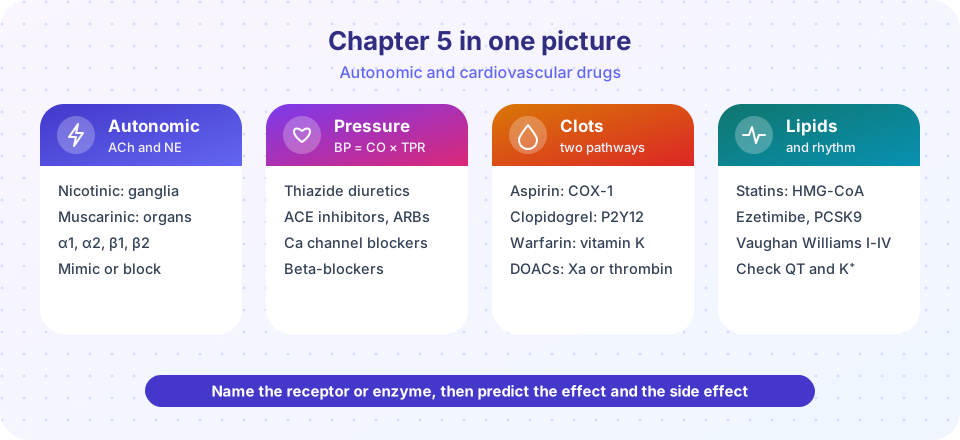
This review pulls the chapter into one page. The pattern to carry forward is simple: for every drug, name the target (receptor, enzyme, channel or transporter), then the effect that follows from blocking or activating it, then the side effect that follows from the same target elsewhere in the body. When you can do that for atropine, salbutamol, propranolol, ramipril, amlodipine, aspirin, warfarin and atorvastatin, you understand the chapter.
What you will learn
- Recall the key receptors, enzymes and channels of autonomic and cardiovascular pharmacology.
- Link each drug class to its characteristic side effect.
- Use drug-name stems to guess a drug's class.
- Test yourself with a mixed set of questions from all four lessons.
The chapter in a table
| Group | Target | Example drugs | Typical effect | Typical problem |
|---|---|---|---|---|
| Muscarinic blockers | M receptors | atropine, ipratropium | faster heart, drier secretions, wider airways | dry mouth, urinary retention, confusion |
| Cholinesterase inhibitors | acetylcholinesterase | neostigmine, pyridostigmine | more ACh at synapses | slow heart, salivation, cramps |
| β2 agonists | β2 receptors | salbutamol, formoterol | wider airways | tremor, fast heart, low potassium |
| Beta-blockers | β1 (and β2) receptors | metoprolol, propranolol | slower heart, lower pressure | bradycardia, asthma risk, masked hypoglycemia |
| Alpha-1 blockers | α1 receptors | prazosin, tamsulosin | lower pressure, easier urine flow | postural hypotension |
| Thiazides | Na-Cl cotransporter | chlorthalidone, indapamide | less volume, lower pressure | low K⁺ and Na⁺, gout |
| ACE inhibitors | ACE | ramipril, lisinopril | less angiotensin II | cough, angioedema, high K⁺ |
| ARBs | AT1 receptor | losartan, valsartan | block angiotensin II | high K⁺, not in pregnancy |
| Calcium channel blockers | L-type Ca²⁺ channel | amlodipine, verapamil | wider vessels or slower heart | ankle swelling, constipation |
| Antiplatelets | COX-1, P2Y12 | aspirin, clopidogrel | fewer platelet clumps | bleeding |
| Anticoagulants | VKORC1, Xa, thrombin | warfarin, apixaban, dabigatran | fewer fibrin clots | bleeding |
| Statins | HMG-CoA reductase | atorvastatin, rosuvastatin | lower LDL | muscle symptoms, CYP3A4 interactions |
| Antiarrhythmics | Na⁺, K⁺, Ca²⁺ channels, β receptors | flecainide, amiodarone | steadier rhythm | proarrhythmia, QT prolongation |
Drug-name stems help
Many drug classes share a word ending, called a stem, which is agreed internationally. Reading a stem is a reliable shortcut: -pril is an ACE inhibitor, -sartan an ARB, -olol a beta-blocker, -dipine a dihydropyridine calcium channel blocker, -statin an HMG-CoA reductase inhibitor, -xaban a factor Xa inhibitor and -gatran a direct thrombin inhibitor. Carvedilol and labetalol end in -ol too, but are mixed alpha and beta blockers, a reminder that stems are guides and not rules.
Three connections to carry forward
Receptors repeat across systems. The β1 receptor appears in the heart and the kidney, and a beta-blocker acts on both. Knowing where a receptor sits tells you which unwanted effects to expect.
The equation organizes the classes. Blood pressure is output times resistance, and each class changes one term. Heart failure drugs also work on the neurohormonal response, which is why some of the same drugs appear in both lessons.
Benefit and harm share a mechanism. An anticoagulant that prevents a stroke also causes bleeds, and an anticholinergic that dries secretions also dries the mouth. Chapter 8 returns to this when it covers adverse reactions and how regulators weigh benefit against risk.
How to study this chapter
Resist memorizing drug lists. Instead, draw the four pictures from the lessons from memory: the two autonomic pathways, the receptor map, the RAAS chain and the two-sided clotting diagram. Then place each drug on a picture. If a drug will not fit anywhere, you have found the gap. A second useful habit is to ask "what would happen if this drug reached a different organ that has the same receptor?" That single question predicts most side effects, from the dry mouth of atropine to the tremor of salbutamol.
Finally, keep a short list of the monitoring that goes with each class. Warfarin needs the INR, ACE inhibitors and spironolactone need potassium and creatinine checks, digoxin needs attention to potassium and kidney function, and amiodarone needs thyroid, liver and lung surveillance. Monitoring is the practical face of a narrow therapeutic index, and it comes back in chapter 8.
Common misconceptions
"The more selective a drug is, the safer it is." Selectivity narrows the effects but does not remove them, and it may disappear at higher doses.
"A drug that lowers a lab value must help the patient." The CAST trial showed that suppressing extra heartbeats raised mortality. Outcomes matter more than markers.
Try it
First, a drug-name stem decoder. Add your own names to the list to see how far the stems take you. It is a revision tool, and some names do not follow a stem.
Press Run (or Ctrl + Enter) to see the result here.
Program input · what you'd type while the program runs
Type the answers before you press Run, one per line. Each time the program reads a line (with input()), it gets the next line from this box.
Second, flashcards. Press the button to flip between the question and the answer, and move through the cards.
Check your understanding
Quick check · 10 questions
of 10 answered You scored / 10 · perfect!
-
1. Which receptor change explains the faster heart rate caused by atropine?
Atropine removes the vagal brake by blocking muscarinic M2 receptors. -
2. A patient on a blood pressure drug develops a persistent dry cough. Which drug is the likely cause?
Ramipril is an ACE inhibitor; the cough is attributed to bradykinin. -
3. Which class shares the pregnancy contraindication of ACE inhibitors?
ACE inhibitors and ARBs both interfere with angiotensin II signalling and harm fetal kidney development. -
4. Which drug irreversibly blocks COX-1 in platelets?
Aspirin acetylates COX-1; the platelet cannot make new enzyme. -
5. Which stem identifies a beta-blocker?
Metoprolol, bisoprolol and propranolol all end in -olol. -
6. Why does warfarin need days to reach full effect?
Warfarin blocks new synthesis; factor II with its long half-life sets the pace. -
7. Which drug combination is not recommended because of a high risk of angioedema?
Both block pathways that break down bradykinin, so bradykinin builds up. -
8. Phenylephrine raises blood pressure but slows the heart. What is the best explanation?
The raised pressure triggers the baroreflex, which increases vagal slowing of the heart. -
9. The CAST trial is remembered because:
CAST showed that suppressing an arrhythmia marker did not equal benefit, and harm occurred. -
10. Which is a feature of non-dihydropyridine calcium channel blockers (verapamil, diltiazem)?
They act mainly on the heart, so combining them with beta-blockers raises the risk of heart block.
Summary
- Name the target, then the effect, then the side effect that comes from the same target elsewhere.
- Blood pressure drugs act on volume, heart output or resistance; RAAS blockers and diuretics have predictable electrolyte effects.
- Antiplatelets treat arterial clots, anticoagulants treat venous and atrial fibrillation clots, and both cause bleeding.
- Statins lower LDL and prevent events; antiarrhythmics can cause arrhythmias; outcomes, not markers, decide benefit.
Track your progress
Create a free account to tick off lessons and pick up where you left off on any device.
of Pharmacology lessons completed