


















Lesson 9 of 48 · Principles of Drug Action
Agonists and antagonists: full, partial, inverse and competitive
Learn how agonists, partial agonists, inverse agonists and antagonists differ, how competitive and irreversible antagonists change dose-response curves, and how to read a Schild plot.
Two drugs can bind the same receptor with equal affinity and have opposite effects. One switches the receptor on, the other leaves it silent and simply stands in the way. This is the difference between an agonist and an antagonist, and it is one of the most useful ideas in pharmacology. It explains how an overdose of morphine is reversed by naloxone, why a beta-blocker slows the heart, and why a drug called a "partial agonist" can both relieve withdrawal and be safer in overdose.
What you will learn
- The definitions of full, partial and inverse agonists and of antagonists.
- How competitive and irreversible antagonists change a dose-response curve.
- How to calculate a dose ratio and read a Schild plot.
- Other kinds of antagonism, and allosteric modulation.
Key terms
- Agonist: a ligand that binds and activates a receptor, producing a response.
- Antagonist: a ligand that binds a receptor and blocks the action of an agonist, with no response of its own.
- Partial agonist: an agonist that cannot produce the full maximal response even at full occupancy.
- Inverse agonist: a ligand that reduces the activity a receptor has even with no agonist present.
- Dose ratio: the factor by which an agonist concentration must be raised to give the same response in the presence of an antagonist.
Agonists: full and partial
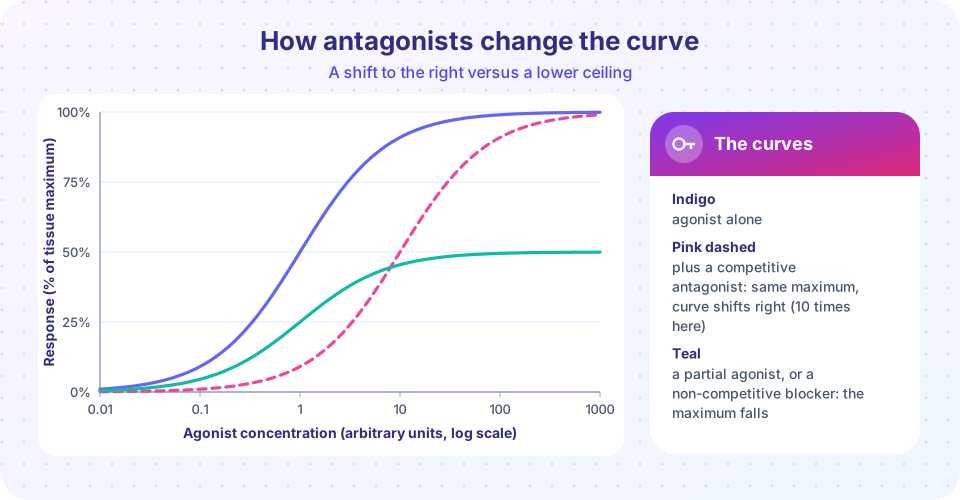
A full agonist produces the maximum response the tissue can give. A partial agonist produces less, even when every receptor is occupied. The difference is called intrinsic efficacy: the full agonist is a strong switch, the partial one a weak switch. In a tissue with many spare receptors, a partial agonist may still give a full response, so "partial" depends on the tissue.
Partial agonists have a surprising property. In the presence of a full agonist, a partial agonist competes for the same receptors, and because it activates them less, it lowers the net response. It acts as an antagonist of the full agonist. This explains why buprenorphine, a partial agonist at the mu-opioid receptor, is used in opioid dependence: it relieves withdrawal and cravings, yet its ceiling effect on breathing is lower than that of full agonists like heroin or methadone, and it can block more powerful opioids. Another example is aripiprazole, a partial agonist at dopamine D2 receptors, which acts as a stabilizer: it raises low dopamine signalling and lowers excessive signalling.
Inverse agonists
Many receptors have a little constitutive activity: they switch on spontaneously, without any ligand. An agonist increases the activity above this baseline. A neutral antagonist blocks the agonist but leaves the baseline unchanged. An inverse agonist binds the receptor and reduces the baseline. Many drugs classified as "antagonists" or "blockers" are in fact inverse agonists. Many modern H1 antihistamines, for example, are best described as inverse agonists at the histamine H1 receptor. The distinction matters most when a receptor is overactive without any natural ligand, for instance because of a mutation.
Competitive antagonists
A competitive antagonist binds reversibly to the same site as the agonist. Agonist and antagonist compete: which one occupies a given receptor at a given instant depends on their concentrations and affinities. With enough agonist, the antagonist can be outcompeted, so the maximum response is restored. This is surmountable antagonism. On the dose-response plot the curve shifts to the right in parallel, with the same ceiling.
With agonist A, antagonist B, and dissociation constants KA and KB, the fraction of receptors occupied by the agonist is:
occupancy by agonist = (A/KA) / (1 + A/KA + B/KB)
The antagonist adds the B/KB term to the denominator, so more agonist is needed for the same occupancy. The factor by which the agonist concentration must rise is the dose ratio:
dose ratio (DR) = 1 + B / KB
At B = KB the dose ratio is 2. At B = 10 KB it is 11. The Schild equation turns this into a straight line: log(DR - 1) = log B - log KB. A plot of log(DR - 1) against log B has a slope of 1 for simple competitive antagonism, and the intercept on the x axis gives KB, a measure of antagonist affinity (also reported as pA2). If the slope is not 1, the antagonism is probably not simple and competitive.
Clinical examples include naloxone at opioid receptors (it reverses an opioid overdose, but lasts less long than many opioids, so respiratory depression can return), atropine at muscarinic receptors, propranolol at beta-adrenergic receptors and flumazenil at the benzodiazepine site.
Irreversible and non-competitive antagonists
An irreversible antagonist forms a covalent bond or dissociates extremely slowly. It removes receptors from the pool. When enough receptors have been lost to fall below the number needed for a maximal response (in tissue with spare receptors, first a rightward shift, then a falling ceiling), increasing the agonist cannot restore the maximum. Phenoxybenzamine at alpha-adrenergic receptors is a classic example, used for example before surgery to remove a tumour that releases adrenaline.
A non-competitive antagonist acts at a different site (an allosteric site) or later in the pathway. It also lowers the maximum, with little shift at first. Ketamine, which blocks the pore of the NMDA receptor channel, is an example of a channel blocker whose action does not depend on competition for the agonist site.
Other kinds of antagonism
- Physiological antagonism. Two drugs act on different receptors with opposite effects on the same function. Adrenaline relaxes airway muscle through beta-2 receptors and reverses the bronchoconstriction caused by histamine in anaphylaxis, though neither drug blocks the other's receptor.
- Chemical antagonism. One substance neutralizes another by direct chemical combination. Protamine binds heparin and reverses it. Antivenoms bind venom proteins. Chelators bind metals.
- Pharmacokinetic antagonism. One drug speeds the removal of another, for example when an enzyme inducer lowers the level of a second drug.
Allosteric modulators and biased agonism
The binding site of the natural messenger is the orthosteric site. An allosteric modulator binds elsewhere and changes how the receptor responds to the orthosteric ligand. A positive allosteric modulator (PAM), such as diazepam at the GABA-A receptor, makes the natural messenger more effective without activating the receptor alone. This can be an advantage: the effect depends on the natural signal, so the effect is limited when the signal is absent, and a ceiling can be built in. Negative allosteric modulators do the opposite.
Receptors can also signal through more than one pathway. A biased agonist activates one pathway more than another, which has encouraged the search for opioid drugs that relieve pain with fewer of the side effects. The idea is attractive, though its clinical value is still being tested.
Common misconceptions
- "An antagonist reduces the receptor's activity." A neutral antagonist does nothing by itself: it only prevents agonists acting. Only inverse agonists reduce baseline activity.
- "Naloxone is a permanent cure for opioid overdose." It competes for receptors and wears off, often sooner than the opioid, so a person must be monitored and may need more doses and emergency care.
- "A partial agonist is just a weak drug." It can be a strong binder with a low ceiling, and in the presence of a full agonist it can behave as an antagonist.
Try it
First, simulate competitive antagonism and construct a Schild plot. The data are generated from the equations above with KB = 10 nM; the line should have a slope of 1 and cross zero near log B = 1 (10 nM).
Press Run (or Ctrl + Enter) to see the result here.
Program input · what you'd type while the program runs
Type the answers before you press Run, one per line. Each time the program reads a line (with input()), it gets the next line from this box.
Second, an interactive tug-of-war. Raise the antagonist concentration, then raise the agonist to overcome it. The bars show the share of receptors held by the agonist, held by the antagonist, and empty. It is a demonstration of the equation, with KA = KB = 10 nM.
Check your understanding
Quick check · 6 questions
of 6 answered You scored / 6 · perfect!
-
1. What does a competitive antagonist do to a dose-response curve?
Because the antagonist can be outcompeted by more agonist, the curve shifts right in parallel and the ceiling is restored. -
2. An antagonist at concentration B = 3 x KB gives a dose ratio of
DR = 1 + B/KB = 1 + 3 = 4. -
3. How does a partial agonist differ from a full agonist?
Partial agonists have lower intrinsic efficacy, so the ceiling is lower. -
4. Which pair is an example of physiological antagonism?
They act on different receptors with opposite effects. Naloxone-morphine is competitive; protamine-heparin is chemical antagonism. -
5. On a Schild plot of simple competitive antagonism, the expected slope is
log(DR - 1) = log B - log KB, which has slope 1. -
6. What is an inverse agonist?
Inverse agonists lower constitutive activity; neutral antagonists do not.
Summary
- Agonists activate, full ones give the maximum and partial ones give less; antagonists bind without activating; inverse agonists lower baseline activity.
- Competitive antagonists shift the curve to the right (dose ratio = 1 + B/KB); irreversible or non-competitive antagonists lower the ceiling.
- A Schild plot has slope 1 for simple competitive antagonism and its intercept gives KB.
- Antagonism can also be physiological or chemical, and allosteric modulators and biased agonists add subtlety.
Track your progress
Create a free account to tick off lessons and pick up where you left off on any device.
of Pharmacology lessons completed