


















Lesson 5 of 48 · Getting Started
Chapter 1 review: getting started
Review chapter 1: the two halves of pharmacology, drug names and classes, and routes of administration, with a one-page recap, a units workbench and a ten-question quiz.
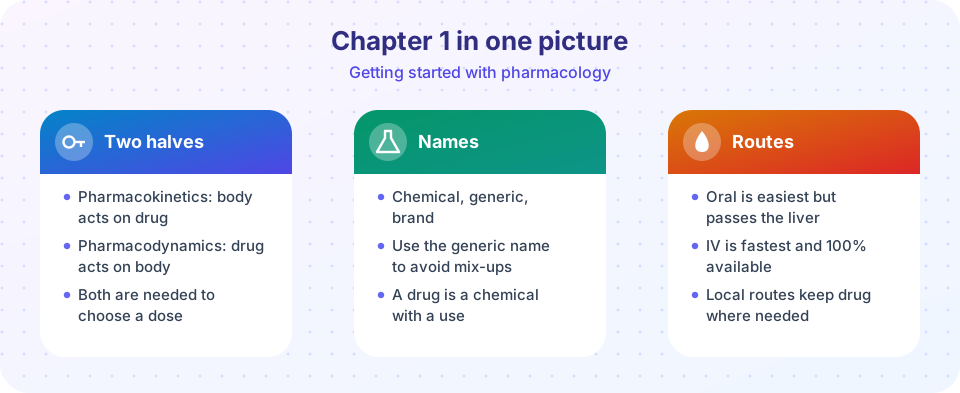
You now have the vocabulary and the map. Before moving into the mechanisms of Chapter 2, this review pulls the whole of Chapter 1 onto one page, gives you a recap table to check against, and lets you practice the unit arithmetic that every later chapter assumes. If any row of the table feels unfamiliar, follow its link back to the lesson.
What you will learn
- A consolidated summary of the main ideas of Chapter 1.
- Which lesson to revisit for each idea.
- How to convert between common units of dose and concentration.
- Whether you can apply the ideas in a ten-question quiz.
Recap table
| Idea | Key facts | Lesson |
|---|---|---|
| Pharmacology | Study of how substances interact with living systems; PK is body acting on drug, PD is drug acting on body | What is pharmacology? |
| History | Paracelsus and the dose; isolation of morphine, aspirin, digoxin; receptor theory (Langley, Ehrlich, Clark); thalidomide led to stricter regulation | What is pharmacology? |
| Names | Chemical, generic (INN) and brand; use the generic name; stems hint at class | Names, sources, classes |
| Sources | Plants, microbes, animals, chemical synthesis, biotechnology; small molecules versus biologics | Names, sources, classes |
| Classification | By use, mechanism, chemistry, body system, or WHO ATC code | Names, sources, classes |
| Routes | Enteral (oral, sublingual, rectal), parenteral (IV, IM, SC, intrathecal), inhaled, topical, transdermal | Routes of administration |
| First pass | Oral drugs pass the liver before the body; sublingual and IV avoid it | Routes of administration |
The ideas in one paragraph
Pharmacology asks what a drug does to the body (pharmacodynamics) and what the body does to the drug (pharmacokinetics). Every drug has a chemical name, an international generic name and brand names, and its stem often reveals its class. Drugs come from plants, microbes, animals, laboratories and living cells, and they can be grouped by use, mechanism or the ATC code. The route of administration decides the speed, the fraction that arrives (bioavailability) and the risk, which is why insulin is injected and glyceryl trinitrate is held under the tongue.
Unit arithmetic you will use everywhere
Most dosing errors are unit errors. Three habits help. Write the unit with every number. Convert to the same unit before you compute. Check that the answer is plausible, for example by comparing it with the usual range for that kind of drug. The key conversions are:
- 1 g = 1,000 mg; 1 mg = 1,000 micrograms (written mcg or µg; spell out "micrograms" on prescriptions to avoid confusion with mg).
- A 1% solution contains 1 g in 100 mL, which is 10 mg per mL.
- A ratio of 1 in 1,000 (1:1000) means 1 g in 1,000 mL, which is 1 mg per mL.
- Concentration times volume gives amount: 2 mg/mL × 5 mL = 10 mg.
Try it
The workbench below converts between these units and checks a few typical calculations. Edit the numbers and predict each result before running.
Press Run (or Ctrl + Enter) to see the result here.
Program input · what you'd type while the program runs
Type the answers before you press Run, one per line. Each time the program reads a line (with input()), it gets the next line from this box.
The second exercise tests whether a calculation is plausible. A tenfold slip in a decimal point is the classic error. The checker below flags any answer outside a range you choose.
Press Run (or Ctrl + Enter) to see the result here.
Program input · what you'd type while the program runs
Type the answers before you press Run, one per line. Each time the program reads a line (with input()), it gets the next line from this box.
Check your understanding
Quick check · 10 questions
of 10 answered You scored / 10 · perfect!
-
1. Pharmacokinetics is best described as
Absorption, distribution, metabolism and excretion are the body's handling of the drug. -
2. Which name should be used when you want to avoid giving two products with the same ingredient?
The generic name reveals the active ingredient, so duplicates are easier to see. -
3. The stem -prazole in omeprazole suggests
-prazole marks proton pump inhibitors, though always verify the class. -
4. Which route avoids first-pass metabolism in the liver and gives 100% bioavailability?
The drug goes directly into the blood stream. -
5. How many mg per mL are in a 1% solution?
1% means 1 g in 100 mL = 1,000 mg / 100 mL = 10 mg/mL. -
6. A 1:1000 solution contains how much drug per mL?
1 g in 1,000 mL equals 1 mg per mL. -
7. Why are large protein drugs usually injected?
Proteins are digested in the gut, so oral absorption is poor. -
8. Which classification is based on how a drug works at a molecular level?
Mechanism-based classes, such as beta-blockers or statins, describe the molecular target. -
9. Which route would be most appropriate to treat a sudden asthma attack with minimal body-wide exposure?
An inhaler delivers the drug straight to the airways, with fast onset and a small systemic dose. -
10. In the ATC code A10BA02 for metformin, the first letter A stands for
A is the anatomical main group for the alimentary tract and metabolism; A10 covers drugs used in diabetes.
Summary
- Pharmacology splits into pharmacokinetics (the body acts on the drug) and pharmacodynamics (the drug acts on the body).
- Use generic names, learn the common stems, and remember the five sources and several classification schemes.
- The route sets speed, bioavailability and risk; IV and sublingual avoid first pass.
- Careful unit conversion and plausibility checks prevent most dosing errors.
Track your progress
Create a free account to tick off lessons and pick up where you left off on any device.
of Pharmacology lessons completed