


















Lesson 44 of 48 · Projects and Practice
Case studies and practice problems
Reason through six invented drug scenarios with the five-step method, then check your understanding with seven numerical problems on half-life, dosing, NNT and the therapeutic index.
A good way to find out whether you understand a drug is to meet it in a situation. The six cases below are invented composites, written to bring together ideas from earlier chapters. For each one, stop after the scenario and try to answer in your own words using the five questions: target, effect, kinetics, safety, monitoring. Then read the model reasoning. After the cases come seven numerical problems with answers, and the code on this page checks every one of them.
Educational information only. These cases are fictional. The answers describe how pharmacologists reason and are not instructions for any real person. Real prescribing needs the full history, current measurements and a qualified clinician.
What you will learn
- Apply the five-step method to realistic scenarios.
- Recognize interaction and kinetic patterns that recur in practice.
- Solve basic numerical problems with half-life, volume of distribution, clearance and risk.
Key terms
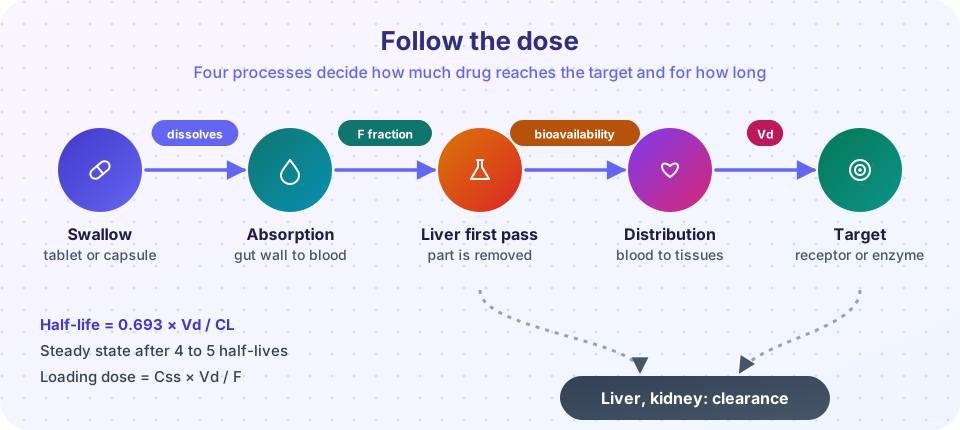
First-pass metabolism: removal of part of an oral dose by the gut wall and liver before it reaches the circulation.
Bioavailability (F): the fraction of a dose that reaches the bloodstream unchanged.
Volume of distribution (Vd): the apparent volume in which a drug is dissolved, equal to the amount in the body divided by the plasma concentration.
Clearance (CL): the volume of blood cleared of drug per unit time.
Therapeutic index: the ratio of the dose that causes toxicity to the dose that gives benefit.
Six cases
Case 1: a crowded medicine cabinet
A 70-year-old takes low-dose aspirin since a heart attack, ibuprofen for knee pain and sertraline for low mood. She develops stomach pain and unusual tiredness.
Think first: Which of the three drugs could contribute to bleeding in the gut, and how?
Model reasoning. Target and effect: aspirin irreversibly blocks COX-1 in platelets (less thromboxane A2) and in the stomach lining, where prostaglandins normally protect the mucosa. Ibuprofen also blocks COX-1, which removes more of that protection. Sertraline blocks the serotonin transporter, and platelets rely on serotonin uptake, so platelet function is slightly impaired. Each drug adds to bleeding risk through a different route, a pharmacodynamic interaction. Kinetics: aspirin's effect lasts the platelet's life of about a week, so stopping it does not remove its effect for days. Ibuprofen can also compete with aspirin at COX-1 and weaken its antiplatelet effect when taken first, a known interaction. Safety and monitoring: a clinician would check hemoglobin for anemia and review whether all three drugs are needed. Options include a non-NSAID painkiller such as paracetamol for the knee, or adding stomach protection with a proton pump inhibitor when an NSAID or aspirin is necessary.
Case 2: a fall in the bathroom
A 78-year-old man takes a thiazide diuretic for blood pressure, and his doctor adds an alpha-1 blocker for difficulty passing urine. A week later he feels dizzy on standing and falls.
Think first: Why does standing up matter here?
Model reasoning. On standing, blood pools in the legs and the baroreflex constricts vessels through sympathetic α1 receptors. An α1 blocker impairs that response and the thiazide reduces blood volume, so pressure drops on standing (postural hypotension). Age blunts the baroreflex further. This is a type A reaction: an exaggeration of the drugs' pharmacology, especially around the first doses. Monitoring includes lying and standing blood pressure. The clinician may change the regimen or dose timing. The lesson is that every new drug in an older person should be considered in the context of what they already take.
Case 3: the tickle that will not go away
A 55-year-old starts ramipril. After three weeks he has a dry, irritating cough that is worse at night. No infection is found.
Think first: What does ACE normally do besides making angiotensin II?
Model reasoning. ACE also breaks down bradykinin, so ACE inhibitors raise bradykinin, which is linked to the cough, a class effect. Switching to an angiotensin receptor blocker such as losartan keeps the RAAS blockade without raising bradykinin, so cough is much less likely. The patient should never stop the drug on his own, since uncontrolled blood pressure is also harmful. Angioedema, swelling of the lips or tongue, comes from the same mechanism and needs urgent attention.
Case 4: tremor and unsteadiness on lithium
A woman who has taken lithium for years for bipolar disorder starts taking ibuprofen for a painful back. Over a week she develops a hand tremor, nausea and unsteadiness.
Think first: What do lithium and sodium have in common in the kidney?
Model reasoning. The kidney handles lithium like sodium, and NSAIDs reduce renal blood flow and the excretion of lithium. At steady state, the level is the dosing rate divided by clearance, so a drop in clearance of a quarter raises the level by a third. Lithium has a narrow therapeutic index, so this can push a patient into toxicity, with tremor, vomiting and ataxia. Thiazides, ACE inhibitors and dehydration act the same way. The fix is prevention: avoid the interacting drug, use a safer pain relief, and measure lithium levels after any change.
Case 5: aching muscles after an antibiotic
A man who has taken simvastatin for years is given clarithromycin for a chest infection. Ten days later he has severe muscle pain and dark urine.
Think first: Which liver enzyme clears simvastatin, and what does clarithromycin do to it?
Model reasoning. Simvastatin is cleared mostly by CYP3A4, and clarithromycin inhibits CYP3A4, so simvastatin levels climb several-fold. High statin exposure can cause muscle breakdown (rhabdomyolysis), with myoglobin darkening the urine and endangering the kidneys. The effect is dose-related, so it is a type A reaction produced by a pharmacokinetic interaction. Prescribers usually avoid the combination, choose an antibiotic with little CYP3A4 inhibition such as azithromycin, or pause the statin. Muscle pain with dark urine needs urgent assessment.
Case 6: the tablets that stopped working
A woman who takes warfarin with a stable INR is started on a long course of rifampicin for tuberculosis. Her INR falls well below target within two weeks.
Think first: What does rifampicin do to liver enzymes, and what will happen when it is stopped?
Model reasoning. Rifampicin induces CYP enzymes, speeding up warfarin clearance, so the same dose now gives a lower level and less anticoagulation, with a risk of clots. The dose must be raised, with frequent INR checks. Induction takes days to build and also fades over weeks after the inducer is stopped. If the warfarin dose is not reduced at that time, the INR will overshoot and bleeding becomes a risk. Offset kinetics matter as much as onset.
Seven practice problems
Try each by hand before you run the code. Use the half-life relationships from chapter 3.
- Dilution. A 200 mg intravenous dose is given to a person in whom the drug's volume of distribution is 50 L. What is the starting concentration? If the half-life is 4 hours, what is the concentration after 12 hours?
- Loading and maintenance. To reach a target steady-state concentration of 10 mg/L with Vd = 40 L and clearance = 5 L/h, find the loading dose and the maintenance rate when bioavailability is 1, and then 0.5.
- Half-life and steady state. A drug has Vd = 70 L and CL = 3.5 L/h. What is its half-life, and about how long to steady state?
- NNT. The event rate is 12 percent in the control group and 9 percent in the treated group. Find the relative risk reduction, absolute risk reduction and NNT.
- Interaction. A drug at steady state has a level of 0.8 mmol/L. An interacting drug reduces its clearance by 25 percent. What is the new level?
- Therapeutic index. Drug A has TD50 = 60 mg and ED50 = 5 mg. Drug B has TD50 = 12 mg and ED50 = 4 mg. Compute each therapeutic index and say which needs closer monitoring.
- Dose-response. For a full agonist with ED50 = 2 and Emax = 100 percent, what is the response at a dose of 6? If a competitive antagonist produces a dose ratio of 3, what is the response at the same dose?
Common misconceptions
"Interactions are rare." In older adults taking several drugs they are common, and many are predictable from the mechanism, as these cases show.
"If I stop an interacting drug, the interaction ends at once." Inhibition and induction fade over days to weeks, and the effect on drug levels follows that schedule.
"A calculation gives the dose." It gives an estimate. Real patients differ in clearance and volume, and doses are adjusted by response and measured levels.
Try it
First, the answers to all seven problems, computed in code. Compare each with your own working.
Press Run (or Ctrl + Enter) to see the result here.
Program input · what you'd type while the program runs
Type the answers before you press Run, one per line. Each time the program reads a line (with input()), it gets the next line from this box.
Second, a practice generator. It makes random half-life problems so that you can rehearse the "number of half-lives" arithmetic. Type your answer in mg/L and press Check.
Check your understanding
Quick check · 5 questions
of 5 answered You scored / 5 · perfect!
-
1. Why does ibuprofen added to aspirin and an SSRI raise bleeding risk?
Aspirin and ibuprofen block COX-1 and weaken the gastric lining and platelets, while SSRIs impair platelet function. -
2. Why can stopping rifampicin cause bleeding in a patient taking warfarin?
Clearance returns toward normal over weeks, so the previously raised dose becomes too high. -
3. For a drug with a half-life of 4 hours, how much remains after 12 hours?
12 hours is three half-lives, and 0.5 cubed is one eighth. -
4. Which has the narrower therapeutic margin: TI = 12 or TI = 3?
A smaller therapeutic index means the toxic dose is closer to the effective dose. -
5. Clarithromycin raises simvastatin levels by:
Inhibition of the clearing enzyme raises exposure.
Summary
- The five-step method works on real scenarios: find the target, the effect, the kinetics, the safety issue and the monitoring.
- Common patterns are additive pharmacodynamic effects, CYP inhibition raising levels, CYP induction lowering them (and fading after stopping), and clearance falling in older people.
- Half-life, volume of distribution and clearance link in simple formulas: C0 = dose / Vd, t½ = 0.693 Vd / CL, load = Css Vd / F.
Track your progress
Create a free account to tick off lessons and pick up where you left off on any device.
of Pharmacology lessons completed