


















Lesson 33 of 48 · Anti-Infective and Cancer Drugs
Chapter 7 overview: anti-infective and cancer drugs
Why antibiotics can kill bacteria without killing us, why cancer is harder, and a map of chapter 7 covering antibacterials, antivirals, antifungals, antiparasitics and chemotherapy.
Most drugs help a patient by nudging the patient's own physiology: lowering a blood pressure, quieting a neuron. Anti-infective drugs and cancer drugs are different. Their purpose is to kill or stop an enemy living inside the patient: a bacterium, a virus, a fungus, a parasite, or a tumor made of the patient's own mutated cells. The central problem is the same in every case. The drug must hurt the enemy much more than it hurts the host, a property called selective toxicity.
The idea goes back to Paul Ehrlich, who in the early 1900s dreamed of a "magic bullet" that would seek out a germ and spare the body. His team's arsenic compound salvarsan, introduced in 1910, was an early, imperfect attempt against syphilis. Gerhard Domagk's sulfonamide dye prontosil followed in 1935, Alexander Fleming noticed the antibacterial mold in 1928, and Howard Florey and Ernst Chain turned penicillin into a usable drug in the early 1940s. Since then, the story has been a race between new drugs and the evolution of resistance.
Educational information only. This chapter explains how anti-infective and cancer drugs work. It does not tell anyone how to treat an infection or cancer. Never use leftover antibiotics or share them, and do not change a prescribed course without advice.
What you will learn
- Explain selective toxicity and why it is easier for bacteria than for cancer.
- Name the main targets of antibacterial, antiviral, antifungal and antiparasitic drugs.
- Describe why resistance is inevitable and what slows it.
- See how the lessons of this chapter fit together.
The chapter at a glance
Selective toxicity
The gap is the therapeutic window.
Bacteria
Lesson 2
Viruses, fungi, parasites
Lesson 3
Cancer
Lesson 4
Where each lesson fits
- Antibiotics: mechanisms and resistance: the major classes, how each kills or stops bacteria, how doses are chosen, and how resistance spreads.
- Antivirals, antifungals and antiparasitics: drugs for herpes, flu, HIV and hepatitis C, fungal infections, and malaria and worms.
- Cancer chemotherapy and targeted drugs: cytotoxic drugs, the log-kill idea, kinase inhibitors, antibodies and immunotherapy.
- Chapter 7 review: a summary picture and ten questions.
Why bacteria are easier than cancer
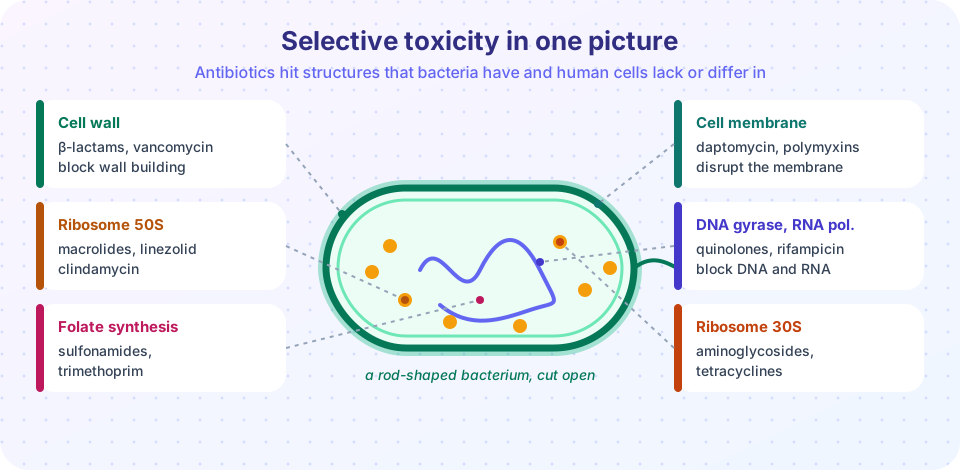
A bacterium is a different kind of cell from ours. It has a peptidoglycan wall, a layer that human cells simply lack, so a drug that blocks wall building can kill bacteria and leave our cells alone. Bacteria have 70S ribosomes while ours are 80S, so a drug can bind one and not the other. They make their own folate, which we get from food, so inhibitors of the bacterial pathway are harmless to us. These are all real differences, and penicillin's remarkable safety in people without allergy rests on the first one.
A virus hijacks our own cells, so there is less to aim at. The best antivirals attack viral enzymes that have no human counterpart, such as the neuraminidase of influenza or the reverse transcriptase of HIV. A fungus is a eukaryote like us, so the differences are smaller (its membrane uses ergosterol where ours uses cholesterol), and antifungal drugs have a narrower margin. A parasite may be a whole animal, such as a worm, which gives drug designers more to work with, or a single-celled eukaryote, which gives them less.
Cancer is the hardest case, because every cancer cell is derived from the patient's own cells. Classic chemotherapy exploits the fact that cancer cells divide faster than most normal cells, but this is a matter of degree, so bone marrow, hair follicles and the gut lining are also hit. Newer drugs aim at proteins that are mutated or overactive in cancer, such as the BCR-ABL kinase in chronic myeloid leukemia, and at the immune system's response to tumors. The more a drug depends on a feature found only in the tumor, the better its selectivity.
The one rule that links the chapter
Pathogens and tumors evolve. Any large population of bacteria, viruses or cancer cells contains rare variants that happen to survive a drug. If the drug is applied, it removes the sensitive cells and the resistant ones take over. This is natural selection occurring in a patient, in a hospital or in a whole country. Strategies to slow it appear in every lesson: use drugs only when needed, give enough drug to kill rather than merely stress, combine drugs with different targets (tuberculosis, HIV and malaria treatment all do this), and keep new drugs in reserve.
Common misconceptions
"Antibiotics work against colds and flu." Antibiotics act on bacteria. Colds and flu are caused by viruses, so antibiotics do nothing for them and expose the patient to side effects and resistance.
"Resistance means the body has become resistant to the drug." The bacteria, not the person, become resistant. A resistant bacterium can infect anyone.
"Chemotherapy poisons the whole body equally." It acts mainly on dividing cells, which is why fast-turnover tissues are affected, though many chemotherapy drugs affect other organs too.
Try it
First, a picture of the therapeutic window. Each drug has a dose-response curve for killing the target and another for harming the host. The gap between them is what makes treatment possible. The curves below are illustrative and not measured.
Press Run (or Ctrl + Enter) to see the result here.
Program input · what you'd type while the program runs
Type the answers before you press Run, one per line. Each time the program reads a line (with input()), it gets the next line from this box.
Second, a target lookup: choose an enemy and see what is different about it that a drug can exploit. It is a summary tool and leaves out many details.
Check your understanding
Quick check · 5 questions
of 5 answered You scored / 5 · perfect!
-
1. Why is penicillin relatively safe for people without an allergy?
Selective toxicity: the target (cell wall building) is absent from human cells. -
2. Which is harder to treat selectively?
Cancer cells derive from the patient's own cells, so there are fewer unique targets. -
3. Who becomes resistant to an antibiotic?
Resistance is a property of the microbes, selected by exposure to the drug. -
4. Tuberculosis, HIV and malaria are treated with several drugs together mainly to:
A microbe resistant to several drugs at once is far rarer than one resistant to a single drug. -
5. Why do antifungal drugs generally have a narrower safety margin than antibacterials?
The closer the biochemistry of the pathogen to ours, the harder selective toxicity becomes.
Summary
- Selective toxicity means hurting the enemy far more than the host; it depends on a difference to exploit.
- Bacteria offer many targets (wall, 70S ribosome, folate, gyrase), viruses and fungi fewer, and cancer cells fewest.
- Pathogens and tumors evolve resistance, so drugs are combined, used sparingly and monitored.
- Chapter 7 covers antibacterials, antivirals, antifungals and antiparasitics, and cancer drugs, in that order.
Track your progress
Create a free account to tick off lessons and pick up where you left off on any device.
of Pharmacology lessons completed