


















Lesson 25 of 48 · Autonomic and Cardiovascular Drugs
Drugs for high blood pressure and heart failure
How thiazides, ACE inhibitors, ARBs, calcium channel blockers and beta-blockers lower blood pressure, how the RAAS works, and the four pillars of heart failure treatment.
High blood pressure is the most common long-term condition treated with drugs. It rarely causes symptoms, yet over years it damages arteries, the heart, the kidneys and the brain, and it is one of the leading causes of stroke and heart attack worldwide. Because the person usually feels fine, the main job of the drug is prevention: it is judged not by how the patient feels but by how many strokes, heart attacks and hospital stays do not happen. This lesson explains the equation that every blood pressure drug works on, the hormone system most of them target, and the main drug classes with their characteristic side effects. It ends with heart failure, where several of the same drugs save lives in a different way.
Educational information only. The classes and examples below describe how drugs work, not what any person should take. Blood pressure treatment is chosen by a clinician using measurements, other conditions, other medicines and pregnancy status.
What you will learn
- Use
BP = cardiac output × total peripheral resistanceto place each drug class. - Describe the RAAS and the three ways to interrupt it.
- Match the major antihypertensive classes with their typical side effects.
- Explain the four drug groups that improve survival in heart failure with reduced ejection fraction.
Key terms
Mean arterial pressure (MAP): the average pressure driving blood through the tissues, about diastolic pressure plus one third of the pulse pressure.
Total peripheral resistance (TPR): how much the small arteries resist flow; narrower vessels raise it.
RAAS: the renin-angiotensin-aldosterone system, a hormone chain that raises blood pressure and keeps salt and water.
Ejection fraction: the share of blood in the left ventricle that is pumped out with each beat; low in heart failure with reduced ejection fraction.
Postural hypotension: a drop in pressure on standing that causes dizziness.
The equation behind every drug
Blood pressure is the product of how much blood the heart pumps per minute (cardiac output) and how much the arterial tree resists that flow (total peripheral resistance):
MAP ≈ cardiac output × TPR
Cardiac output itself is heart rate times stroke volume, and stroke volume depends on blood volume and the force of the beat. So there are only a few ways to lower pressure: reduce the volume in the circulation (diuretics), reduce the rate and force of the heart (beta-blockers, verapamil), or widen the resistance vessels (vasodilators, RAAS blockers, calcium channel blockers, alpha-blockers). The classes below are really answers to that question.
How high is too high? Guidelines differ. Some define hypertension in a clinic as 140/90 mmHg or above, while the 2017 American guidelines use 130/80 mmHg. The SPRINT trial, published in 2015, found that in high-risk adults without diabetes, aiming for a systolic pressure below 120 mmHg led to fewer cardiovascular events than aiming for below 140, with more side effects such as low blood pressure and kidney injury. Debates about targets continue, but the principle that lower pressures prevent events is well supported.
The RAAS: a hormone chain with four drug targets
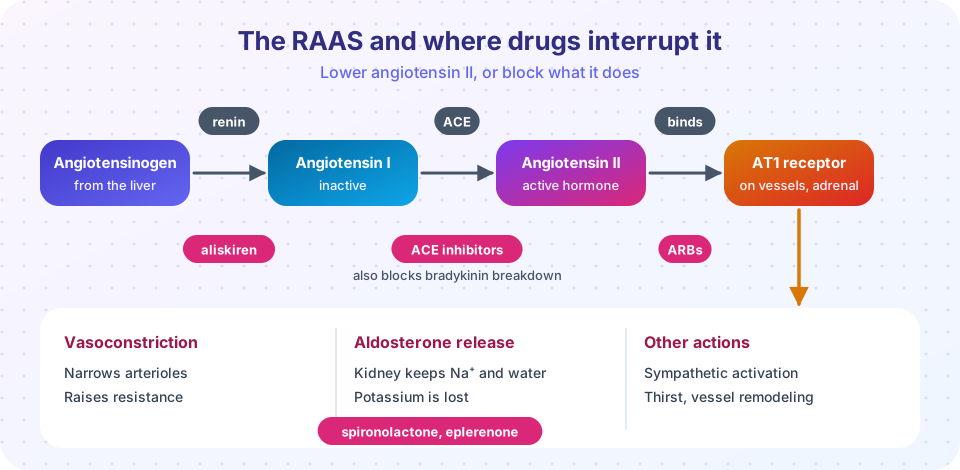
When blood pressure or blood sodium falls, the kidney releases the enzyme renin. Renin cuts the liver protein angiotensinogen into the inactive angiotensin I. Angiotensin-converting enzyme (ACE), found mainly on the lining of lung blood vessels, converts angiotensin I to angiotensin II. Angiotensin II acts on the AT1 receptor to narrow arterioles, trigger release of aldosterone from the adrenal cortex, increase thirst and strengthen sympathetic activity. Aldosterone makes the kidney keep sodium and water and lose potassium.
That gives four sites for drugs:
- Aliskiren blocks renin directly; it is rarely used.
- ACE inhibitors (the "-pril" drugs: ramipril, lisinopril, enalapril) lower angiotensin II. Because ACE also breaks down the peptide bradykinin, these drugs raise bradykinin. This explains two characteristic effects: a dry cough in a noticeable minority of patients, and, rarely, angioedema, swelling of the lips, tongue and throat that can be dangerous.
- Angiotensin receptor blockers, or ARBs (the "-sartan" drugs: losartan, valsartan, candesartan), block the AT1 receptor. They do not alter bradykinin, so cough is much less common. They are a standard alternative when an ACE inhibitor causes cough.
- Mineralocorticoid receptor antagonists (spironolactone, eplerenone) block aldosterone's receptor.
ACE inhibitors and ARBs share some cautions because they share the pathway. They can raise blood potassium (because aldosterone is reduced), they can cause a rise in creatinine when the kidney depends on angiotensin II to hold up filtration pressure, and they are contraindicated in pregnancy because they harm fetal kidney development. They protect the kidney in people with diabetes and protein in the urine, which is one reason they are often chosen for that group. Combining an ACE inhibitor with an ARB is not recommended: large trials such as ONTARGET found more adverse effects without added benefit.
The main classes
Thiazide and thiazide-like diuretics (hydrochlorothiazide, chlorthalidone, indapamide) block the sodium-chloride cotransporter in the distal convoluted tubule of the kidney. At first they lower blood volume, and with long use they also lower peripheral resistance. Typical problems are low potassium and sodium, a rise in uric acid that can provoke gout, small increases in blood sugar and, through a different mechanism, higher blood calcium. The ALLHAT trial in 2002 found that the thiazide-like drug chlorthalidone did at least as well as an ACE inhibitor and a calcium channel blocker for the main outcome and was better at preventing heart failure. Loop diuretics such as furosemide act on a different transporter in the thick ascending limb and produce much larger urine volumes; they are used for fluid overload rather than routine blood pressure control. Spironolactone is a potassium-sparing diuretic, so low potassium is not the problem; high potassium is.
Calcium channel blockers block L-type calcium channels. The dihydropyridines (amlodipine, nifedipine) act mostly on the smooth muscle of arterioles and lower resistance; ankle swelling, flushing and headache are the common effects, and the swelling is a result of vessel widening, not of heart failure. The non-dihydropyridines (verapamil and diltiazem) act on the heart, slow the atrioventricular node and weaken contraction. They are used for rate control in atrial fibrillation and should not be combined casually with beta-blockers because both slow conduction. Verapamil is well known for causing constipation.
Beta-blockers lower cardiac output, reduce renin release and slow the heart. In uncomplicated hypertension they are no longer first choice in many guidelines, but they remain central after a heart attack, in angina and in heart failure. Alpha-blockers, central α2 agonists and direct vasodilators (hydralazine, minoxidil) are used as add-ons; some are used in pregnancy, where labetalol, nifedipine and methyldopa have long safety records while ACE inhibitors and ARBs are avoided.
Most people with hypertension need more than one drug. Adding a second drug from a different class usually lowers pressure more than doubling the dose of the first, and single-pill combinations make daily use easier. Missing doses is the commonest reason for treatment failure, which is why simple regimens matter.
Heart failure: the four pillars
In heart failure with reduced ejection fraction, the heart cannot pump enough blood. The body responds with sympathetic and RAAS activation, which helps in the short term and damages the heart over months. Four drug groups block that harmful response and have each been shown to reduce death and hospital admission:
- An ACE inhibitor, an ARB, or sacubitril/valsartan. Sacubitril blocks neprilysin, an enzyme that breaks down natriuretic peptides, which help the body shed salt and relax vessels. In the PARADIGM-HF trial the combination reduced the risk of cardiovascular death or hospitalization compared with enalapril. It must not be taken with an ACE inhibitor because the combination raises the risk of angioedema.
- A beta-blocker with proven benefit (bisoprolol, carvedilol or metoprolol succinate), started at a low dose and raised slowly. This seems odd because beta-blockers weaken the heartbeat. Over months they protect the heart from constant adrenaline stimulation and improve its function.
- A mineralocorticoid receptor antagonist (spironolactone or eplerenone), with blood potassium checked regularly.
- An SGLT2 inhibitor (dapagliflozin or empagliflozin). Originally diabetes drugs, they reduce hospitalization for heart failure even in people without diabetes. The exact mechanism is still debated.
Loop diuretics relieve breathlessness and swelling by removing fluid but have not been shown to prolong life. Digoxin raises the force of contraction by blocking the sodium-potassium pump. It has a narrow therapeutic index: toxicity causes nausea, visual disturbance and arrhythmias, and low potassium makes it worse. This theme, a narrow gap between a helpful and a harmful dose, returns in chapter 8.
Common misconceptions
"Blood pressure tablets can be stopped once the numbers are normal." The numbers are normal because of the drug. Stopping usually lets the pressure return.
"Ankle swelling on amlodipine means heart failure." It is a local effect of arteriole dilation raising pressure in the capillaries. It is common and can be reduced by combining the drug with an ACE inhibitor or ARB.
"Beta-blockers are dangerous in heart failure because they weaken the heart." Started slowly in a stable patient they improve survival. They are harmful only when given in large doses to an unstable patient.
Try it
First, a picture of the equation. The contour map shows mean arterial pressure for different combinations of cardiac output and resistance. The arrows show where different drug classes push a patient. The arrows are illustrative directions, not measured effects.
Press Run (or Ctrl + Enter) to see the result here.
Program input · what you'd type while the program runs
Type the answers before you press Run, one per line. Each time the program reads a line (with input()), it gets the next line from this box.
Second, a side-effect matcher for revision. Choose a symptom and see which class is a likely culprit and why. It is a study aid for learning the mechanisms, not a way to diagnose a drug reaction.
Check your understanding
Quick check · 5 questions
of 5 answered You scored / 5 · perfect!
-
1. Which drug class is most likely to cause a dry cough?
ACE inhibitors raise bradykinin, which is linked to cough. ARBs do not affect bradykinin breakdown. -
2. Which pair of drugs should NOT be taken together because of the risk of angioedema?
Blocking both neprilysin and ACE leaves bradykinin unchecked, and angioedema becomes much more likely. -
3. Spironolactone is classed as potassium-sparing. Which problem does that make more likely?
By blocking aldosterone, it reduces potassium loss in the kidney, so blood potassium can rise. -
4. According to the equation MAP = cardiac output × resistance, which action lowers pressure by reducing resistance?
Amlodipine relaxes arteriolar smooth muscle and lowers total peripheral resistance. -
5. Which is one of the four pillars of treatment for heart failure with reduced ejection fraction?
SGLT2 inhibitors, together with RAAS/ARNI drugs, evidence-based beta-blockers and mineralocorticoid antagonists, reduce hospitalization and death.
Summary
- Blood pressure equals cardiac output times resistance; every drug class lowers one of those terms.
- ACE inhibitors, ARBs, aliskiren and spironolactone interrupt the RAAS at different points; ACE inhibitors raise bradykinin, which explains cough and angioedema.
- Thiazides, calcium channel blockers and beta-blockers have class-specific side effects that follow from their mechanisms.
- Heart failure with reduced ejection fraction is treated with four survival-improving drug groups, and loop diuretics relieve congestion.
Next: Antithrombotic, lipid-lowering and antiarrhythmic drugs
Track your progress
Create a free account to tick off lessons and pick up where you left off on any device.
of Pharmacology lessons completed