


















Lesson 29 of 48 · Central Nervous System Drugs
Pain, opioids and anesthesia
Follow the pain pathway from injury to brain and see how NSAIDs, paracetamol, opioids, local anesthetics and general anesthetics each interrupt it, with their risks.
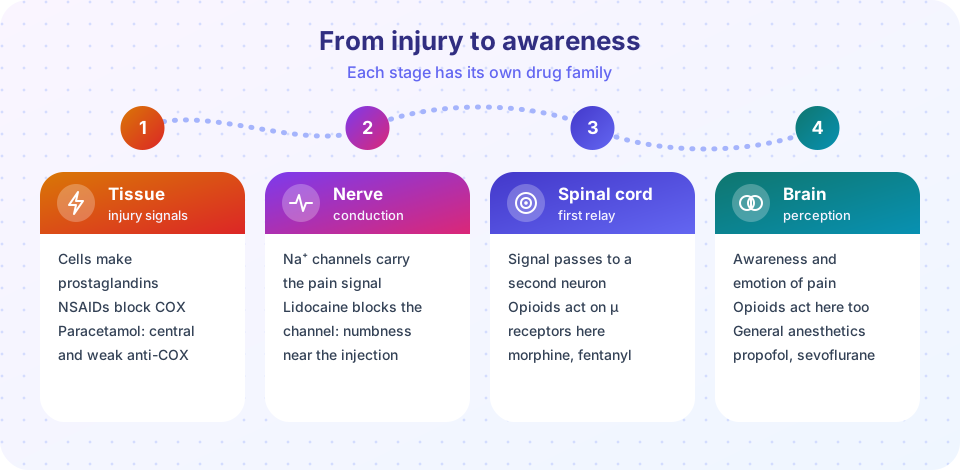
Pain is a warning system, and it is also a medical problem in its own right. A person with a broken leg needs relief within minutes. A surgeon needs the patient unconscious and still. A person with long-term cancer pain needs relief that lasts for months. Different drugs solve these problems by acting at different points along the same pathway, and their risks differ just as much as their benefits. This lesson follows the signal from the damaged tissue to the brain and shows where each drug family intervenes.
Educational information only. Dosing, combining and stopping pain medicines, especially opioids, is a clinical decision. If you or someone near you has taken too much of any sedating drug, treat it as an emergency and call your local emergency number.
What you will learn
- Trace the pain signal from nociceptor to cortex and name the drug target at each stage.
- Explain how NSAIDs and paracetamol work, and the toxicities that follow from their mechanisms.
- Describe how opioids act at mu receptors, which effects develop tolerance and which do not, and how naloxone works.
- Explain how local and general anesthetics produce numbness and unconsciousness.
Key terms
Nociceptor: a sensory nerve ending that responds to damaging stimuli.
Opioid: any drug that acts on opioid receptors; includes morphine and fentanyl.
Partial agonist: a drug that activates a receptor but cannot produce the full maximal response, even at high doses.
Multimodal analgesia: using several drug types with different mechanisms together.
MAC: minimum alveolar concentration, the concentration of an inhaled anesthetic that prevents movement to a surgical incision in half of patients; a measure of potency.
The pain pathway
When tissue is damaged, injured cells release chemicals: prostaglandins, bradykinin, hydrogen ions and others. These make nociceptors more sensitive, which is why a bruise hurts to touch. Two types of nerve fiber carry the signal. Thin myelinated A-delta fibers carry sharp, fast pain, and unmyelinated C fibers carry the dull, burning pain that follows. Both end in the dorsal horn of the spinal cord, where they release glutamate and a peptide called substance P onto second-order neurons. Those neurons cross to the opposite side and ascend to the thalamus and then to the cortex, where the signal becomes a conscious experience with an emotional tone.
The system is not a one-way wire. In 1965 Ronald Melzack and Patrick Wall proposed the gate control theory: signals in the dorsal horn are modulated by other fibers and by descending pathways from the brain. A brainstem region called the periaqueductal gray sends signals down the cord that release the body's own opioids, the endorphins and enkephalins. This explains why rubbing a bumped elbow helps, why athletes sometimes feel no pain during a game, and why opioid drugs are so effective.
Anti-inflammatory and non-opioid analgesics
NSAIDs (non-steroidal anti-inflammatory drugs) such as ibuprofen, naproxen and diclofenac block the enzymes cyclooxygenase-1 and -2 (COX-1 and COX-2). These enzymes make prostaglandins, which sensitize nociceptors and cause inflammation and fever. Blocking them reduces all three. The same mechanism explains the side effects. COX-1 makes prostaglandins that protect the stomach lining and support blood flow in the kidney and platelet function. Blocking it raises the risk of stomach ulcers and bleeding, and of kidney injury in people who are dehydrated or already have kidney disease. NSAIDs can also raise blood pressure and, with long use, the risk of heart attack and stroke. Selective COX-2 inhibitors (celecoxib) were designed to spare the stomach. The rofecoxib story is a classic caution: it was withdrawn worldwide in 2004 after a trial showed more cardiovascular events than placebo. NSAIDs are avoided late in pregnancy, and some people with asthma react badly to aspirin.
Paracetamol (acetaminophen) relieves pain and reduces fever but has little anti-inflammatory effect. How it works is still debated; it probably acts partly in the brain and spinal cord on COX and other pathways. What is well understood is its main danger. In the liver, a small fraction of each dose is turned into a reactive metabolite called NAPQI, which is normally neutralized by glutathione. In an overdose, glutathione runs out, NAPQI binds to liver proteins and liver cells die. Liver damage may not appear for a day or more, when it is harder to treat, so any overdose is treated as an emergency. The antidote N-acetylcysteine replenishes glutathione and works best when given early.
Opioids
Opium from the poppy has been used for thousands of years. Friedrich Sertürner isolated morphine from it in the early 1800s. The brain has its own opioid system with three receptor families, mu (μ), delta (δ) and kappa (κ). Most clinically important opioids act on the mu receptor. It is a G-protein-coupled receptor linked to Gi: activation lowers cyclic AMP, opens potassium channels and closes calcium channels. The net effect is that neurons become harder to fire and release less neurotransmitter. In the spinal cord this reduces transmission of pain signals, and in the brain it activates the descending pain-control pathway and changes the emotional response to pain.
The same receptors are found elsewhere, which produces the typical side effects:
- Respiratory depression: the brainstem becomes less sensitive to carbon dioxide, so breathing slows. This is the main cause of death in overdose.
- Miosis: pinpoint pupils, a useful clinical sign.
- Constipation, from mu receptors in the gut wall.
- Nausea and vomiting, itching, sedation and euphoria, which underlies the risk of misuse.
- Cough suppression, used therapeutically with codeine.
Tolerance develops to the analgesia, euphoria, nausea and respiratory depression, but it develops little or not at all to constipation and pinpoint pupils. This is one reason the safe margin can narrow: a person who has lost tolerance during a period of abstinence may take a dose that used to be comfortable and stop breathing.
The family contains many drugs. Morphine is the standard. Codeine is a prodrug that the liver enzyme CYP2D6 converts to morphine, so people with an ultra-rapid CYP2D6 variant can receive a dangerous amount, and poor metabolizers receive little benefit. Fentanyl is roughly 50 to 100 times more potent than morphine by weight, and the tiny amounts involved are why contamination of street drugs with fentanyl has driven overdose deaths. Methadone has a long and variable half-life and is used in addiction treatment. Buprenorphine is a partial agonist at the mu receptor: it activates it less fully, so its effect on breathing reaches a ceiling, which makes it safer in overdose, although not risk free. It is used for pain and in opioid use disorder.
Naloxone is a competitive mu antagonist with a high affinity. Given by injection or nasal spray, it can reverse an opioid overdose within minutes. Because its action lasts for roughly 30 to 90 minutes, shorter than that of many opioids, a person can sink back into respiratory depression, so observation and calling for help continue after the first dose.
The public-health lesson is a balanced one. Opioids are essential for severe acute pain, cancer pain and palliative care, and the World Health Organization's analgesic ladder, first published in 1986, gave a framework for using them. The widespread marketing of long-acting opioids in the 1990s, together with the belief that addiction was rare in patients with pain, contributed to a wave of prescription opioid misuse and later heroin and fentanyl deaths. Today there is little good evidence that long-term opioids improve function in chronic non-cancer pain, and many guidelines advise caution, non-drug approaches and the lowest effective dose.
Local anesthetics
A dentist's injection of lidocaine stops pain without any loss of consciousness. Local anesthetics block voltage-gated sodium channels inside the nerve fiber, so no action potential can travel. The drug enters as an uncharged base, which can cross the membrane, and then picks up a hydrogen ion in the cell to become the charged form that blocks the channel. Small, lightly myelinated fibers are blocked first, so pain and temperature go before touch and movement. Adding epinephrine constricts local vessels, which keeps the drug in place longer and reduces bleeding. In infected tissue the local pH is low, more of the drug is in the charged form outside the cell and less crosses, which is a reason why local anesthesia can fail in an abscess.
Toxicity occurs when too much drug enters the blood. Early signs include tingling around the mouth and a metallic taste, followed by confusion and seizures; bupivacaine is particularly dangerous to the heart. Lipid emulsion infusion is used as a rescue treatment. The first local anesthetic was cocaine, used in eye surgery in 1884 by Carl Koller; modern drugs are safer synthetic compounds.
General anesthetics
Surgery before the 1840s was a race against agony. The first public demonstration of ether anesthesia took place at Massachusetts General Hospital in 1846. Modern general anesthesia has four goals: unconsciousness, absence of movement, pain relief and amnesia. It is achieved by combining drugs. Propofol is injected to induce sleep within seconds. An inhaled agent such as sevoflurane keeps the patient anesthetized. An opioid provides analgesia and a muscle relaxant such as rocuronium allows the surgeon to work. At the end the relaxant is reversed with sugammadex or neostigmine.
Most anesthetics enhance GABA-A receptors, and others, notably ketamine and nitrous oxide, block NMDA glutamate receptors. A century ago Meyer and Overton noticed that potency of anesthetics correlates with how soluble they are in lipid, which hinted at action in the cell membrane. Today's view is that they bind to specific sites on ion channels. Potency of inhaled agents is expressed as MAC. A rare, dangerous reaction is malignant hyperthermia, a genetic problem of calcium release in muscle, which causes a rapid rise in temperature and is treated with dantrolene.
Common misconceptions
"Opioid tolerance protects against overdose." Tolerance to pain relief can develop faster than tolerance to respiratory depression and not at all for pupils and gut effects. Overdose risk remains, and rises sharply after a break in use.
"Paracetamol is the safest painkiller, so extra is harmless." The safe margin is real, but liver damage after an overdose can be fatal. Combination cold remedies often contain it too.
"Anesthesia is a deep sleep." General anesthesia is a controlled drug state with unconsciousness, amnesia, immobility and blocked pain signals. Monitoring of breathing, heart and depth is continuous.
Try it
First, a model of why partial agonists are safer. The graph plots analgesia and respiratory depression for a full and a partial agonist. The parameters are made up to show the shape of the curves and are not measured values.
Press Run (or Ctrl + Enter) to see the result here.
Program input · what you'd type while the program runs
Type the answers before you press Run, one per line. Each time the program reads a line (with input()), it gets the next line from this box.
Second, an interactive look at why local anesthetics work poorly in acidic tissue. Only the uncharged form crosses the membrane. The fraction uncharged comes from the Henderson-Hasselbalch equation: fraction = 1 / (1 + 10^(pKa - pH)). The pKa values are approximate.
Check your understanding
Quick check · 5 questions
of 5 answered You scored / 5 · perfect!
-
1. NSAIDs relieve pain mainly by blocking which enzymes?
COX enzymes make prostaglandins, which sensitize nociceptors and cause inflammation. -
2. Paracetamol overdose damages the liver mainly because:
NAPQI binds liver proteins once glutathione is depleted. N-acetylcysteine replenishes glutathione. -
3. Which opioid effect shows little or no tolerance with continued use?
Constipation and pinpoint pupils persist, while tolerance develops to the other effects. -
4. Why is buprenorphine considered safer in overdose than morphine?
A partial agonist produces a submaximal response even at high doses, so the effect on breathing plateaus, although risk is not zero. -
5. Local anesthetics block nerve conduction by acting on:
By blocking sodium channels inside the fiber they stop action potentials from propagating.
Summary
- The pain signal passes from nociceptors through the dorsal horn to the thalamus and cortex, and descending pathways can dampen it.
- NSAIDs block COX and risk stomach, kidney and cardiovascular harm; paracetamol is safe at the right dose but toxic to the liver in overdose.
- Opioids act on mu receptors; respiratory depression is the main danger, tolerance is incomplete, and naloxone reverses overdose briefly.
- Local anesthetics block sodium channels; general anesthetics mostly enhance GABA-A or block NMDA receptors.
Track your progress
Create a free account to tick off lessons and pick up where you left off on any device.
of Pharmacology lessons completed