


















Lesson 16 of 48 · Pharmacokinetics
Chapter 3 review: pharmacokinetics
Review chapter 3: absorption, distribution, metabolism, elimination, key formulas for F, Vd, CL and half-life, a renal dose-adjustment calculator and a ten-question quiz.
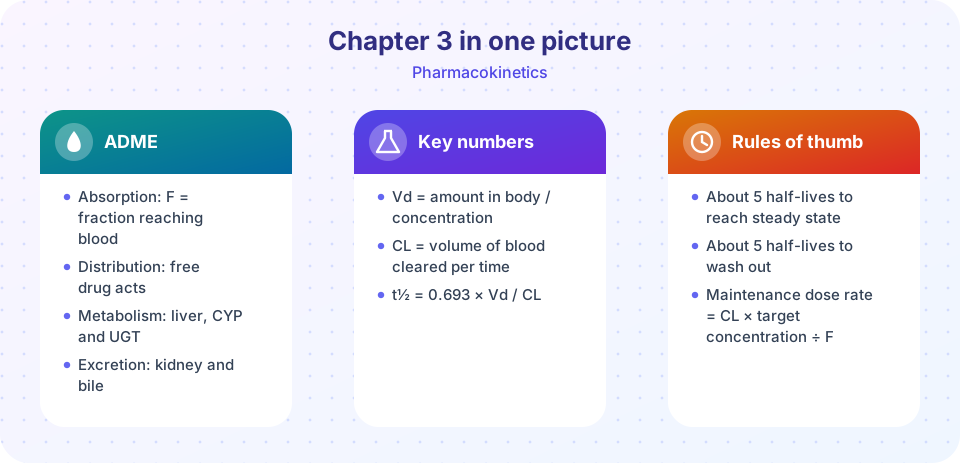
You have followed a dose from the mouth to the kidney. This review collects the numbers and formulas of Chapter 3 on a single page so that you can see how they fit: bioavailability sets what gets in, volume sets where it goes, clearance sets how fast it leaves, and half-life and steady state follow. Use the table to check your recall and the calculator to practice a typical applied problem, then take the long quiz.
What you will learn
- A single-page summary of the formulas and ideas of Chapter 3.
- How the four main quantities F, Vd, CL and t½ relate to each other.
- How reduced kidney function changes dosing, with a worked calculator.
Recap table
| Quantity or idea | Formula or key fact | Lesson |
|---|---|---|
| Passive absorption | Unionized fraction from pH and pKa; surface area often dominates | Absorption |
| Bioavailability | F = fa x Fg x (1 - Eh); F = AUC(oral) / AUC(IV) | Absorption |
| Volume of distribution | Vd = amount in body / concentration; loading dose = Vd x Ctarget / F | Distribution |
| Protein binding | Only free drug is active; matters most when more than 90% bound | Distribution |
| Metabolism | Phase I (CYP oxidation) and phase II (conjugation); inducers lower, inhibitors raise levels | Metabolism |
| Zero-order kinetics | Rate approaches Vmax at high concentration; Css rises steeply with dose | Metabolism |
| Clearance | CL = rate of elimination / C; sum of organ clearances | Elimination |
| Half-life | t½ = 0.693 x Vd / CL; about 5 half-lives to wash out | Elimination |
| Steady state | Css = F x Dose / (CL x tau); reached in about 4 to 5 half-lives | Elimination |
How the quantities connect
Vd and CL are independent properties of the drug and the patient, and half-life is derived from them. This is why you can reason in a chain.
- A patient with kidney disease has a lower CL for a renally cleared drug. The half-life rises, steady state takes longer, and the average concentration at the same dose rises. To keep the same level, lower the maintenance dose or lengthen the interval.
- A patient with low albumin has a higher free fraction of an acidic, highly bound drug. Total concentration may look normal while the free (active) concentration is high.
- A patient given an enzyme inducer has a higher CL for a drug cleared by that enzyme, so the average concentration falls, and the dose may have to be increased until the inducer is stopped.
- A drug given by mouth rather than IV has F below 1, so the oral dose must be larger for the same AUC.
Try it
When a drug is cleared mainly by the kidney, a common approach is to estimate the creatinine clearance (CrCl) using the Cockcroft-Gault equation, then scale the dose. The code below does this for a fictional drug that is 80% excreted unchanged by the kidney. It uses the Kiley-Dettli style adjustment: the dose factor is 1 - fe x (1 - CrCl/120). This illustrates the reasoning only; real adjustments come from product labels and clinical references.
Press Run (or Ctrl + Enter) to see the result here.
Program input · what you'd type while the program runs
Type the answers before you press Run, one per line. Each time the program reads a line (with input()), it gets the next line from this box.
The second exercise strings together bioavailability, volume and clearance to design a regimen for an imaginary oral drug.
Press Run (or Ctrl + Enter) to see the result here.
Program input · what you'd type while the program runs
Type the answers before you press Run, one per line. Each time the program reads a line (with input()), it gets the next line from this box.
Check your understanding
Quick check · 10 questions
of 10 answered You scored / 10 · perfect!
-
1. A drug has an oral bioavailability of 25%. Compared with the IV dose that gives the same AUC, the oral dose must be about
F = 0.25, so you need 1 / 0.25 = 4 times the IV dose. -
2. Which pair of quantities determines half-life?
t1/2 = 0.693 x Vd / CL. -
3. A drug with a large volume of distribution is poorly removed by dialysis because
Dialysis cleans blood. If little of the drug is in blood, little is removed. -
4. An enzyme inhibitor is added to a drug cleared mainly by that enzyme. What happens to the average steady-state concentration?
Clearance falls, so Css = F x Dose / (CL x tau) rises. -
5. A patient takes 150 mg every 6 h of a drug with F = 1 and CL = 10 L/h. What is the average steady-state concentration?
150 / (10 x 6) = 2.5 mg/L. -
6. A drug has a half-life of 10 h. About how long until it is effectively washed out (5 half-lives)?
5 x 10 h = 50 h. -
7. Which statement about first-pass metabolism is true?
Absorbed drug passes the liver before the systemic circulation, where part is metabolized. -
8. Why is phenytoin hard to dose?
Michaelis-Menten kinetics with a Km in the therapeutic range make levels rise disproportionately. -
9. Which is the best description of clearance?
CL has units of volume per time. -
10. If a dose is doubled for a first-order drug, the time needed to reach steady state
It depends only on half-life, which is dose independent for first-order kinetics.
Summary
- F governs what gets in, Vd where it goes, CL how fast it leaves; t½ = 0.693 x Vd / CL and Css = F x Dose / (CL x tau).
- Disease, genes, other drugs and the route all shift these quantities in predictable directions.
- About five half-lives are needed to wash out a drug or reach steady state; loading doses speed the start.
- Renal dose adjustment scales the dose with creatinine clearance for drugs cleared by the kidney.
Next: Chapter 4 overview: pharmacodynamics and dose-response
Track your progress
Create a free account to tick off lessons and pick up where you left off on any device.
of Pharmacology lessons completed