


















Lesson 1 of 48 · Getting Started
Course map: how this pharmacology course works
Start here: what pharmacology is, who this course is for, the nine chapters at a glance, how to study with the interactive examples, and an educational-use note.
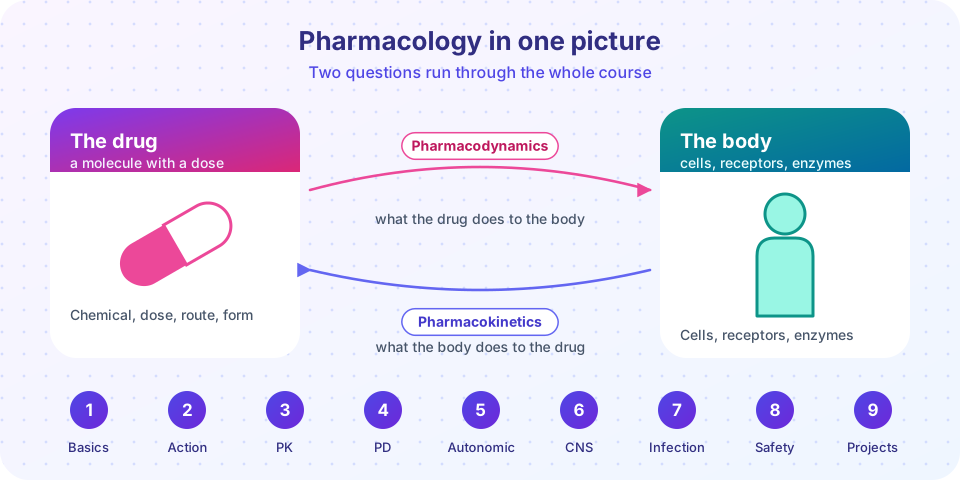
Every medicine you have ever taken, from a headache tablet to an inhaler, works because a molecule meets a living body and something changes. Pharmacology is the science of that meeting. It asks two simple questions: what does the drug do to the body, and what does the body do to the drug? The rest of this course is a careful, step-by-step answer, with numbers, pictures and small experiments you can run in your browser.
Educational information only. This course explains how drugs work in general. It is not medical advice and cannot tell you what to take, how much, or when to stop. The dose examples use made-up drugs or simplified numbers so you can practice the arithmetic. Always follow the advice of a doctor, pharmacist or other licensed professional about real medicines.
What you will learn
- What the field of pharmacology covers and how its main branches fit together.
- Who this course is written for and what background helps.
- What each of the nine chapters teaches, and how the chapters build on one another.
- How to use the quizzes, plots and interactive widgets to learn faster.
Who this course is for
The course is written for learners of about 16 and older: upper secondary and A-level or IB students curious about medicine, first-year university students in nursing, pharmacy, biomedical science, medicine, dentistry or veterinary science, and adults who simply want to understand the medicines in their own cabinet. It follows the common core of an international introductory pharmacology syllabus rather than any single country's exam board.
You do not need to have studied pharmacology before. You will get more from it if you have:
- Basic biology: cells, membranes, proteins and enzymes, and the main organ systems (heart, lungs, liver, kidney, brain).
- Basic chemistry: what a molecule is, acids and bases, and the idea of a concentration such as mg/L or mol/L.
- Comfortable algebra: substituting numbers into a formula, powers of ten, and a little about logarithms. Where we need an exponential or a logarithm, we explain it on the spot.
If a term is new, the lesson defines it the first time it appears and collects the important ones in a Key terms box.
The nine chapters at a glance
Read the chapters in order the first time. Each one opens with an overview lesson, has several content lessons, and ends with a review lesson that contains a longer quiz.
Part 1: the foundations
These four chapters are the tool kit for everything else.
Part 2: drugs in action
Here you apply the tool kit to real drug families.
Part 3: bringing a drug to people
From a molecule in a lab to a medicine you can trust.
- Chapter 1, Getting Started, defines drugs, explains how they are named and classified, and tours the routes by which they enter the body.
- Chapter 2, Principles of Drug Action, covers receptors, the occupancy law, the four families of target, and the difference between agonists and antagonists.
- Chapter 3, Pharmacokinetics, follows a dose through absorption, distribution, metabolism and excretion, and introduces clearance, half-life and steady state.
- Chapter 4, Pharmacodynamics and Dose-Response, explains how concentration becomes effect, how to compare potency and efficacy, how to measure safety, and why people respond differently.
- Chapters 5 to 7 survey the nervous-system, cardiovascular, anti-infective and cancer drug families.
- Chapters 8 and 9 cover how drugs are developed, tested and monitored, and give you projects to practice.
How to study each lesson
Content lessons follow one pattern so you always know where you are: What you will learn, Key terms, the explanation with worked examples, Common misconceptions, Try it (interactive examples), a short quiz, and a summary. A good routine is:
- Skim the outcomes, then read the lesson once without stopping.
- Run every example in Try it. Change a number and predict the result before you press Run.
- Take the quiz. A wrong answer is useful: read the explanation, then reread the section it points to.
- Next day, write the summary bullets from memory, then compare with the lesson.
Key terms
- Drug: a chemical substance that changes how the body works, used or studied for treating, preventing or diagnosing disease.
- Pharmacokinetics (PK): what the body does to the drug: absorption, distribution, metabolism, excretion.
- Pharmacodynamics (PD): what the drug does to the body, including its action at receptors and its dose-response relationship.
- Dose: the amount of drug given. Concentration is how much drug is present in a volume of blood or tissue.
- Therapeutic effect and adverse effect: the wanted and the unwanted results of a drug.
A first look: dose, concentration and effect
Two ideas will repeat in every chapter, so it is worth seeing them now. First, a bigger dose gives a higher concentration. Second, concentration falls over time as the body removes the drug. If a drug enters the blood in one rapid injection and spreads through a volume Vd, the starting concentration is C0 = dose / Vd, and it then decays by a fixed fraction per hour. The plot below uses a made-up drug with Vd = 40 L and an elimination rate of 0.15 per hour.
Press Run (or Ctrl + Enter) to see the result here.
Program input · what you'd type while the program runs
Type the answers before you press Run, one per line. Each time the program reads a line (with input()), it gets the next line from this box.
Concentration alone does not tell you the effect. The effect depends on how strongly the drug acts on its target at that concentration. The widget below is a simplified demonstration (not a prescribing tool): it uses the same Vd = 40 L and an imaginary drug that produces half of its maximum effect at 0.5 mg/L.
Common misconceptions
- "More drug always means more effect." Effects level off at a ceiling, and side effects keep rising. Chapter 4 shows why.
- "Natural means safe." Many of the most dangerous poisons are natural, and many natural products, such as grapefruit juice or St John's wort, change how real medicines work (Chapter 4).
- "A drug has one effect." Almost every drug has several, because its target is found in more than one organ. The unwanted ones are called side effects.
Check your understanding
Quick check · 4 questions
of 4 answered You scored / 4 · perfect!
-
1. Which question belongs to pharmacokinetics?
Pharmacokinetics is what the body does to the drug: absorption, distribution, metabolism and excretion. Receptor action and effect size are pharmacodynamics. -
2. In the first plot, what happens to every concentration when the dose is doubled?
With the simple model C = dose / Vd, concentration is proportional to dose at every time. -
3. Which background is most useful before starting this course?
The course explains pharmacology from the beginning. Basic biology, chemistry and algebra are enough. -
4. Why does the course use made-up drugs in some dose examples?
Teaching examples are for learning the method. Real doses must come from a prescriber, a label or an official reference.
Summary
- Pharmacology asks what a drug does to the body (pharmacodynamics) and what the body does to the drug (pharmacokinetics).
- The course has nine chapters: foundations (1-4), drug families (5-7) and development and practice (8-9).
- A higher dose gives a higher concentration, concentration falls over time, and effect levels off at a ceiling.
- All dose examples here are for learning, not for treating anyone.
Track your progress
Create a free account to tick off lessons and pick up where you left off on any device.
of Pharmacology lessons completed