


















Lesson 24 of 48 · Autonomic and Cardiovascular Drugs
The autonomic nervous system and its drugs
Learn how acetylcholine and norepinephrine signal through nicotinic, muscarinic and adrenergic receptors, and how atropine, salbutamol and beta-blockers follow from the map.
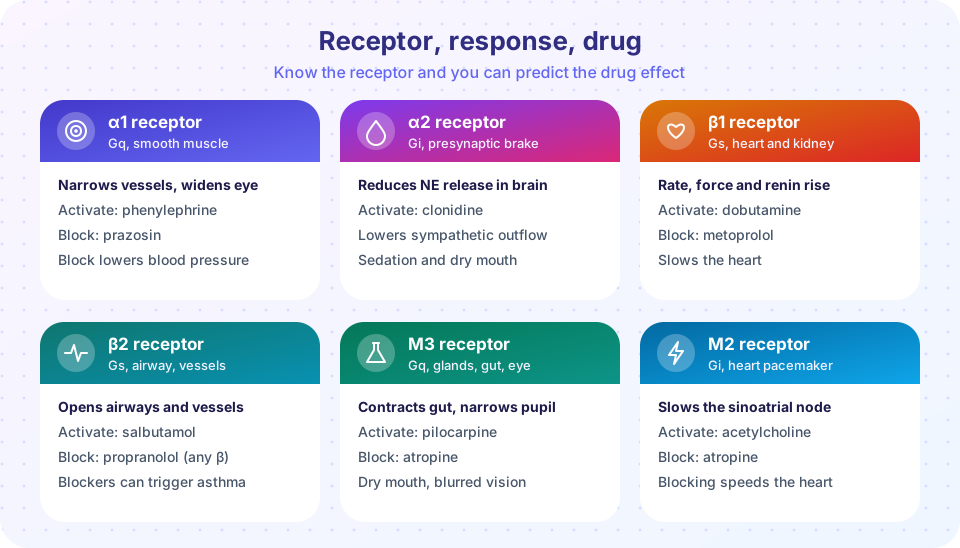
If you can remember six receptors, you can predict the main effects of dozens of drugs. Atropine speeds the heart because it blocks M2 receptors. Salbutamol opens the airways because it activates β2 receptors. A beta-blocker slows the heart because it blocks β1 receptors, and for the same reason it can narrow the airways if it also blocks β2. This lesson builds that receptor map and then uses it, drug by drug, to show how the pieces fit.
What you will learn
- Name the main cholinergic and adrenergic receptors and what each one does.
- Explain the five points at which a drug can interfere with a transmitter.
- Predict the effects of atropine, neostigmine, phenylephrine, salbutamol and propranolol from the receptor map.
- Describe why receptor selectivity is helpful but never perfect.
Key terms
Agonist: a drug that binds a receptor and activates it, copying the natural transmitter.
Antagonist: a drug that binds a receptor and blocks the transmitter without activating it.
Selectivity: the degree to which a drug prefers one receptor subtype over others.
Cholinesterase inhibitor: a drug that stops the enzyme acetylcholinesterase from breaking down acetylcholine, so the transmitter lasts longer.
Sympathomimetic: a drug that mimics sympathetic nerve activity.
Two transmitters, two receptor families
The parasympathetic nerves and a few sympathetic ones use acetylcholine (ACh). It is made in the nerve ending from choline and acetyl-coenzyme A by the enzyme choline acetyltransferase, packed into vesicles, and released when an action potential arrives. In the synaptic cleft, the enzyme acetylcholinesterase destroys it within milliseconds. That speed is why the effect of a nerve signal is brief, and it explains why blocking the enzyme has such dramatic results.
ACh acts on two receptor families:
- Nicotinic receptors are ligand-gated ion channels. The ganglionic type (Nn) is found in all autonomic ganglia; the muscle type (Nm) is found at the neuromuscular junction on skeletal muscle. Nicotine activates them, which gives the family its name.
- Muscarinic receptors are G-protein-coupled receptors (named for muscarine, a mushroom toxin). The M2 subtype is in the heart and acts through Gi to slow the pacemaker. The M3 subtype is on smooth muscle and glands and acts through Gq to contract the gut and bladder, narrow the airways and the pupil, and drive secretions. M1 receptors in the brain and stomach and M4 and M5 receptors in the brain are less important for this chapter.
Norepinephrine (NE) is the main sympathetic transmitter. It is made from the amino acid tyrosine through L-DOPA and dopamine, stored in vesicles, and released onto adrenergic receptors. Unlike ACh it is not destroyed in the cleft. Most of it is taken back into the nerve ending by the norepinephrine transporter (also called uptake-1). Two enzymes, monoamine oxidase (MAO) and catechol-O-methyltransferase (COMT), break down what is left. The adrenal medulla also releases epinephrine, and to a lesser extent NE, into the blood.
The adrenergic receptors come in four main types that you should know:
| Receptor | G protein | Main locations | Effect when activated |
|---|---|---|---|
| α1 | Gq | blood vessels, iris, prostate and bladder neck | vasoconstriction, pupil dilation, contraction |
| α2 | Gi | presynaptic nerve endings, brainstem | less NE release, lower sympathetic outflow |
| β1 | Gs | heart, kidney | faster rate, stronger beat, renin release |
| β2 | Gs | airways, skeletal muscle vessels, uterus | smooth muscle relaxation, bronchodilation |
A third β type, β3, is found in the bladder wall and in fat. Epinephrine acts on all of these, with a lower dose favoring β receptors and a higher dose bringing in α1.
Five places to intervene
A transmitter has a life cycle, and every step of it is a drug target:
- Synthesis. Blocking the making of the transmitter. Metyrosine blocks tyrosine hydroxylase, the first step in NE synthesis, and is used rarely, mainly in adrenal tumors.
- Storage and release. Reserpine empties vesicles of NE; botulinum toxin stops ACh release; amphetamine and tyramine push NE out of nerve endings.
- The receptor. Agonists activate it and antagonists block it. This is where most drugs act.
- Reuptake. Cocaine and tricyclic antidepressants block the NE transporter, so NE stays longer.
- Breakdown. Cholinesterase inhibitors preserve ACh; MAO inhibitors preserve NE and other monoamines.
Keeping this list in mind turns a long list of drug names into a short list of strategies.
Cholinergic drugs
Direct agonists copy ACh but resist cholinesterase. Pilocarpine activates muscarinic receptors; it is used as eye drops in some forms of glaucoma and as tablets for dry mouth. Bethanechol is used to stimulate bladder emptying when the bladder is weak.
Cholinesterase inhibitors work by raising ACh at every synapse where it is released. Neostigmine and pyridostigmine do not cross into the brain easily. They are used in myasthenia gravis, a disease with too few functional nicotinic receptors at the neuromuscular junction, and neostigmine is used to reverse the paralysis caused by some muscle relaxants after surgery. Donepezil crosses into the brain and is used in Alzheimer's disease, where it gives a modest symptom benefit and does not stop the disease. Irreversible inhibitors are the organophosphates, found in some insecticides and in nerve agents such as sarin. They cause excess ACh: tears, saliva, sweating, a slow heart, narrow pupils and muscle paralysis. The antidotes combine atropine, which blocks muscarinic receptors, with pralidoxime, which can reactivate the enzyme if given early.
Muscarinic antagonists (anticholinergics) block the parasympathetic brake. Atropine, from the deadly nightshade plant Atropa belladonna, raises heart rate in a very slow heart, dries secretions before surgery and dilates the pupil. Ipratropium and tiotropium are inhaled to relax airways in chronic obstructive pulmonary disease. Oxybutynin reduces bladder spasm. Scopolamine patches prevent motion sickness. The side effects follow one pattern: dry mouth, blurred vision, constipation, urinary retention, fast heart and, especially in older people, confusion. An old rhyme sums up poisoning: hot as a hare, dry as a bone, blind as a bat, red as a beet and mad as a hatter.
Adrenergic drugs
Sympathomimetics. Epinephrine is the first-line treatment for anaphylaxis because it constricts vessels (α1), opens the airways (β2) and supports the heart (β1) at the same time, which is exactly what a collapsing, wheezing patient needs. Norepinephrine is a vasopressor used in septic shock. Phenylephrine is an almost pure α1 agonist, used as a nasal decongestant and to raise blood pressure during anesthesia. Dobutamine stimulates β1 receptors to strengthen the failing heart for short periods. Salbutamol (known as albuterol in the United States) is a short-acting β2 agonist and relieves asthma attacks within minutes; salmeterol and formoterol are long-acting versions that are taken regularly alongside an inhaled corticosteroid.
Alpha-blockers. Prazosin and doxazosin block α1 receptors and relax arterial and prostate smooth muscle. They lower blood pressure and ease urine flow in benign prostate enlargement, and tamsulosin is selective for the α1A subtype in the prostate. The characteristic problem is postural hypotension, a dizzy drop in pressure on standing, worst with the first dose.
Central α2 agonists. Clonidine activates α2 receptors in the brainstem and reduces sympathetic outflow, which lowers blood pressure. It also sedates and dries the mouth, and it must not be stopped suddenly because blood pressure can rebound.
Beta-blockers. Propranolol blocks both β1 and β2 receptors. Metoprolol, atenolol and bisoprolol prefer β1 and are called cardioselective. Carvedilol and labetalol also block α1 receptors. Beta-blockers slow the heart, weaken each beat, lower renin release and reduce the oxygen the heart needs. They are used after a heart attack, in angina, in heart failure (bisoprolol, carvedilol and metoprolol succinate), in rate control for atrial fibrillation and for migraine prevention. Cautions follow directly from the receptors: blocking β2 can narrow the airways in asthma, a very slow heart can be dangerous, and the warning signs of low blood sugar such as a pounding heart can be masked in people with diabetes. Stopping a beta-blocker abruptly can cause rebound fast heart rate and angina because the receptors have become more numerous.
A classic demonstration of the receptor map is epinephrine reversal. If an α-blocker is given first, the vasoconstriction from epinephrine is removed, but the β2 vasodilation in muscle is not. The blood pressure then falls when epinephrine is given. Seeing this explained by receptors, rather than memorized, is a good test of understanding.
Common misconceptions
"Cardioselective means safe in asthma." Selectivity is relative. At higher doses a β1-selective blocker also blocks β2. Beta-blockers need care in asthma regardless of how selective they are.
"Anticholinergic drugs are mild." The same blockade that relieves bladder spasm also impairs memory and attention, especially in older adults. The cumulative effect of several mild anticholinergic drugs is called anticholinergic burden.
"Epinephrine and norepinephrine do the same thing." Epinephrine acts on α and β receptors including β2. Norepinephrine has little β2 action, so it raises blood pressure strongly but does not open the airways much.
Try it
First, a model of competitive antagonism. A beta-blocker competes with an agonist at the same receptor, which pushes the agonist's dose-response curve to the right without lowering its maximum. The code uses illustrative numbers (an agonist EC50 of 10 nM and an antagonist dissociation constant of 3 nM) and the Schild relationship: the dose ratio equals 1 + [B]/KB.
Press Run (or Ctrl + Enter) to see the result here.
Program input · what you'd type while the program runs
Type the answers before you press Run, one per line. Each time the program reads a line (with input()), it gets the next line from this box.
Second, a table-driven drug explorer. Pick a drug and read its main effects. It is a demonstration of the receptor logic, with simplified, typical effects, and it is not a prescribing tool.
Check your understanding
Quick check · 5 questions
of 5 answered You scored / 5 · perfect!
-
1. Which receptor does salbutamol mainly activate?
Salbutamol is a β2 agonist that relaxes airway smooth muscle. -
2. A patient is poisoned by an organophosphate insecticide. Which treatment pairing is correct?
Atropine blocks the excess muscarinic stimulation, and pralidoxime can reactivate the inhibited cholinesterase if given early. -
3. Why can propranolol be a problem in a person with asthma?
Blocking β2 removes the relaxing influence on airway smooth muscle, so the airways can narrow. -
4. A competitive antagonist added to an agonist's dose-response curve does what?
More agonist can overcome a competitive blocker, so the maximum is unchanged but a higher concentration is needed. -
5. Phenylephrine raises blood pressure but often slows the heart rate. What explains the slowing?
The baroreflex detects the rise in pressure and increases vagal tone to the heart, which lowers the rate.
Summary
- ACh acts on nicotinic channels and muscarinic G-protein receptors; NE and epinephrine act on α1, α2, β1 and β2 receptors.
- A transmitter can be disrupted at synthesis, storage and release, the receptor, reuptake or breakdown.
- Atropine blocks muscarinic receptors, neostigmine preserves ACh, salbutamol activates β2, and beta-blockers block β receptors.
- Receptor selectivity is relative, and side effects follow the receptors that are touched.
Track your progress
Create a free account to tick off lessons and pick up where you left off on any device.
of Pharmacology lessons completed