


















Lesson 20 of 48 · Pharmacodynamics and Dose-Response
Variability and pharmacogenomics: why people respond differently
Why the same dose affects people differently: age, weight, disease, tolerance, placebo and genes. Learn CYP2D6 phenotypes, key gene-drug pairs and how to simulate a population, with plots and a calculator.
Give the same standard dose of a drug to a hundred people and you will see a hundred slightly different results. For most drugs the spread is modest and the dose works for nearly everyone. For some, a few people get no benefit, and a few get a serious reaction. Understanding why people differ is the foundation of safe prescribing and of modern "precision medicine". This lesson covers the sources of variability, and then focuses on the one with the clearest scientific story: genes.
What you will learn
- The main sources of variability in drug response, both kinetic and dynamic.
- How tolerance, desensitization and placebo effects change response over time.
- What pharmacogenomics is, and the CYP2D6 phenotypes with the codeine example.
- Other key gene-drug pairs and how clinical guidelines use them.
Key terms
- Pharmacogenomics (pharmacogenetics): the study of how genes affect response to drugs.
- Genotype and phenotype: the genetic makeup, and the observable trait (such as poor or ultrarapid metabolizer) that follows from it.
- Polymorphism: a common variation in a gene, found in at least 1% of a population.
- Tolerance: a reduced response to the same dose after repeated use.
- Placebo effect: a real change in symptoms caused by the expectation of treatment rather than by the drug's pharmacology.
Sources of variability
Variability can arise at every step of the chain from dose to effect.
Pharmacokinetic causes (different concentration):
- Age. Newborns have immature liver enzymes and kidneys, so some drugs accumulate: chloramphenicol can cause "grey baby syndrome" because the newborn liver cannot conjugate it. In older adults, kidney function falls, body fat rises and albumin may fall, so many drugs need lower doses.
- Body size and composition. Weight, fat and water change the volume of distribution; doses are scaled for children by weight or body surface area.
- Organ disease. Kidney disease slows the excretion of renally cleared drugs. Liver disease reduces metabolism and plasma protein. Heart failure lowers blood flow to the liver and kidney.
- Pregnancy. Blood volume, kidney flow and enzyme activity change.
- Other drugs, food and smoking. Enzyme inducers and inhibitors, grapefruit juice and tobacco smoke (which induces CYP1A2) change clearance.
- Genes. Variants in metabolizing enzymes and transporters change clearance and activation.
- Adherence. A large share of "variability" is simply that people do not take the drug as prescribed.
Pharmacodynamic causes (different effect at the same concentration):
- Receptor number and sensitivity, which change with age, disease and previous drug exposure.
- Disease state. An inflamed airway responds differently to a bronchodilator; an adrenaline-depleted heart responds differently to a beta-blocker.
- Genes in the target. For example, variants in the VKORC1 gene (the target of warfarin) shift the dose needed.
- Physiological state and other drugs acting on the same system.
Tolerance, desensitization and rebound
With repeated or continuous exposure, response can change over time.
- Tolerance. A larger dose is needed to produce the same effect. It occurs with opioids, nitrates and benzodiazepines. Causes include faster metabolism (enzyme induction), fewer or less sensitive receptors, and homeostatic changes in the body.
- Tachyphylaxis. A rapid form of tolerance that appears within minutes or hours, for example with repeated doses of some nasal decongestants or indirect-acting amines.
- Receptor desensitization and down-regulation. After prolonged agonist exposure, receptors are phosphorylated, uncoupled from their signalling and internalized by cells, and the total number may fall.
- Up-regulation and rebound. Chronic blockade can increase receptor number. If a beta-blocker is stopped abruptly, the cells are suddenly over-sensitive to adrenaline, and heart rate and blood pressure may surge. Many drugs are therefore tapered rather than stopped suddenly.
Placebo and nocebo effects
A placebo is an inactive treatment, and the placebo effect is the real improvement that follows expectation, attention, ritual and natural recovery. It is strongest for symptoms the brain modulates, such as pain, nausea and mood, and it is why trials compare a drug with a placebo (Chapter 8). The reverse, the nocebo effect, is the appearance of side effects because they are expected. A placebo response is not "imaginary"; it can be measured, but it does not shrink a tumour or cure an infection. Account for it when judging whether a drug works.
Pharmacogenomics
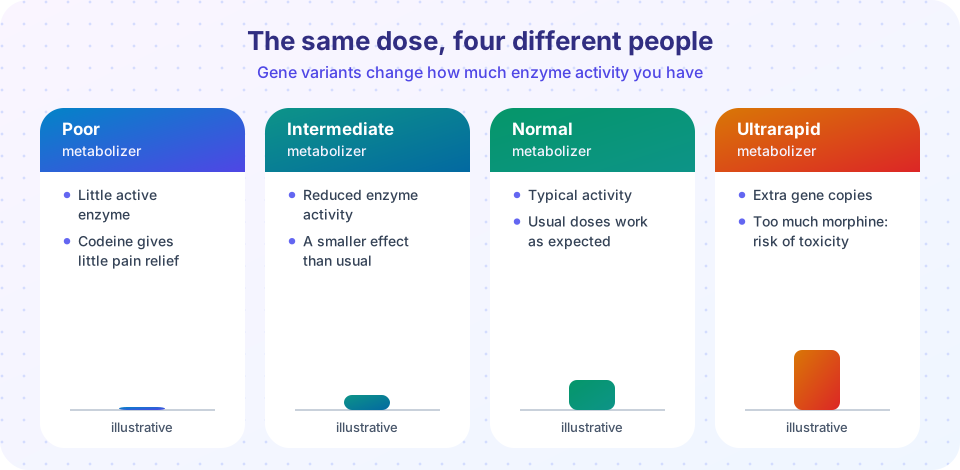
Genes carry the instructions for enzymes, transporters and receptors. Polymorphisms in these genes cause differences in function that can be large. The classic example is CYP2D6, which handles a substantial share of commonly used drugs (often quoted as 20 to 25%), including codeine, tramadol, many antidepressants and antipsychotics, and metoprolol. CYP2D6 has many variants (alleles) with normal, reduced or no function, and some people carry extra copies. Clinical laboratories convert the combination into an activity score and a phenotype:
| Phenotype | Meaning |
|---|---|
| Poor metabolizer | No functional enzyme |
| Intermediate metabolizer | Reduced activity |
| Normal metabolizer | Typical activity |
| Ultrarapid metabolizer | Increased activity, usually from extra gene copies |
Frequencies depend on ancestry. Roughly 5 to 10% of people of European ancestry are poor metabolizers, and the proportion is lower in many East Asian populations. Ultrarapid metabolizers are uncommon in some populations and considerably more common in others.
Codeine shows why this matters. Codeine is a prodrug that CYP2D6 converts to morphine. A poor metabolizer makes very little morphine and gets little pain relief. An ultrarapid metabolizer can make too much morphine from a normal dose. Cases of serious breathing depression and death in children after tonsil surgery, and in breast-fed infants of ultrarapid mothers, led regulators to restrict codeine use in children and to add warnings. Tramadol shares this prodrug feature. For drugs that are inactivated by CYP2D6, such as some antidepressants, the logic reverses: poor metabolizers have higher levels and more side effects.
Other gene-drug pairs
- CYP2C19 and clopidogrel. Clopidogrel needs CYP2C19 to be activated. Poor metabolizers form less active drug and may have a higher risk of clots after a stent, so another antiplatelet drug may be chosen.
- CYP2C9 and VKORC1 with warfarin. Variants in these two genes explain a large part of the dose differences between patients. Dosing algorithms include them.
- TPMT and azathioprine or mercaptopurine. Low TPMT activity causes build-up of toxic metabolites and a risk of severe bone marrow suppression, so the dose is reduced.
- HLA-B*57:01 and abacavir. Carriers risk a severe hypersensitivity reaction, so patients are tested before treatment.
- HLA-B*15:02 and carbamazepine. The allele is strongly linked to severe skin reactions (Stevens-Johnson syndrome) in people of some Asian ancestries, and testing is recommended in these groups.
- G6PD deficiency and some drugs (such as primaquine and rasburicase). Red blood cells lacking G6PD can break down, so testing precedes use.
- DPYD and fluorouracil. Low enzyme activity causes severe toxicity from standard doses.
Expert groups such as the Clinical Pharmacogenetics Implementation Consortium (CPIC) and the Dutch Pharmacogenetics Working Group publish guidelines that turn test results into dosing advice, and many drug labels list gene effects. Testing is routine for some pairs (HLA-B*57:01) and under evaluation for others. A genotype is one piece of information, and it works alongside age, other drugs and clinical judgement.
Common misconceptions
- "Genes determine drug response completely." For most drugs genes explain only part of the variation. Age, disease, other drugs and behaviour often matter as much.
- "A placebo effect means the patient is faking." The relief is real, produced by the brain's own mechanisms. It is why controlled comparisons are needed.
- "A normal dose is safe for everyone." A dose that is average for a population can be too low or too high for individuals, and rare genetic variants or organ disease make the gap larger.
Try it
First, simulate a population. Clearance varies between individuals roughly log-normally, with a median of 6 L/h and about 40% spread. The same dose rate gives a spread of steady-state concentrations, and some people fall below the effective range while others go above the toxic one. The numbers are illustrative.
Press Run (or Ctrl + Enter) to see the result here.
Program input · what you'd type while the program runs
Type the answers before you press Run, one per line. Each time the program reads a line (with input()), it gets the next line from this box.
Second, a small calculator of the CYP2D6 activity score. The allele values follow the scheme used in current consensus guidelines (1 for normal function, 0.25 for some decreased-function alleles, 0 for no function, and a duplication counts twice). It is a teaching example, not a laboratory tool.
Press Run (or Ctrl + Enter) to see the result here.
Program input · what you'd type while the program runs
Type the answers before you press Run, one per line. Each time the program reads a line (with input()), it gets the next line from this box.
Check your understanding
Quick check · 6 questions
of 6 answered You scored / 6 · perfect!
-
1. Why does codeine give little pain relief to a CYP2D6 poor metabolizer?
Codeine is a prodrug that depends on CYP2D6 to form morphine. -
2. Why is the risk different for an ultrarapid CYP2D6 metabolizer taking codeine?
Faster conversion means higher morphine levels and a risk of breathing depression. -
3. A genotype *1/*4 has an activity score of 1.0. The phenotype is
A score above 0 and below 1.25 is intermediate. -
4. What is the nocebo effect?
It is the negative counterpart of the placebo effect. -
5. Why should beta-blockers not be stopped suddenly?
Chronic blockade increases receptor number, so rebound over-stimulation can occur. -
6. HLA-B*57:01 testing before abacavir is used to prevent
Carriers have a high risk of hypersensitivity, so they are tested.
Summary
- Variability comes from kinetics (age, size, organ disease, other drugs, genes, adherence) and dynamics (receptor changes, disease, target genes).
- Tolerance, desensitization, up-regulation and rebound change response over time; placebo and nocebo effects are real and must be accounted for.
- Pharmacogenomics links genes to response: CYP2D6 (codeine), CYP2C19 (clopidogrel), CYP2C9/VKORC1 (warfarin), TPMT, HLA-B variants, G6PD and DPYD.
- Guidelines (CPIC, DPWG) turn genotypes into dosing advice, alongside clinical judgement.
Next: Drug interactions
Track your progress
Create a free account to tick off lessons and pick up where you left off on any device.
of Pharmacology lessons completed