


















Lesson 26 of 48 · Autonomic and Cardiovascular Drugs
Antithrombotic, lipid-lowering and antiarrhythmic drugs
How aspirin, clopidogrel, warfarin, DOACs, statins and the Vaughan Williams antiarrhythmic classes work, with the trials that shaped modern cardiovascular prevention.
Heart attacks and most strokes begin the same way: a fatty plaque in an artery cracks, a clot forms on it, and the clot blocks the flow of blood. Other clots form in slow-flowing veins or in a heart that beats irregularly, and travel to the lungs or the brain. Three groups of drugs attack this chain at different points. Antithrombotics stop clots forming or growing, lipid-lowering drugs slow the plaque that starts the process, and antiarrhythmics steady the electrical rhythm of the heart. This lesson follows the main drugs in each group, the trials that proved their value, and the side effects that follow from their mechanisms.
Educational information only. This lesson describes drug mechanisms and evidence. Decisions about starting or stopping blood thinners, statins or rhythm drugs depend on bleeding risk, other medicines and the person's circumstances, and belong to a clinician.
What you will learn
- Distinguish antiplatelet drugs from anticoagulants and say which clots each treats.
- Explain why warfarin takes days to work and why it needs monitoring.
- Describe how statins lower LDL cholesterol and what evidence supports them.
- Place the main antiarrhythmic drugs in the Vaughan Williams classes and explain proarrhythmia.
Key terms
Antiplatelet: a drug that stops platelets from clumping; most useful against clots in arteries.
Anticoagulant: a drug that interferes with the clotting factors that build fibrin; most useful in veins and in atrial fibrillation.
INR: the international normalized ratio, a blood test of clotting time used to monitor warfarin.
LDL cholesterol: the cholesterol carried in low-density lipoprotein particles, which deposit in artery walls.
QT interval: the part of the electrocardiogram that reflects ventricular recovery; drugs that prolong it can cause the dangerous rhythm torsades de pointes.
Antiplatelet drugs
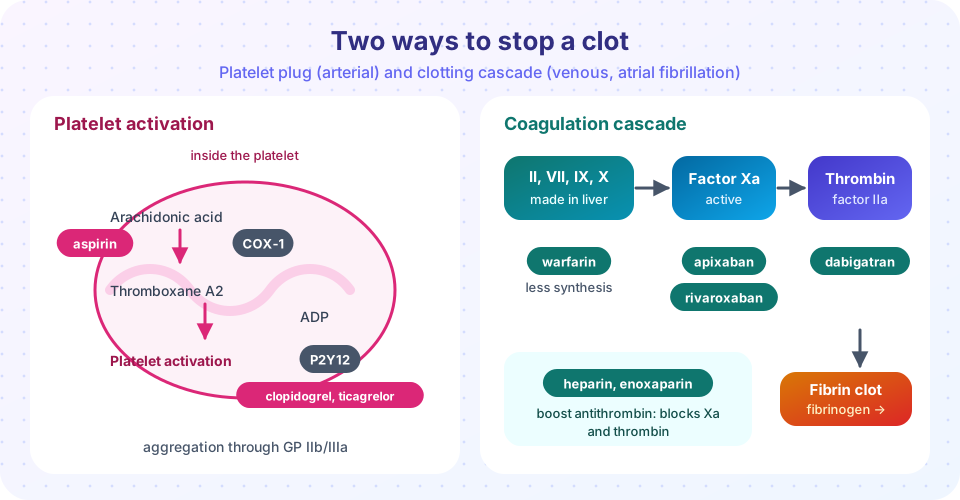
When a plaque cracks, platelets stick to the exposed surface, release signals and clump. Aspirin blocks cyclooxygenase-1 (COX-1) by transferring an acetyl group onto the enzyme, which is a permanent change. Platelets have no nucleus and cannot make new enzyme, so a single low dose disables the platelet for its whole life of about 7 to 10 days. That blocks the making of thromboxane A2, a strong platelet activator. For people who already had a heart attack or stroke, low-dose aspirin lowers the risk of another. For healthy people the picture is less clear: large trials such as ASPREE, ARRIVE and ASCEND found a small reduction in cardiovascular events that was largely offset by more major bleeding, so guidelines now limit aspirin for primary prevention. The main adverse effect is gastrointestinal bleeding.
Clopidogrel blocks the P2Y12 receptor, the platelet receptor for ADP. It is a prodrug: the liver enzyme CYP2C19 turns it into the active form. People with genetic variants that make this enzyme less active get less benefit, and some acid-reducing drugs that inhibit CYP2C19 (such as omeprazole) can weaken its effect. Prasugrel and ticagrelor are stronger, faster P2Y12 blockers; ticagrelor binds reversibly and can cause a feeling of breathlessness. After a stent is placed in a coronary artery, dual antiplatelet therapy with aspirin plus a P2Y12 blocker is given for months to stop clots forming on the metal.
Anticoagulants
Heparin was discovered in 1916 by Jay McLean, then a second-year medical student, while working in a liver research laboratory. Unfractionated heparin binds to the natural inhibitor antithrombin and speeds its action on thrombin and factor Xa. It acts at once, and it is monitored with a clotting test called the aPTT. Its antidote is protamine. A rare complication, heparin-induced thrombocytopenia, causes a paradoxical clotting disorder with a low platelet count. Low-molecular-weight heparins such as enoxaparin are chopped-up heparins that mostly inhibit factor Xa. They give a more predictable effect and are injected under the skin, usually without monitoring.
Warfarin has an unusual origin. In the 1920s, cattle in North America bled to death after eating spoiled sweet clover hay. Karl Paul Link's group in Wisconsin identified the culprit (dicoumarol) and developed a related compound, named warfarin after the university's research foundation. Warfarin blocks the enzyme vitamin K epoxide reductase (VKORC1). Without recycled vitamin K the liver cannot finish making clotting factors II, VII, IX and X, nor the natural anticoagulants protein C and S. The drug acts on new synthesis only, so factors already in the blood have to decay first. Factor VII has a half-life of roughly 6 hours, but factor II lasts 2 to 3 days, which is why warfarin needs several days to reach full effect and why a heparin bridge is often given at the start. Its dose must be individualized and checked with the INR, because it has a narrow therapeutic index, is affected by genetic variation (CYP2C9 and VKORC1), by the amount of vitamin K in the diet and by many other drugs. Overdose is treated with vitamin K or a prothrombin complex concentrate. Warfarin crosses the placenta and can harm the fetus.
The direct oral anticoagulants (DOACs) act on one clotting factor each. Apixaban, rivaroxaban and edoxaban inhibit factor Xa. Dabigatran inhibits thrombin directly. They have a quick onset, fixed doses, few dietary interactions and no routine monitoring. In trials in atrial fibrillation (RE-LY, ROCKET AF, ARISTOTLE) they were at least as good as warfarin at preventing stroke, with fewer bleeds in the brain. They are cleared partly by the kidneys, so kidney function matters, and they are not suitable for mechanical heart valves, where warfarin remains the choice. Specific antidotes exist: idarucizumab for dabigatran and andexanet alfa for the factor Xa inhibitors.
The shared side effect of every antithrombotic is bleeding. That is not a flaw to be engineered out; it is the same mechanism as the benefit. Choosing between drugs is a trade between the risk of a clot and the risk of a bleed.
Lipid-lowering drugs
Statins inhibit HMG-CoA reductase, the rate-limiting enzyme of cholesterol synthesis in the liver. The liver cell, running short of cholesterol, makes more LDL receptors and pulls more LDL out of the blood. Atorvastatin and rosuvastatin are "high-intensity" statins that can lower LDL cholesterol by 50 percent or more. The first big outcome trial, the Scandinavian Simvastatin Survival Study (1994), showed fewer deaths in people with heart disease. The Cholesterol Treatment Trialists' meta-analysis of many trials later found that each reduction of 1 mmol/L (about 39 mg/dL) in LDL cholesterol was associated with roughly a 20 to 22 percent reduction in major vascular events. That is a log-linear relationship, which means the relative benefit keeps growing as LDL falls further.
Statins are well tolerated by most people. Muscle aches are the common complaint. Interestingly, blinded trials find these symptoms nearly as common on placebo as on statin, and a trial in which people took a statin or a placebo in alternating months suggested that most reported symptoms are not caused by the drug, although true statin muscle injury exists. Rare rhabdomyolysis (severe muscle breakdown) is more likely when drugs that block CYP3A4 are combined with simvastatin, for example the antibiotic clarithromycin. Statins are avoided in pregnancy.
When a statin is not enough, other drugs add to it. Ezetimibe blocks the intestinal absorption of cholesterol and gave a modest extra benefit in the IMPROVE-IT trial. PCSK9 inhibitors (evolocumab, alirocumab) are antibodies that stop the liver destroying its LDL receptors, and they lower LDL by roughly half again, with fewer events in trials such as FOURIER. Inclisiran works on the same pathway by silencing the gene for PCSK9, so it is injected only twice a year after starting.
Antiarrhythmic drugs
The Vaughan Williams classification sorts rhythm drugs by their main action on the heart cell's electrical signal.
| Class | Main action | Examples |
|---|---|---|
| I | Block sodium channels (Ia, Ib, Ic differ in strength and speed) | quinidine, lidocaine, flecainide |
| II | Block β-adrenergic receptors | metoprolol, bisoprolol |
| III | Block potassium channels, prolong repolarization | amiodarone, sotalol |
| IV | Block L-type calcium channels | verapamil, diltiazem |
Some useful drugs sit outside the list. Adenosine briefly stops conduction through the atrioventricular node and ends some fast rhythms; its half-life is only seconds, which is why it is injected quickly. Digoxin slows conduction through the same node and is used for rate control.
The most important lesson here is proarrhythmia: drugs that treat arrhythmias can cause them. The Cardiac Arrhythmia Suppression Trial (CAST, 1989) gave class Ic drugs to people after a heart attack to suppress extra heartbeats that were thought to be warning signs. The drugs suppressed the extra beats but the patients died more often. The finding became a standard warning that a good change in a surrogate marker does not guarantee a benefit to the patient. Amiodarone is very effective, but it contains iodine and accumulates in tissue with a half-life of weeks to months, so it can harm the thyroid, lungs, liver and eyes. Class III drugs prolong the QT interval, and low potassium or magnesium raises the risk of the dangerous rhythm torsades de pointes.
Common misconceptions
"Blood thinners thin the blood." They do not change the thickness of blood. They reduce the ability of platelets to clump or the chain of clotting factors to build fibrin.
"Aspirin is harmless because it is sold without a prescription." Even a low dose raises the risk of bleeding in the gut and brain, and the benefit in healthy people is small.
"Cholesterol drugs are only needed if cholesterol is very high." Statins lower risk in people with a high chance of a heart attack, even when their LDL is not unusually high, because the relative risk falls with each reduction in LDL.
Try it
First, why warfarin is slow. When warfarin stops new synthesis, each clotting factor decays by its own half-life. The model below uses approximate half-lives from the textbook range and an ideal complete block, so it is a teaching model rather than a prediction for a patient.
Press Run (or Ctrl + Enter) to see the result here.
Program input · what you'd type while the program runs
Type the answers before you press Run, one per line. Each time the program reads a line (with input()), it gets the next line from this box.
Second, the statin benefit curve. Using the roughly 22 percent reduction in major vascular events per 1 mmol/L fall in LDL cholesterol from the meta-analysis, the relative risk reduction for a given LDL fall is 1 - 0.78^x. It is an approximation for several years of treatment, not a personal risk estimate.
Press Run (or Ctrl + Enter) to see the result here.
Program input · what you'd type while the program runs
Type the answers before you press Run, one per line. Each time the program reads a line (with input()), it gets the next line from this box.
Third, a quick lookup of antithrombotic targets, to make the figure interactive. Choose a drug and see where it acts. It is a revision aid and not clinical guidance.
Check your understanding
Quick check · 5 questions
of 5 answered You scored / 5 · perfect!
-
1. Why does one low dose of aspirin affect platelets for about a week?
Platelets lack a nucleus, so COX-1 irreversibly acetylated by aspirin is not replaced until new platelets are made. -
2. Why does warfarin take several days to reach its full effect?
Warfarin stops new synthesis only; factor II, with a half-life of 2 to 3 days, sets the pace. -
3. Which drug blocks factor Xa directly?
Apixaban, rivaroxaban and edoxaban are direct factor Xa inhibitors; dabigatran is a thrombin inhibitor. -
4. Statins lower LDL mainly by:
Reduced cholesterol synthesis in the liver raises LDL receptor numbers, which removes more LDL from blood. -
5. What did the CAST trial teach about antiarrhythmic drugs?
Flecainide and encainide reduced the ectopic beats but raised mortality, showing that suppression of a marker is not proof of benefit.
Summary
- Antiplatelet drugs (aspirin, clopidogrel) treat platelet-rich arterial clots; anticoagulants (heparin, warfarin, DOACs) interfere with the clotting cascade.
- Warfarin blocks vitamin K recycling and needs INR monitoring and several days to act; DOACs act on factor Xa or thrombin with fixed doses.
- Statins block HMG-CoA reductase; each 1 mmol/L fall in LDL cholesterol lowers major vascular events by about a fifth.
- Antiarrhythmics fall into Vaughan Williams classes I to IV, and several can cause arrhythmias, as CAST showed.
Next: Chapter 5 review
Track your progress
Create a free account to tick off lessons and pick up where you left off on any device.
of Pharmacology lessons completed