


















Lesson 42 of 48 · Drug Development, Safety and Ethics
Chapter 8 review: drug development, safety and ethics
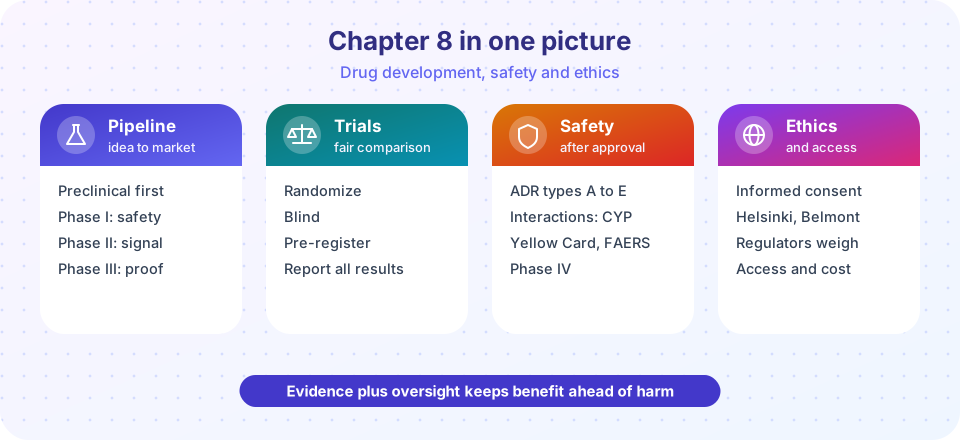
Review chapter 8 with a one-picture summary, a recap table of trial phases, adverse reaction types and ethical codes, a risk calculator and ten mixed questions.
Chapter 8 asked a single question from several angles: how do we know that a medicine is worth taking, and how do we keep it that way? The answers form a chain. Careful preclinical work sets a safe starting dose. Phases I to III and well-designed trials show whether the drug works. Regulators weigh benefit against risk. After approval, pharmacovigilance watches for rare harms. All of it is bound by ethical rules that put the participant first. Each link exists because an earlier gap hurt people.
What you will learn
- Recall the purpose of each trial phase and the key protections of an RCT.
- Distinguish adverse reaction types and interaction mechanisms.
- Recall the milestones of regulation and research ethics.
- Practice computing and interpreting risk reduction.
The chapter in a table
| Topic | Key facts |
|---|---|
| Pipeline | discovery, preclinical, phase I (safety), II (signal), III (proof), review, IV (monitoring); about 8 percent of phase I entrants reach approval |
| First-in-human | NOAEL with safety factor; TGN1412 (2006) led to staggered dosing |
| RCT protections | randomization, blinding, pre-registration, intention-to-treat |
| Endpoints | clinical versus surrogate; CAST showed surrogates can mislead |
| Risk numbers | RRR, ARR, NNT = 1/ARR; always ask the baseline risk |
| Adverse reactions | A augmented, B bizarre, C chronic, D delayed, E end of use |
| Pharmacogenomics | CYP2D6 (codeine), CYP2C19 (clopidogrel), HLA-B*5701 (abacavir), TPMT and DPYD |
| Interactions | PK: absorption, CYP inhibition or induction, excretion. PD: additive or opposing effects |
| Pharmacovigilance | Yellow Card (1964), FAERS, VigiBase; signals need follow-up |
| Regulation | FDA, EMA, MHRA; ICH (1990); generics by bioequivalence (80 to 125 percent) |
| Ethics | Nuremberg Code (1947), Helsinki (1964), Belmont (1979): respect, beneficence, justice |
Questions to ask about any claim for a drug
When you read a news story or an advertisement about a medicine, five questions will take you quite far. Was it a randomized trial, and was it blinded? What was the comparator: placebo, usual care or nothing? What was the endpoint, a clinical outcome or a surrogate? What is the absolute difference, not only the relative one, and in whom? And who funded and registered the study? None of these questions needs special training, and together they separate strong evidence from weak.
A worked example of reading a claim
Suppose a news report says that a new drug "cuts heart attacks by 30 percent". Apply the questions. The report does not say whether the trial was randomized, so you would look for the original paper and registry entry. If heart attacks fell from 5 percent to 3.5 percent over three years, the relative reduction is 30 percent, but the absolute reduction is 1.5 percentage points and the NNT is about 67. That may still be worthwhile, particularly if the drug is cheap and well tolerated, but it is a very different message from the headline. If the trial excluded people over 75, and most of the people who will take the drug are older, the result may not apply to them. If the main outcome was a blood marker and not a heart attack, the headline would be on weaker ground. Finally, a clinician would ask about adverse reactions, such as bleeding, and about interactions with the drugs that the typical patient already takes. This habit of turning a claim into numbers, populations and mechanisms is the main skill the chapter was designed to build, and it transfers to any new treatment you read about.
Common misconceptions
"If a trial is large, it must be right." Size reduces random error but not bias. A large unblinded or poorly designed trial can be misleading.
"Interactions only happen between prescription drugs." Over-the-counter medicines, herbal products and foods such as grapefruit can interact with drugs.
"Ethics rules apply only to experiments." The same principles of consent, beneficence and justice shape routine care and the sharing of data.
Try it
First, a table of trial results to interpret. For each scenario the code computes the relative risk reduction, absolute risk reduction and NNT. Notice how the same relative effect gives very different NNTs at different baseline risks.
Press Run (or Ctrl + Enter) to see the result here.
Program input · what you'd type while the program runs
Type the answers before you press Run, one per line. Each time the program reads a line (with input()), it gets the next line from this box.
Second, flashcards for the chapter. Flip each card and then press Next.
Check your understanding
Quick check · 10 questions
of 10 answered You scored / 10 · perfect!
-
1. A trial reports a 25 percent relative risk reduction. What else do you need to judge its importance?
The absolute benefit depends on the baseline risk, and the NNT follows from it. -
2. Which pairing of reaction type and example is correct?
End-of-use reactions occur after stopping. Warfarin bleeding is type A and penicillin anaphylaxis is type B. -
3. Which test is advised before starting abacavir?
HLA-B5701 predicts abacavir hypersensitivity; HLA-B1502 relates to carbamazepine. -
4. Which event led directly to the Belmont Report?
Public exposure of Tuskegee in 1972 led to the National Research Act and then the Belmont Report in 1979. -
5. Why is a surrogate endpoint risky?
CAST showed that suppressing arrhythmias did not save lives and raised deaths. -
6. A CYP3A4 inhibitor is added to a statin cleared mainly by CYP3A4. What is the likely result?
Inhibition slows clearance, so exposure rises. -
7. Which is the correct purpose of intention-to-treat analysis?
Randomization is preserved only if patients are analyzed as randomized. -
8. What is the main role of pharmacovigilance?
Trials are too small to find very rare harms, so monitoring continues in the real world. -
9. Which description of equipoise is correct?
Equipoise justifies randomizing patients because nobody knows which option is best. -
10. A generic and the original product give the same drug exposure. How was this shown?
Generics rely on bioequivalence rather than repeating the clinical efficacy trials.
Summary
- The pipeline filters candidates from discovery through phases I to III and review; monitoring continues in phase IV.
- RCTs rely on randomization, blinding, pre-registration and intention-to-treat; read RRR, ARR and NNT together with baseline risk.
- Adverse reactions are types A to E; genes and interactions explain why people differ.
- Regulation and ethics grew out of harm: Nuremberg, Helsinki, Belmont, thalidomide, Tuskegee.
Track your progress
Create a free account to tick off lessons and pick up where you left off on any device.
of Pharmacology lessons completed