


















Lesson 47 of 48 · Projects and Practice
Pharmacology cheat sheet: formulas, drug families and rules of thumb
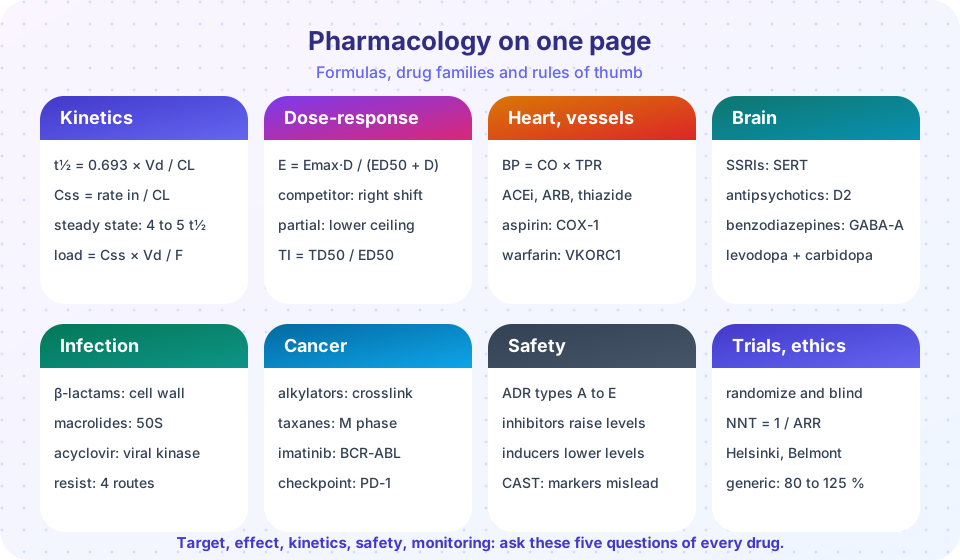
A one-page pharmacology revision sheet with the key equations, drug families by system, safety rules, trial statistics and ten rules of thumb, with a poster summary.
This page is meant to be printed, bookmarked or copied into your own notes. It does not teach anything new. It gathers the ideas that did most of the work in the course, in the order you are likely to need them: the five questions, the equations, the drug families by system, the safety rules and the statistics of evidence. If a line here does not ring a bell, follow the lesson it came from and rebuild the idea from the beginning.
What you will learn
- Recall the central equations and drug families on one page.
- Use ten rules of thumb to check your reasoning.
- Spot the common traps that catch learners.
How to use this sheet
Do not read the sheet from top to bottom the night before an exam. Cover the answers and try to produce each equation or drug family from memory first, then check. Anything you miss goes on a short list for tomorrow. Over a week, the list shrinks, and what remains is usually the handful of facts that deserve a closer look in the lessons.
The five questions
Ask these of every drug, in this order.
- Target. Receptor, enzyme, channel, transporter or pathogen structure?
- Effect. What changes in the cell and in the organ as a result?
- Kinetics. How is it absorbed, distributed, cleared, and how long does it last?
- Safety. What happens when the same target is hit elsewhere, when other drugs are present, or when the patient is old, young, pregnant, or has organ disease?
- Monitoring. What test or sign shows that it works and that it is not harming?
Key equations
- Concentration after an intravenous dose:
C0 = dose / Vd. - Decay:
C(t) = C0 × 0.5^(t / t½). After n half-lives, one over two to the n remains. - Half-life:
t½ = 0.693 × Vd / CL. - Elimination rate constant:
ke = CL / Vd = 0.693 / t½. - Steady state: reached after about four to five half-lives; after five, 97 percent.
- Average steady-state concentration:
Css,avg = F × dose / (CL × τ). - Loading dose:
Css × Vd / F. Maintenance rate:CL × Css / F. - Oral single dose:
C(t) = F·D·ka / (V·(ka − ke)) × (e^(−ke·t) − e^(−ka·t)). - Hyperbolic dose-response:
E = Emax × D / (ED50 + D). - Competitive antagonist: dose ratio
= 1 + [B] / KB; the curve shifts right and the maximum is unchanged. - Therapeutic index:
TD50 / ED50; smaller means a narrower margin. - Mean arterial pressure:
MAP ≈ cardiac output × peripheral resistance. - Risk:
RRR = (control − treated) / control;ARR = control − treated;NNT = 1 / ARR. - Interaction with one enzyme:
AUC ratio = 1 / (fm × activity + (1 − fm)).
Drug families by system
Autonomic and cardiovascular. Acetylcholine acts on nicotinic channels and muscarinic G-protein receptors; norepinephrine acts on α1, α2, β1 and β2. Atropine blocks muscarinic receptors, salbutamol activates β2, and beta-blockers block β1 (and β2 if non-selective). Blood pressure drugs lower volume (thiazides), output (beta-blockers, verapamil) or resistance (ACE inhibitors, ARBs, dihydropyridines). ACE inhibitors raise bradykinin (cough, angioedema). Aspirin blocks COX-1 irreversibly, clopidogrel blocks P2Y12, warfarin blocks VKORC1, apixaban blocks factor Xa and dabigatran blocks thrombin. Statins block HMG-CoA reductase.
Central nervous system. Four messengers: glutamate, GABA, dopamine and serotonin. NSAIDs block COX, opioids activate mu receptors, local anesthetics block sodium channels, general anesthetics enhance GABA-A or block NMDA. SSRIs block SERT, antipsychotics block D2, benzodiazepines enhance GABA-A, lithium has a narrow window. Antiseizure drugs block sodium channels, enhance GABA, block T-type calcium channels or bind SV2A. Levodopa with carbidopa replaces dopamine.
Infection. Beta-lactams and vancomycin block the cell wall; aminoglycosides and tetracyclines bind 30S; macrolides, linezolid and clindamycin bind 50S; quinolones block gyrase; trimethoprim and sulfonamides block folate; rifampicin blocks RNA polymerase. Resistance arises by destroying, pumping out, changing the target or reducing entry. Acyclovir is activated by viral kinase. Azoles block ergosterol synthesis, amphotericin B binds ergosterol, echinocandins block the glucan wall. Artemisinin is used in combinations.
Cancer. Alkylators and platinum drugs crosslink DNA, antimetabolites act in S phase, taxanes and vinca alkaloids act in M phase, imatinib blocks BCR-ABL, PARP inhibitors exploit BRCA loss, and checkpoint inhibitors release T cells.
Safety rules
- Adverse reactions: A augmented, B bizarre, C chronic, D delayed, E end of use.
- CYP inhibitors (clarithromycin, azoles, ritonavir, grapefruit) raise levels. CYP inducers (rifampicin, carbamazepine, phenytoin, St John's wort) lower levels, and the effect fades over weeks after stopping.
- Narrow-index drugs need blood tests: lithium, phenytoin, digoxin, warfarin (INR), aminoglycosides.
- Thiazides, NSAIDs and ACE inhibitors raise lithium levels.
- Opioids with benzodiazepines or alcohol can stop breathing.
- Do not stop beta-blockers, clonidine, benzodiazepines or antiseizure drugs suddenly.
- Pregnancy: avoid ACE inhibitors, ARBs, valproate, statins and warfarin unless a specialist decides otherwise.
Evidence and ethics
- A fair trial randomizes, blinds, pre-registers its outcomes and analyzes by intention to treat.
- Always ask for the baseline risk: the same relative reduction can mean an NNT of 8 or of 250.
- Surrogates can mislead (CAST). Approval means that benefit outweighs known risk, and monitoring continues afterward.
- Generics: bioequivalence, with AUC and Cmax ratios within 80 to 125 percent.
- Ethics: Nuremberg (consent), Helsinki (ethics review), Belmont (respect, beneficence, justice).
Ten rules of thumb
- Name the target before you predict the effect.
- Side effects are usually the main effect in the wrong place.
- Five half-lives to steady state, and five half-lives to wash out.
- Halve the clearance and, for the same dose, the level doubles.
- A prodrug depends on the enzyme that activates it.
- A narrow therapeutic index means blood tests and attention to interactions.
- Combination therapy slows resistance in infection and cancer.
- Check whether a drug is a substrate, an inhibitor or an inducer of CYP enzymes.
- Ask for absolute risk, not only relative risk.
- When in doubt, ask a pharmacist.
Common traps
Confusing potency with efficacy. A drug needing a smaller dose is not necessarily stronger.
Forgetting that onset can lag behind the target. Warfarin and antidepressants act slowly for different reasons: factor decay in one case and slow adaptation in the other.
Assuming the effect stops when the drug stops. Aspirin's effect on platelets lasts a week, and enzyme induction lasts weeks after rifampicin ends.
Try it
First, the equations as a small function library. Change the numbers to explore how the formulas respond. For example, change the clearance and watch the half-life and the average level move.
Press Run (or Ctrl + Enter) to see the result here.
Program input · what you'd type while the program runs
Type the answers before you press Run, one per line. Each time the program reads a line (with input()), it gets the next line from this box.
Second, three quick calculators on one page. Choose a formula, enter the numbers and read the answer.
Check your understanding
Quick check · 4 questions
of 4 answered You scored / 4 · perfect!
-
1. A drug has Vd = 70 L and CL = 3.5 L/h. What is its approximate half-life?
t½ = 0.693 × 70 / 3.5 = 13.9 h. -
2. Which rule of thumb describes the time to steady state?
After five half-lives the level is about 97 percent of steady state. -
3. A competitive antagonist has what effect on a dose-response curve?
More agonist can overcome the blocker, so the maximum stays the same. -
4. Which drug family is NOT correctly matched to its target?
SSRIs block the serotonin transporter SERT.
Summary
- Five questions organize every drug: target, effect, kinetics, safety, monitoring.
- A handful of equations cover most calculations: C0 = dose / Vd, t½ = 0.693 Vd / CL, Css,avg = F D / (CL τ), and NNT = 1 / ARR.
- Safety rules center on interactions, narrow-index drugs, pregnancy and not stopping certain drugs suddenly.
- Trials need randomization, blinding and baseline-risk thinking; ethics rests on consent, review and justice.
Next: Further study
Track your progress
Create a free account to tick off lessons and pick up where you left off on any device.
of Pharmacology lessons completed