


















Lesson 36 of 48 · Anti-Infective and Cancer Drugs
Cancer chemotherapy and targeted drugs
Understand how cytotoxic chemotherapy, kinase inhibitors, antibodies and checkpoint inhibitors work, the log-kill idea, and why cancer drugs have narrow therapeutic windows.
Cancer is not one disease but hundreds, united by cells that divide without proper control. Treatment can involve surgery and radiation, which remove or destroy tumors locally, and drugs, which travel through the blood and reach cancer cells wherever they are. Drug treatment has changed enormously within a single human lifetime. In the 1940s doctors saw the first temporary remissions with nitrogen mustard in lymphoma; in 1948 Sidney Farber produced remissions in children with leukemia using the folate antagonist aminopterin. Today some leukemias, testicular cancer and many childhood cancers are often cured, and diseases once fatal within months, such as chronic myeloid leukemia, are controlled with a daily tablet. This lesson follows the three eras: cytotoxic chemotherapy, targeted drugs and immunotherapy.
Educational information only. Cancer treatment is highly individual and depends on the exact type, stage, tumor genetics and the patient's health. This lesson explains how drug classes work and is not a guide to treatment.
What you will learn
- Explain how cytotoxic drugs exploit cell division and why they harm fast-dividing healthy tissue.
- Describe the fractional kill (log-kill) idea and why treatment is given in cycles.
- Name the major chemotherapy classes with a characteristic toxicity of each.
- Explain how targeted drugs and checkpoint inhibitors differ from chemotherapy.
Key terms
Cytotoxic: toxic to cells; chemotherapy drugs that kill dividing cells.
Targeted therapy: a drug aimed at a specific molecule that drives a cancer, such as a mutated kinase or a hormone receptor.
Tyrosine kinase inhibitor: a drug that blocks an enzyme that switches on growth signals by adding phosphate to tyrosine.
Synthetic lethality: a situation where losing either of two genes is survivable, but losing both kills the cell.
Immune checkpoint: a brake on T cells, such as PD-1, that tumors can exploit to avoid attack.
Cytotoxic chemotherapy
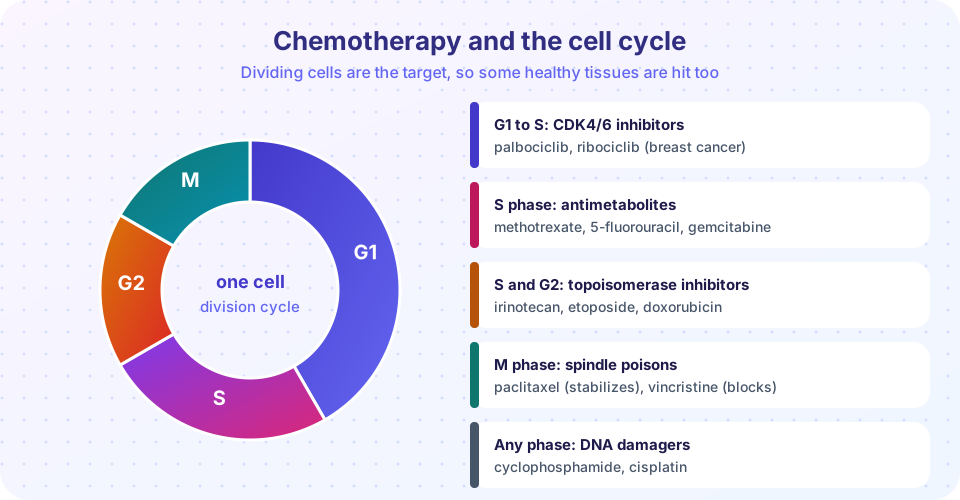
Classic chemotherapy works because cancer cells divide more often than most normal cells. Each class interferes with a step in DNA copying or cell division. The picture above shows where in the cycle they act.
Alkylating agents and platinum drugs (cyclophosphamide, cisplatin) attach chemical groups to DNA and form crosslinks, so the cell cannot copy its genome. Cyclophosphamide breaks down into a metabolite, acrolein, that irritates the bladder, which is prevented with the drug mesna and extra fluids. Cisplatin transformed the treatment of testicular cancer, where cure rates now exceed 90 percent, but it can damage kidneys and hearing and causes intense nausea.
Antimetabolites look like building blocks of DNA or the vitamins needed to make them, and block the enzymes that use them. Methotrexate blocks dihydrofolate reductase, so cells cannot make the folate coenzymes used in DNA synthesis. Folinic acid (leucovorin) can be given afterward to "rescue" healthy cells. 5-fluorouracil blocks thymidylate synthase. Gemcitabine is built into DNA and stops it extending. They act in S phase and so act mostly on cells that are copying DNA.
Topoisomerase inhibitors (irinotecan, etoposide) trap enzymes that untangle DNA, so strand breaks pile up. Anthracyclines such as doxorubicin intercalate in DNA and poison topoisomerase II. They have a unique cumulative heart toxicity: the risk of heart failure rises with total lifetime dose, which is why total doses are capped.
Antimicrotubule drugs act in M phase on the spindle that pulls chromosomes apart. Paclitaxel locks microtubules in a rigid, stable state, while vincristine prevents them forming. Both cause nerve damage (peripheral neuropathy). Vincristine is a famous safety case: injected into the spinal fluid by mistake, it is fatal, so it is only given into a vein and prepared with special labeling.
Because these drugs hit all fast-dividing cells, their side effects are predictable: bone marrow suppression (low white cells with infection risk, low platelets, anemia), mucositis and diarrhea from the gut lining, hair loss, and nausea and vomiting through the vomiting center, which is relieved by 5-HT3 blockers such as ondansetron. Growth factors such as G-CSF help marrow recovery. Fertility can be affected, and some drugs slightly raise the risk of a second cancer years later.
The log-kill idea
In the 1960s, Howard Skipper and colleagues studied leukemia in mice and proposed the fractional cell kill hypothesis: a dose of drug kills a constant fraction of the cancer cells, not a constant number. If a cycle kills 99.9 percent of the cells (a "3-log" kill), a tumor of 10^9 cells, which is about a gram and near the limit of detection, falls to 10^6 and not to zero. Between cycles surviving cells regrow. The aim is that each cycle removes more than the regrowth adds back, so repeated cycles reach a very small number of cells that the immune system can clear. This explains why chemotherapy is given in cycles with rest periods for normal tissue to recover, why doses are kept as high as tolerated, and why a few resistant cells can cause relapse. The hypothesis is a simplification, because real tumors are mixtures of different cells, but it explains the structure of many treatment schedules.
Targeted therapy
The discovery of the genes that drive cancer led to drugs designed against specific molecules. The model case is chronic myeloid leukemia (CML). Almost all patients have the Philadelphia chromosome, a swap of DNA between chromosomes 9 and 22 that creates the fusion gene BCR-ABL. It makes an always-on tyrosine kinase that drives the leukemia. Imatinib, developed by Brian Druker, Nicholas Lydon, Charles Sawyers and colleagues and approved in 2001, blocks the ATP-binding site of that kinase. It changed CML from a disease with a poor outlook to one where most patients treated with a daily tablet can expect a near-normal life expectancy. Resistance still occurs through mutations in the kinase, which led to second- and third-generation drugs.
Other targeted drugs follow the same pattern: find the driver, make a drug that blocks it, and test the drug in patients who have that driver.
- Antibodies against surface receptors. Trastuzumab binds HER2, a growth-factor receptor overproduced in about one in five breast cancers, and helps patients whose tumors carry the amplification. A known risk is cardiac toxicity.
- Kinase inhibitors. Osimertinib for EGFR-mutant lung cancer and vemurafenib for BRAF V600E melanoma follow the imatinib model.
- Hormone therapy. Tamoxifen blocks the estrogen receptor and aromatase inhibitors lower estrogen synthesis in estrogen receptor positive breast cancer, while androgen deprivation therapy treats prostate cancer.
- PARP inhibitors. Olaparib exploits synthetic lethality. Cells with mutated BRCA1 or BRCA2 cannot repair some DNA damage accurately, so they depend on PARP for backup repair. Blocking PARP is toxic to BRCA-mutant tumor cells and much less so to normal cells with one working copy of the gene.
- CDK4/6 inhibitors such as palbociclib stop the cell cycle at the G1 to S transition and are used in hormone receptor positive breast cancer.
Targeted drugs need a biomarker, a test showing that the tumor has the target. Without it they are no better than placebo, and with it they can transform outcomes. They generally have milder side effects than cytotoxics, but not mild: rash and diarrhea with EGFR inhibitors, high blood pressure with drugs that block blood vessel growth. Tumors still evolve resistance, so drugs are used in sequence or in combinations.
Immunotherapy
The immune system can kill cancer cells, but tumors learn to switch T cells off. A T cell displays the surface proteins CTLA-4 and PD-1, which act as brakes. Checkpoint inhibitors are antibodies that release the brake: ipilimumab blocks CTLA-4, and pembrolizumab and nivolumab block PD-1. James Allison and Tasuku Honjo shared the 2018 Nobel Prize for discovering these brakes. The drugs produce durable responses in some patients with melanoma, lung cancer and others, which was unusual in advanced disease. They also cause immune-related adverse events, because the released immune system attacks normal tissues: colitis, hepatitis, thyroid disease, skin and lung inflammation. They are treated with immunosuppressants such as corticosteroids. CAR-T cell therapy goes further by engineering a patient's own T cells to recognize a protein on the tumor, and has produced remissions in some blood cancers.
Common misconceptions
"Chemotherapy kills only cancer cells." It kills dividing cells, which include some normal ones. The side effects are the price of this limited selectivity.
"Targeted therapy has no side effects." It has different ones. Some, such as rash or high blood pressure, are common.
"Cancer drugs fail because patients do not tolerate them." Many fail because tumors are genetically diverse and evolve, so resistant cells survive.
Try it
First, the log-kill model. A tumor starts at 10^9 cells. Each cycle kills a fixed fraction, and the survivors regrow during the rest period. The numbers below are illustrative and the model is deliberately simple, so it demonstrates the principle and not a prediction for any patient.
Press Run (or Ctrl + Enter) to see the result here.
Program input · what you'd type while the program runs
Type the answers before you press Run, one per line. Each time the program reads a line (with input()), it gets the next line from this box.
Second, a toy illustration of synthetic lethality. Tick the boxes to set whether a cell has working BRCA genes and whether a PARP inhibitor is present. The rule is deliberately simple: a cell dies only when both repair routes are gone. A conceptual demonstration, not a model of any patient.
Check your understanding
Quick check · 5 questions
of 5 answered You scored / 5 · perfect!
-
1. Why does chemotherapy often cause hair loss, mouth sores and low blood counts?
Cytotoxic drugs have limited selectivity for rapidly dividing cells, and some normal tissues divide quickly. -
2. Under the fractional cell kill hypothesis, a cycle that kills 99.9 percent of 10^9 cells leaves about:
A 3-log kill leaves one thousandth of the cells, so 10^6 remain, which is why repeated cycles are needed. -
3. What does imatinib block?
Imatinib occupies the ATP site of the fusion kinase that drives chronic myeloid leukemia. -
4. Which drug is limited by a cumulative lifetime dose because of heart toxicity?
Anthracyclines such as doxorubicin damage heart muscle in a dose-dependent, cumulative way. -
5. Checkpoint inhibitors cause immune-related side effects because they:
By unleashing T cells, they can cause colitis, hepatitis, thyroid disease and other inflammatory problems.
Summary
- Cytotoxic drugs (alkylators, antimetabolites, topoisomerase inhibitors, antimicrotubule drugs) exploit cell division and so harm fast-dividing healthy tissues.
- Fractional cell kill explains why chemotherapy is given in cycles and why a few survivors can cause relapse.
- Targeted drugs such as imatinib, trastuzumab and PARP inhibitors need a biomarker and have different side effects.
- Checkpoint inhibitors release the brakes on T cells and cause immune-related adverse events.
Next: Chapter 7 review
Track your progress
Create a free account to tick off lessons and pick up where you left off on any device.
of Pharmacology lessons completed