


















Lesson 8 of 48 · Principles of Drug Action
Drug targets: receptors, ion channels, enzymes and transporters
Tour the four main families of drug target with real examples, learn how enzyme inhibitors differ, meet other targets such as DNA and antibodies, and see why selectivity limits side effects.
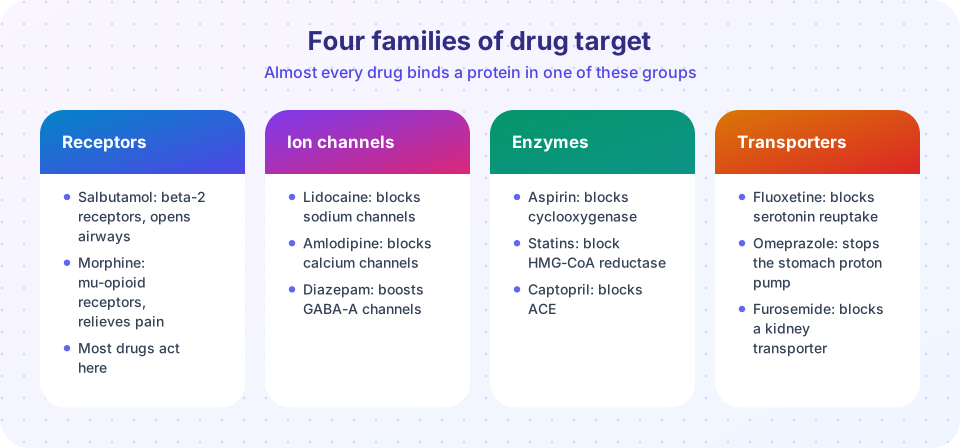
A drug is only as useful as its target. The human body has around twenty thousand protein-coding genes, yet the proteins that today's medicines act on are drawn from a much smaller set, concentrated in a few families. Learning these families gives you a map: when you meet a new drug, ask which family its target belongs to, and you can often predict its effects, its speed of action and its side effects.
What you will learn
- The four main drug-target families, with an example drug for each.
- How competitive, non-competitive and irreversible enzyme inhibitors differ.
- Other targets: nucleic acids, structural proteins, soluble ligands and non-protein targets.
- How selectivity connects targets to side effects.
Key terms
- Ion channel: a membrane protein that forms a pore letting particular ions cross when it opens.
- Enzyme inhibitor: a drug that reduces the rate of an enzyme-catalyzed reaction.
- Transporter (carrier): a membrane protein that moves a molecule or ion across the membrane, sometimes using energy.
- Substrate: the molecule that an enzyme or transporter acts upon.
- Km and Vmax: the substrate concentration giving half the maximum rate, and the maximum rate of an enzyme.
Receptors
You met receptors in the last lesson. Drugs acting here either imitate the natural messenger (agonists) or block it (antagonists). Salbutamol activates beta-2 adrenergic receptors in the airways, so the muscle relaxes and the airway opens. Morphine activates mu-opioid receptors in the brain and spinal cord to reduce pain. Propranolol blocks beta receptors in the heart and slows it. Because receptors are tuned to the body's own messages, receptor drugs are often potent and selective, and their effects mirror physiology: you can predict the effect from what the natural messenger does.
Ion channels
Ion channels control the electrical activity of nerves, heart and muscle. A drug can block the pore, change the gating (how easily it opens), or act on a regulatory site.
- Lidocaine blocks voltage-gated sodium channels in nerve fibres, which prevents action potentials and numbs the area.
- Amlodipine blocks L-type calcium channels in vascular smooth muscle, relaxing arteries and lowering blood pressure.
- Diazepam binds a site on the GABA-A receptor channel (not the site where GABA itself binds) and makes the channel open more effectively in response to GABA, so inhibition in the brain increases. This is called positive allosteric modulation.
- Sulfonylureas such as gliclazide close ATP-sensitive potassium channels in pancreatic beta cells, depolarizing them and increasing insulin release.
Enzymes
Enzymes are the commonest drug targets after receptors. Many drugs are enzyme inhibitors.
- Aspirin irreversibly acetylates cyclooxygenase (COX), which stops the production of prostaglandins and thromboxane. Platelets cannot make new enzyme, so the effect on platelets lasts for their lifetime of about a week, which is the basis for low-dose aspirin in preventing clots.
- Statins such as atorvastatin competitively inhibit HMG-CoA reductase, the rate-limiting enzyme of cholesterol synthesis in the liver, lowering LDL cholesterol.
- ACE inhibitors such as captopril and ramipril block angiotensin-converting enzyme, so less angiotensin II (a vasoconstrictor) is made.
- Allopurinol inhibits xanthine oxidase and lowers uric acid in gout.
- A few drugs are enzyme substrates that make a toxic product (for example, some chemotherapy drugs), and a few drugs are enzymes themselves (for example, alteplase, a clot-dissolving enzyme).
How enzyme inhibitors differ. Plotting reaction rate v against substrate concentration [S] gives the Michaelis-Menten curve v = Vmax × [S] / (Km + [S]). A competitive inhibitor binds the same site as the substrate. It raises the apparent Km (you need more substrate to reach half the maximum) but leaves Vmax unchanged, because enough substrate can outcompete it. A non-competitive inhibitor binds elsewhere and lowers Vmax without changing Km. An irreversible inhibitor (like aspirin on COX) forms a covalent bond, permanently removing enzyme molecules until new ones are synthesized, so its effect outlasts its presence in the blood.
Transporters
Transporters move ions, nutrients and neurotransmitters across membranes. Blocking them changes the concentration of their substrate in a compartment.
- Fluoxetine and other SSRIs block the serotonin transporter, which removes serotonin from the synapse, so serotonin stays active longer.
- Omeprazole irreversibly inhibits the H+/K+ ATPase (the proton pump) of stomach parietal cells, reducing acid secretion.
- Furosemide, a loop diuretic, blocks the Na+/K+/2Cl- cotransporter (NKCC2) in the loop of Henle of the kidney, so salt and water are lost in urine.
- Digoxin inhibits the Na+/K+ ATPase pump in heart muscle cells, increasing intracellular calcium and the force of contraction.
Other targets
Not every drug acts on those four families.
- Nucleic acids. Cisplatin forms cross-links in DNA, and some antivirals imitate nucleosides so that a viral polymerase builds a faulty chain.
- Structural proteins. Colchicine and the vinca alkaloids bind tubulin, so microtubules cannot work, which is useful for gout and for stopping cancer cell division.
- Soluble molecules. Monoclonal antibodies such as adalimumab bind a circulating signal (tumour necrosis factor) so that it cannot reach its receptor. Digoxin-binding antibody fragments neutralize the drug itself in overdose.
- Non-protein targets. Antacids neutralize stomach acid chemically. Osmotic laxatives and mannitol draw water by osmosis. Chelators such as EDTA or dimercaprol bind metals.
Selectivity and side effects
No drug is perfectly selective. Two things explain nearly all side effects. First, the same target in another tissue: a beta-blocker acts on beta receptors in the heart (wanted) and in the airways (a risk in asthma). Second, a different target: some antihistamines also block muscarinic receptors, causing dry mouth and drowsiness. Medicinal chemists therefore aim for drugs that are selective for a receptor subtype (such as beta-1 over beta-2) or for a tissue (such as locally delivered inhaled steroids).
A related principle is target validation: before investing in a target, researchers look for evidence that changing it will treat the disease, for example from human genetics. Many drug candidates fail in clinical trials because their target turns out to matter less than hoped.
Common misconceptions
- "An enzyme inhibitor works by destroying the enzyme." Most competitive inhibitors simply occupy the active site reversibly. Only irreversible inhibitors permanently disable enzyme molecules.
- "Blocking a receptor and blocking an enzyme do the same thing." Blocking a receptor stops a signal at the receiving end. Blocking an enzyme reduces the production of a signal or product.
- "All side effects come from the drug acting on the wrong target." Many come from the right target in the wrong place, or from too much effect at the right place.
Try it
First, see how the type of inhibitor changes an enzyme's curve. The plot uses made-up constants for a generic enzyme.
Press Run (or Ctrl + Enter) to see the result here.
Program input · what you'd type while the program runs
Type the answers before you press Run, one per line. Each time the program reads a line (with input()), it gets the next line from this box.
Second, sort drugs into target families. It is a teaching game to fix the examples in memory.
Check your understanding
Quick check · 5 questions
of 5 answered You scored / 5 · perfect!
-
1. A competitive enzyme inhibitor typically changes which constant?
Competitive inhibitors compete with the substrate, so more substrate is needed for half the maximum, but a high enough substrate level still reaches Vmax. -
2. Diazepam acts as a positive allosteric modulator of which target?
It binds a separate site on the GABA-A receptor and enhances the effect of GABA. -
3. Why does low-dose aspirin affect platelets for about a week?
Aspirin acetylates COX covalently. Platelets have no nucleus, so the block lasts for their life span. -
4. Which drug acts on a transporter?
Omeprazole inhibits the H+/K+ ATPase, a pump (transporter) in stomach cells. -
5. Which side effect arises from the same target in a different organ?
Beta receptors are in both heart and airways, so blocking them can affect both.
Summary
- Most drugs act on receptors, ion channels, enzymes or transporters; others act on DNA, structural proteins, soluble ligands or by simple chemistry.
- Receptor drugs imitate or block messengers; channel drugs block or modulate pores; enzyme inhibitors cut a reaction; transporter drugs change how much of a substance crosses a membrane.
- Competitive inhibitors raise Km; non-competitive inhibitors lower Vmax; irreversible ones remove enzyme until it is resynthesized.
- Side effects come from the same target in other tissues or from other targets, so selectivity matters.
Next: Agonists and antagonists
Track your progress
Create a free account to tick off lessons and pick up where you left off on any device.
of Pharmacology lessons completed