


















Lesson 4 of 48 · Getting Started
Routes of administration: how drugs get in
Compare oral, sublingual, rectal, inhaled, topical, transdermal and injected routes: speed, first-pass effect, convenience, risks and examples, with a plot and a route explorer.
The route by which a drug enters the body changes almost everything about how it behaves: how fast it starts working, how much of it arrives, how long the effect lasts, and what can go wrong. The same molecule can be life-saving by one route and useless by another. Insulin works when injected but is digested if swallowed. Glyceryl trinitrate (nitroglycerin) relieves angina in minutes under the tongue but is largely destroyed by the liver if swallowed. This lesson compares the main routes and gives you a simple way to choose between them in principle.
What you will learn
- The difference between enteral, parenteral and local routes.
- The advantages and disadvantages of the main routes, with examples.
- What the first-pass effect is and which routes avoid it.
- How the route changes the shape of the concentration-time curve.
Key terms
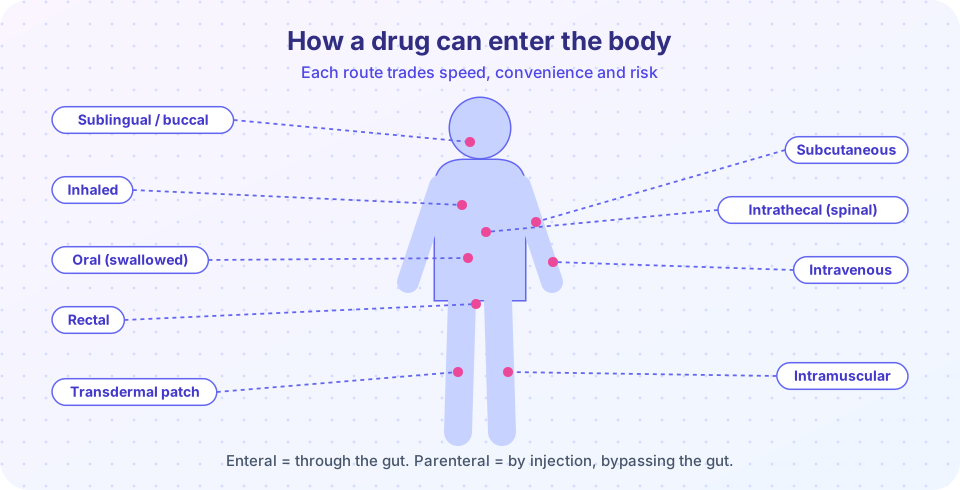
- Enteral: given through the gastrointestinal tract (mouth, stomach, intestine, rectum).
- Parenteral: given by injection, bypassing the gut. The word comes from Greek for "beside the intestine".
- First-pass effect: drug absorbed from the gut passes through the liver before reaching the rest of the body, where part is removed.
- Bioavailability (F): the fraction of a dose that reaches the systemic circulation unchanged.
- Onset of action: the time from giving the drug to the start of its effect.
Enteral routes
Oral (by mouth, "per os"). Tablets, capsules, liquids and powders are swallowed, dissolve, and are absorbed mostly in the small intestine. Oral is the most common route because it is simple, painless, cheap and needs no trained person. The disadvantages are that onset is slow (typically 30 to 90 minutes), absorption varies with food and stomach emptying, stomach acid and enzymes can destroy some drugs, and everything absorbed passes through the liver first. Patients who are vomiting, unconscious or unable to swallow cannot use it. Formulations can modify the pattern: enteric-coated tablets resist stomach acid, and modified-release or extended-release forms dissolve slowly so the drug is taken once or twice daily.
Sublingual and buccal. A small tablet or spray is held under the tongue (sublingual) or against the cheek (buccal). The mouth lining is thin and richly supplied with blood, and the veins drain into the general circulation rather than the liver. Absorption is quick, and the first-pass effect is avoided. This suits small, lipid-soluble molecules, for example glyceryl trinitrate for angina, which acts within minutes.
Rectal. A suppository or enema delivers the drug into the rectum. It is useful when the patient cannot swallow, for example in vomiting or during a seizure (rectal diazepam has been used), and for local effects on the bowel. The lower rectal veins drain into the systemic circulation, so about half of the drug avoids the first pass, but absorption is irregular and many patients dislike the route.
Parenteral routes
Intravenous (IV). The drug goes directly into a vein, so bioavailability is 100% by definition and the effect begins within seconds to minutes. IV is essential in emergencies, for drugs that are not absorbed by other routes, and for fine control through an infusion. The risks are the highest of any route: no way to recall the dose, risk of infection, irritation of the vein, and rapid toxicity if the dose or speed is wrong. IV drugs must be sterile solutions without particles.
Intramuscular (IM). The drug is injected into a large muscle, such as the thigh or upper arm. The muscle has a good blood supply, so absorption is quick (usually minutes) and reliable. IM is used for vaccines, some antibiotics and adrenaline for severe allergic reactions (anaphylaxis). It is painful, can cause local damage, and should be avoided in people who have bleeding problems.
Subcutaneous (SC). The drug is injected into the fat just under the skin. Absorption is slower and steadier than IM because blood flow is lower. Insulin, heparin and many modern biologics are given this way, often by the patient using a pen. Rotating injection sites prevents lumps that disrupt absorption.
Intrathecal and epidural. A needle places the drug in the cerebrospinal fluid around the spinal cord (intrathecal) or just outside the protective membranes (epidural). This allows a very small dose to reach the nerves directly. It is used for spinal anesthesia, some pain treatments and certain chemotherapy. The risks are serious (infection, nerve damage), so it needs specialist skill.
Other routes
- Inhalation. Gases, vapors, aerosols and powders are breathed in. The lungs have an enormous, thin absorbing surface, so the effect is fast, and the dose can be delivered right where it is needed for asthma (salbutamol) while the amount reaching the rest of the body stays small. General anesthetic gases also use this route. Technique matters: many patients do not use inhalers correctly.
- Topical. Creams, ointments, drops and gels act on the skin, eyes, ears or nose. Little reaches the blood, so systemic side effects are low. Strong corticosteroid creams used over large areas can still be absorbed.
- Transdermal. A patch delivers the drug slowly through intact skin into the blood. It gives steady levels for hours or days. It suits potent, lipid-soluble, small molecules such as nicotine, fentanyl, glyceryl trinitrate and some hormones. Onset is slow, and heat (a hot bath, fever) can speed absorption in a harmful way.
- Intranasal. The nasal lining is thin and rich in blood vessels. Sprays can act locally (for hay fever) or systemically (for example naloxone nasal spray in opioid overdose).
Choosing a route
A route is chosen by weighing the clinical situation and the drug. Ask:
- How fast is the effect needed? Cardiac arrest needs IV; a mild headache does not.
- Where should the drug act? Local problems (skin, lung, eye) favour local routes with small systemic exposure.
- Can the drug survive the gut and the liver? Insulin and heparin cannot; they are injected.
- What can the patient manage? Long-term medicines should be simple and painless.
- What are the risks? IV gives control but also the most severe errors.
Route and the concentration curve
The route changes the shape of the concentration-time curve. IV gives the highest starting concentration and then a decline. Oral produces a rise as the drug is absorbed, a peak (Cmax at time Tmax), then a decline, with lower overall exposure when part is lost in the gut wall and liver. A modified-release oral form gives a lower, later and flatter peak. The next code block draws all three for the same 100 mg dose of an imaginary drug.
Common misconceptions
- "Injections are always stronger than tablets." A dose is a dose. The route changes speed and bioavailability, not the inherent strength of the drug.
- "Rectal means the drug acts on the bowel." A suppository can act locally, but the same route is also used to deliver drugs to the whole body.
- "A patch acts instantly." Transdermal systems take hours to build up, which is why they suit chronic needs and not emergencies.
Try it
The first example is a simple pharmacokinetic model: an IV bolus, an oral dose with fast absorption, and a modified-release dose. It is illustrative. The numbers are chosen to show the shapes of curves, not to describe a real drug.
Press Run (or Ctrl + Enter) to see the result here.
Program input · what you'd type while the program runs
Type the answers before you press Run, one per line. Each time the program reads a line (with input()), it gets the next line from this box.
The second example is a route explorer. Click a route to see typical features. The values are broad, typical ranges used for teaching; real onsets depend on the drug and the patient.
Check your understanding
Quick check · 5 questions
of 5 answered You scored / 5 · perfect!
-
1. Which route has a bioavailability of 100% by definition?
An IV dose is placed directly in the blood, so all of it reaches the systemic circulation. -
2. Why does a sublingual tablet avoid the first-pass effect?
Veins from the mouth lining empty into the systemic circulation before the drug passes through the liver. -
3. A patient is vomiting and has a seizure. Which route can still be used for some drugs?
The rectal route works when swallowing is impossible, and diazepam has been given rectally for seizures. -
4. Why is insulin not taken by mouth?
Insulin is a peptide hormone that digestive enzymes break down, so it is injected. -
5. In the plot, what happens when the oral dose is modified-release?
Slower absorption flattens and delays the peak, which suits once-daily dosing.
Summary
- Enteral routes use the gut (oral, sublingual, rectal); parenteral routes are injections (IV, IM, SC, intrathecal); other routes include inhaled, topical, transdermal and intranasal.
- Oral is convenient but slow and subject to first pass; sublingual and IV avoid it; IV gives 100% bioavailability and the fastest, most controllable effect with the highest risk.
- Local routes (inhaled, topical) deliver drug where needed with fewer systemic effects.
- The route changes onset, peak height and duration; modified-release forms flatten and delay the peak.
Track your progress
Create a free account to tick off lessons and pick up where you left off on any device.
of Pharmacology lessons completed