


















Lesson 30 of 48 · Central Nervous System Drugs
Drugs for mood, anxiety and psychosis
How SSRIs, antipsychotics, benzodiazepines and lithium work, what the evidence shows and does not show, and the side effects that follow from their targets.
Psychiatric drugs were discovered mostly by accident. In the early 1950s, French doctors found that chlorpromazine, tried first as a surgical sedative, calmed people with psychosis. A drug used against tuberculosis, iproniazid, unexpectedly lifted patients' moods. Lithium, a salt, was found in 1949 by the Australian psychiatrist John Cade to calm manic patients. These findings gave scientists a trail to follow back to the brain's chemistry, and the trail led to the monoamine transmitters: serotonin, norepinephrine and dopamine. Seventy years later we know a good deal about what these drugs bind to, and much less about exactly why they relieve symptoms. This lesson covers both the mechanisms and the evidence, including the parts that are still argued about.
Educational information only. This lesson describes how psychiatric drugs work and what research shows. It is not a guide to diagnosis or treatment. People experiencing depression, anxiety, psychosis or thoughts of self-harm should speak to a health professional or a local crisis service, and should not start or stop these medicines on their own.
What you will learn
- Explain how SSRIs, SNRIs, tricyclics and MAOIs change monoamine signalling.
- Describe the four dopamine pathways and why antipsychotics cause both therapeutic and movement effects.
- Explain how benzodiazepines act at GABA-A receptors and why their use is time-limited.
- Describe lithium's narrow therapeutic index and the drug interactions that raise its level.
- Weigh the evidence, including its limits, for antidepressants and antipsychotics.
Key terms
Reuptake: the pumping of a transmitter back into the nerve ending that released it, ending its action.
Receptor occupancy: the fraction of receptors in the brain that have a drug bound, measured by PET imaging.
Extrapyramidal symptoms: movement side effects such as stiffness, tremor, restlessness and abnormal movements caused by blocking dopamine in movement circuits.
Therapeutic drug monitoring: measuring blood levels to keep a drug within its safe range.
Serotonin syndrome: a dangerous excess of serotonin signalling with agitation, tremor, fever and muscle jerks.
Antidepressants
Depression involves low mood, loss of interest, changes in sleep and appetite, and impaired thinking, and it ranges from mild to disabling. The monoamine hypothesis proposed that depression reflects too little serotonin or norepinephrine. It grew from the discovery that reserpine, which empties monoamine stores, caused depression in some patients, while drugs that raised monoamines lifted mood. The hypothesis is now seen as incomplete: drugs raise monoamines within hours, but mood usually improves only after two to six weeks, so downstream brain adaptations, probably involving neural plasticity, must matter. Raising serotonin in a healthy person does not simply produce happiness.
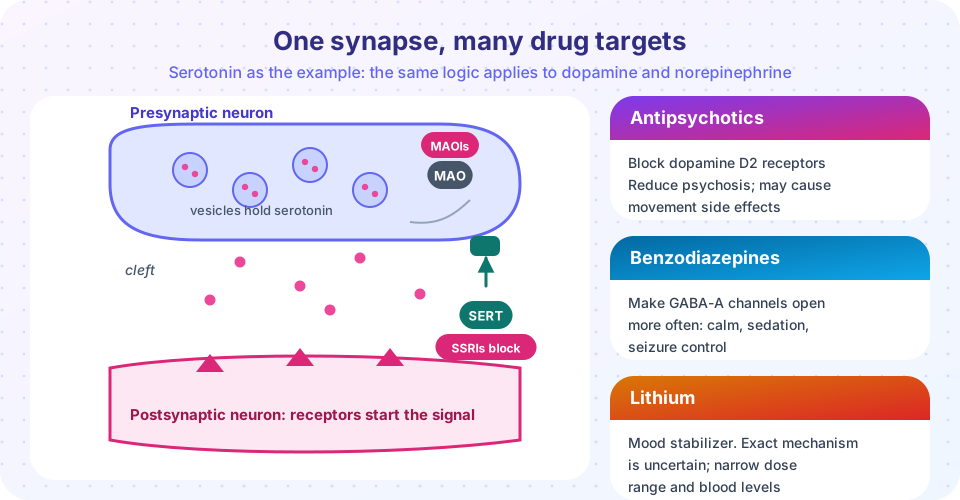
SSRIs (selective serotonin reuptake inhibitors: fluoxetine, sertraline, citalopram, escitalopram, paroxetine) block the serotonin transporter, SERT. Brain imaging suggests that standard doses occupy roughly 80 percent of SERT. They are generally better tolerated than older drugs. Common effects are nausea, headache, sleep changes, and sexual dysfunction, which is common and troublesome. They can cause low blood sodium in older adults and raise the risk of bleeding, particularly with NSAIDs. Serotonin syndrome can follow when serotonergic drugs are combined, especially with an MAO inhibitor, with agitation, sweating, tremor, muscle twitching and fever. Stopping some SSRIs abruptly, paroxetine in particular, can cause discontinuation symptoms: dizziness, "electric shock" sensations and irritability, which is why doses are tapered. In people under 25, regulators in the United States added a warning in the mid-2000s because trials showed a small increase in suicidal thoughts and behavior in the first weeks of treatment; patients and families are told to watch for changes.
SNRIs (venlafaxine, duloxetine) block both serotonin and norepinephrine transporters and can raise blood pressure. Tricyclic antidepressants (amitriptyline, imipramine) also block those transporters but additionally block muscarinic, histamine H1 and α1 receptors, causing dry mouth, constipation, sedation and dizziness on standing. They are dangerous in overdose because they disturb heart conduction. MAO inhibitors (phenelzine, tranylcypromine) stop the enzyme that breaks down monoamines. They are effective but need dietary care: tyramine in aged cheeses and some other foods can then cause a hypertensive crisis, the "cheese reaction", and a washout of about two weeks is needed before starting another antidepressant. Mirtazapine blocks α2 and H1 receptors, causing sedation and weight gain. Bupropion acts on dopamine and norepinephrine and lowers the seizure threshold. Esketamine, a nasal form of the NMDA blocker ketamine, can relieve severe depression within hours in some patients, but is given only under supervision because of dissociative effects and misuse potential.
What does the evidence say? A large network meta-analysis by Cipriani and colleagues (2018, 522 trials) found that all 21 antidepressants studied worked better than placebo in adults with major depression, with small-to-moderate average effects. Researchers such as Irving Kirsch argued that the average difference from placebo is small and may be below what patients notice, particularly in mild depression, and that the placebo response is large. Both views contain truth. The average masks big individual differences, benefit appears more clearly in severe depression, and many people do well on a drug that they first need to try. Large real-world trials such as STAR*D showed that about a third of patients reached remission with the first drug and that several steps were often needed, although the headline cumulative figures have been disputed. Psychotherapy such as cognitive behavioral therapy is about as effective for many people and is often combined with drugs.
Antipsychotics
Psychosis involves losing contact with shared reality: hallucinations, delusions and disorganized thinking. Schizophrenia is the best-known cause. Antipsychotics all block dopamine D2 receptors, a fact established in the 1970s when the potency of the drugs was found to track their D2 binding. The brain has four main dopamine pathways, and each explains a part of the picture:
| Pathway | Function | Effect of D2 blockade |
|---|---|---|
| Mesolimbic | reward, salience | reduces hallucinations and delusions (therapeutic) |
| Mesocortical | thinking, motivation | may worsen negative symptoms |
| Nigrostriatal | movement | stiffness, tremor, restlessness, abnormal movements |
| Tuberoinfundibular | inhibits prolactin | raised prolactin: breast milk, missed periods |
A drug cannot be aimed at one pathway, so therapeutic and unwanted effects come together. PET studies suggest that clinical response needs about 65 to 80 percent D2 occupancy, with movement side effects increasing above about 80 percent.
First-generation drugs (chlorpromazine, haloperidol) cause the most movement effects: acute muscle spasms, parkinsonism, akathisia (an inner restlessness) and tardive dyskinesia, a late-appearing movement disorder that can persist. A rare but serious reaction, neuroleptic malignant syndrome, combines fever, rigidity and altered consciousness. Second-generation drugs (olanzapine, risperidone, quetiapine, aripiprazole) have less movement disturbance but often cause weight gain, high blood sugar and lipid changes, so weight, glucose and lipids are monitored. Aripiprazole is a partial agonist at D2. Clozapine is the most effective drug in treatment-resistant schizophrenia, but it can cause agranulocytosis, a dangerous loss of white blood cells, so patients have regular blood counts. The evidence is clear that antipsychotics reduce acute psychotic symptoms and relapse risk better than placebo. They help positive symptoms more than negative ones, and long-term benefits must be weighed against side effects; the best dose and how long to continue are still active research questions.
Benzodiazepines and other anti-anxiety drugs
Anxiety disorders are among the most common mental health problems. Benzodiazepines (diazepam, lorazepam, clonazepam, alprazolam), developed after chlordiazepoxide was synthesized in the 1950s, bind to a site on the GABA-A receptor, a chloride channel. They do not open it themselves but make GABA more effective at opening it, so inhibition is amplified. This explains their effects: calming, sedation, muscle relaxation and seizure control. The antagonist flumazenil reverses them. They are valuable in status epilepticus, in alcohol withdrawal and for short-term relief of severe anxiety or insomnia.
Their risks explain why guidelines usually limit use to weeks. Tolerance develops, dependence follows with regular use, and stopping suddenly can bring rebound anxiety, insomnia and, in severe cases, seizures, so they are tapered slowly. They impair memory and coordination, increase falls in older people and, combined with opioids or alcohol, can stop breathing. For long-term anxiety, SSRIs, SNRIs and cognitive behavioral therapy are first-line treatments. Other options include buspirone, a partial agonist at serotonin 5-HT1A receptors, and propranolol, which can reduce the physical signs of performance anxiety.
Lithium
Lithium remains a mainstay for preventing relapse in bipolar disorder. How it works is not settled; candidates include inhibition of the enzymes glycogen synthase kinase-3 and inositol monophosphatase. Its pharmacology is dominated by a narrow therapeutic index: blood levels in a range of roughly 0.6 to 1.0 mmol/L are targeted, and toxicity (tremor, vomiting, confusion, unsteady gait, then seizures) appears not far above it. The kidney handles lithium much as it handles sodium, so anything that lowers sodium or reduces kidney blood flow raises lithium levels. Dehydration, thiazide diuretics, ACE inhibitors and ARBs, and NSAIDs are the classic interacting drugs, a direct link to chapter 5. Long-term use can affect the thyroid and kidneys, and use in pregnancy needs careful specialist judgment. Regular blood tests are part of treatment.
Common misconceptions
"Depression is just a serotonin deficiency." The picture is more complex. Serotonin drugs help many people, but the delay in action and the lack of a simple serotonin deficit in studies show that the monoamine idea is only part of the story.
"Antidepressants are addictive." They do not cause craving or compulsive use, but stopping suddenly can cause discontinuation symptoms, which is why tapering is advised.
"Antipsychotics sedate people without treating anything." They reduce hallucinations and delusions in controlled trials, although sedation and other side effects are real and must be balanced.
Try it
First, a model of receptor occupancy. PET studies show that clinical effects track occupancy. The code uses a hyperbolic binding curve with illustrative parameters (an antipsychotic ED50 of 1 mg a day and an SSRI ED50 of 5 mg a day) and shades the commonly quoted windows. The numbers show the shape of the relationship, not the properties of a specific drug.
Press Run (or Ctrl + Enter) to see the result here.
Program input · what you'd type while the program runs
Type the answers before you press Run, one per line. Each time the program reads a line (with input()), it gets the next line from this box.
Second, the lithium interaction. At steady state, the blood level equals the dosing rate divided by clearance. A drug that cuts clearance by a quarter raises the level by a third. The numbers are illustrative; real patients need blood tests.
Press Run (or Ctrl + Enter) to see the result here.
Program input · what you'd type while the program runs
Type the answers before you press Run, one per line. Each time the program reads a line (with input()), it gets the next line from this box.
Check your understanding
Quick check · 6 questions
of 6 answered You scored / 6 · perfect!
-
1. SSRIs act mainly by:
Blocking SERT keeps serotonin in the synaptic cleft for longer. -
2. Which dopamine pathway explains parkinson-like side effects of antipsychotics?
Blocking D2 receptors in the nigrostriatal pathway disturbs movement control. -
3. Which antipsychotic requires regular blood counts because of the risk of agranulocytosis?
Clozapine is the drug with the strongest evidence in treatment-resistant schizophrenia, and the white blood cell count must be monitored. -
4. Benzodiazepines act on the GABA-A receptor by:
They are positive allosteric modulators: they need GABA present and amplify its effect. -
5. Which drug can RAISE lithium blood levels?
Thiazides lower sodium and reduce the kidney's lithium clearance, so levels rise. NSAIDs and ACE inhibitors do the same. -
6. What best summarizes the evidence for antidepressants?
Large meta-analyses show average benefit over placebo that is modest, larger in severe depression, with wide variation between individuals.
Summary
- SSRIs block SERT; SNRIs, tricyclics and MAOIs act on other points in monoamine signalling; benefit often takes weeks, so the monoamine picture is incomplete.
- Antipsychotics block D2 receptors; pathway differences explain why they treat psychosis but also cause movement, prolactin and metabolic effects.
- Benzodiazepines amplify GABA-A inhibition and are used short term because tolerance, dependence and withdrawal develop.
- Lithium has a narrow therapeutic index, and thiazides, ACE inhibitors, ARBs, NSAIDs and dehydration raise its level.
Track your progress
Create a free account to tick off lessons and pick up where you left off on any device.
of Pharmacology lessons completed