


















Lesson 39 of 48 · Drug Development, Safety and Ethics
From laboratory to approval: the pipeline and clinical trials
Follow a drug from preclinical testing through phases I to IV, learn how randomized controlled trials work, and how to read relative risk, absolute risk and NNT.
How do we know a drug works? Personal experience is a poor guide. Many illnesses improve on their own, symptoms fluctuate, and people who take a medicine often expect to feel better. The history of medicine is full of treatments that seemed obviously helpful and were later shown to do nothing or to harm. The modern answer is a sequence of increasingly careful experiments, ending in the randomized controlled trial. This lesson follows a candidate drug along that sequence and then explains how to read the numbers a trial produces, which is a skill every clinician and informed patient needs.
Educational information only. This lesson explains how trials are designed and read. It does not evaluate any particular drug or advise on joining a study.
What you will learn
- Describe preclinical studies and why first-in-human trials start with very small doses.
- State the purpose of phases I, II, III and IV.
- Explain randomization, blinding, placebo and intention-to-treat.
- Calculate relative risk reduction, absolute risk reduction and number needed to treat.
Key terms
Endpoint: the outcome a trial measures to judge a drug, such as survival or blood pressure.
Surrogate endpoint: a lab measure or sign used as a stand-in for a clinical outcome, such as LDL cholesterol or HbA1c.
Placebo: an inactive treatment that looks like the drug.
Power: the probability that a trial will detect a real effect of a stated size.
NNT: the number needed to treat, how many people must be treated for one to benefit.
Before humans: preclinical work
A candidate drug first goes through years of laboratory testing. Chemists and biologists measure how strongly it binds its target and how selective it is. Cell studies look for toxicity and for effects on the heart's potassium channels, which can cause the arrhythmia torsades de pointes. Animal studies show how the body handles the drug (absorption, distribution, metabolism, excretion) and what damage it does at higher doses. Toxicologists find the highest dose that caused no observed adverse effect in the most sensitive species, the NOAEL, and use it to choose a safe first dose for humans, with a large safety factor, usually tenfold or more, and scaling for body size.
Animal tests cannot predict everything. In 2006, six healthy volunteers in London were given the antibody TGN1412 as part of a first-in-human study. It had looked safe in monkeys, but in people it triggered a massive release of inflammatory signals (a cytokine storm), and all six became critically ill; all survived. The tragedy led to reforms: more cautious starting doses based on the lowest dose that has any biological effect, and staggered dosing, so that one volunteer is given the drug and observed before the others.
The four phases
Phase I gives the drug to a small number of people, usually 20 to 100 healthy volunteers (patients in the case of cancer drugs), in rising doses. The aim is safety and pharmacokinetics: how fast the drug is absorbed, how long it lasts, what dose causes side effects.
Phase II treats a few hundred patients with the target condition. It looks for the first signs of benefit and finds the dose to test in phase III. This is the stage where most candidates fail.
Phase III is the confirming trial. It enrolls hundreds to many thousands of patients, usually randomized and often blinded, comparing the drug with placebo or the best existing treatment. Two successful phase III trials were the traditional requirement for approval, although regulators can be flexible, especially for rare diseases.
Phase IV is the monitoring after approval, covering large populations and long periods. It can find rare adverse effects, such as one in 10,000, that need tens of thousands of exposures to appear.
After phase III, the sponsor submits a large dossier to the regulator. Lesson 4 describes what happens next.
What makes a trial fair
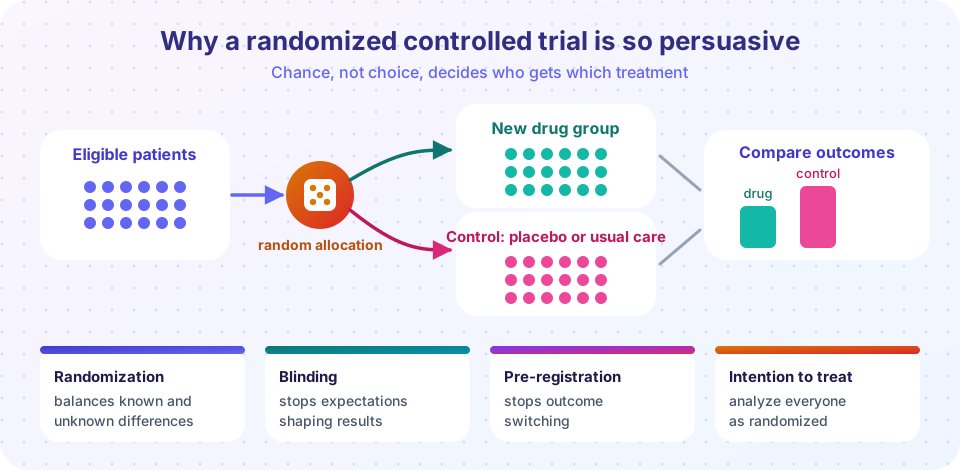
A simple comparison, treating patients with the new drug and comparing with those who were not, is badly biased. Doctors may give the new drug to healthier patients, and people who choose a treatment differ from those who don't. A randomized controlled trial (RCT) fixes this by assigning treatment by chance. The first modern RCT is usually taken to be the British Medical Research Council's streptomycin trial in tuberculosis in 1948, designed by Austin Bradford Hill, though James Lind's 1747 comparison of remedies for scurvy in twelve sailors anticipated the idea.
Four protections are shown in the figure:
- Randomization makes the groups similar, on average, in both known and unknown characteristics, so a difference in outcome can be attributed to the treatment.
- Blinding stops patients (single blind) or patients and doctors and assessors (double blind) from knowing who got what. This matters because expectations influence reported symptoms, and the placebo effect, a real improvement in symptoms with an inert treatment, is strongest for pain, nausea and mood.
- Pre-registration means that the outcomes and analysis plan are written down and published before the trial. This prevents researchers choosing the favorable outcome after seeing the data. Trial registries such as ClinicalTrials.gov exist for this purpose.
- Intention-to-treat analysis analyzes patients in the groups they were randomized to, even if some stopped treatment. It preserves the balance created by randomization and tests the policy of offering the drug.
Other design points matter too. The comparison must be with a relevant control. Non-inferiority trials ask whether a new drug is not worse than an existing one by more than a margin. The sample size must be large enough that a real effect will be seen, which is called having enough power. Adaptive designs let a trial change dose or drop an arm according to pre-planned rules. Independent data monitoring committees can stop a trial early if harm or overwhelming benefit appears.
Choosing the endpoint
A clinical endpoint is something the patient feels or that matters to survival: death, stroke, hospitalization, pain, quality of life. A surrogate endpoint is a measurement that is believed to predict those, such as blood pressure, LDL cholesterol, HbA1c in diabetes or viral load in HIV. Surrogates make trials shorter and smaller, and they have been used well. But history contains warnings. The Cardiac Arrhythmia Suppression Trial in chapter 5 showed drugs that suppressed arrhythmias raising mortality. Surrogates are credible when many trials have shown that improving them improves outcomes, and weak when this has not been confirmed. Regulators sometimes give accelerated approval on a surrogate, on condition that a confirming trial follows.
Reading the numbers
Suppose a trial of a stroke-prevention drug finds that 10 percent of control patients had a stroke over five years, versus 8 percent of treated patients.
- Relative risk is 8 / 10 = 0.8. The relative risk reduction (RRR) is 20 percent.
- Absolute risk reduction (ARR) is 10% - 8% = 2 percentage points.
- NNT = 1 / ARR = 1 / 0.02 = 50. Fifty people must be treated for five years to prevent one stroke.
All three describe the same data. A headline such as "reduces stroke by 20 percent" sounds larger than "2 in 100", but both are true. The same relative effect is worth much more in a high-risk group: if the control risk were 40 percent, a 20 percent relative reduction gives an absolute reduction of 8 points and an NNT of about 12. Always ask what the baseline risk is.
Statistical significance is a separate question. A p-value measures how surprising the data would be if the drug had no effect. A confidence interval shows the range of effects consistent with the data. A tiny effect can be statistically significant in a huge trial and clinically unimportant, and a trial that is too small can miss a real benefit.
Bias can also enter after the trial. Studies with positive results are more likely to be published than negative ones, which is publication bias, and registries help show how many trials were never reported. Trials funded by manufacturers tend to report favorable conclusions more often than independent ones, so readers should look at design and outcomes, not only conclusions.
Common misconceptions
"A significant p-value proves the drug is useful." It says the result is unlikely to be chance. It does not say that the effect is large or clinically meaningful.
"Relative risk reduction tells you how many patients benefit." It does not. Absolute risk and NNT do.
"Placebo means no treatment." Placebo groups get care and monitoring, and they often improve, which is why comparing with them matters.
Try it
First, a power calculation for the stroke example. How many patients per group are needed to have an 80 percent chance of detecting a drop from 10 to 8 percent? The code uses the normal approximation for comparing two proportions, and then runs a quick simulation as a check.
Press Run (or Ctrl + Enter) to see the result here.
Program input · what you'd type while the program runs
Type the answers before you press Run, one per line. Each time the program reads a line (with input()), it gets the next line from this box.
Second, an interactive risk calculator. Set the control and treated risks and read off the relative risk reduction, absolute risk reduction and NNT. It is a calculator for the formulas, so it does not know whether a result is real or what it means for any person.
Check your understanding
Quick check · 5 questions
of 5 answered You scored / 5 · perfect!
-
1. In a trial, 10 percent of the control group and 8 percent of the treated group have a stroke. What is the NNT?
ARR = 2 percentage points = 0.02, so NNT = 1/0.02 = 50. -
2. What is the main purpose of randomization?
Chance allocation balances both measured and unmeasured characteristics between groups. -
3. Why was staggered dosing introduced after the TGN1412 trial?
A severe reaction in the first volunteer can then stop the trial before anyone else is exposed. -
4. Which of these is a surrogate endpoint?
LDL cholesterol is a laboratory measure used as a stand-in for cardiovascular outcomes. -
5. Intention-to-treat analysis analyzes patients:
It preserves the balance created by randomization.
Summary
- Preclinical studies set a cautious first-in-human dose; TGN1412 showed why staggered dosing is needed.
- Phase I tests safety and kinetics, phase II looks for benefit and dose, phase III confirms, and phase IV watches after approval.
- Randomization, blinding, pre-registration and intention-to-treat protect a trial from bias.
- Relative risk reduction, absolute risk reduction and NNT describe the same effect in different ways; always check baseline risk.
Track your progress
Create a free account to tick off lessons and pick up where you left off on any device.
of Pharmacology lessons completed