


















Lesson 23 of 48 · Autonomic and Cardiovascular Drugs
Chapter 5 overview: autonomic and cardiovascular drugs
A big-picture tour of the autonomic nervous system and the drugs that change heart rate, blood pressure, clotting and cholesterol, with a map of chapter 5.
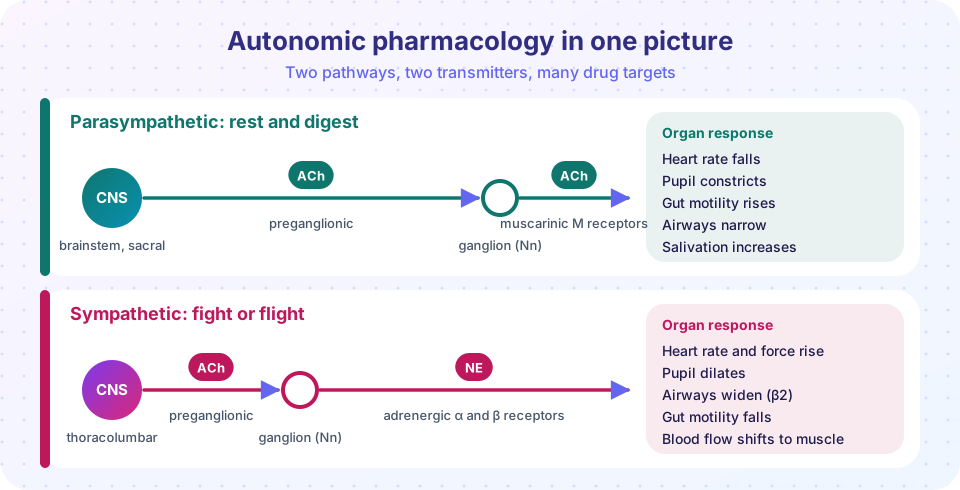
Your heart rate rises when you run for a bus and falls when you sit down. Your pupils narrow in bright light, your gut starts to move after a meal, and your blood vessels tighten when you stand up quickly. None of this needs a conscious decision. It is run by the autonomic nervous system, a network of nerves that adjusts internal organs from second to second. Because it works through a small number of chemical messengers and receptors, it is also one of the most drug-friendly systems in the body. Many of the most widely used medicines in the world act here: blood pressure tablets, asthma inhalers, eye drops, and the drugs that prevent heart attacks and strokes.
This chapter builds on the ideas of the earlier chapters: receptors, agonists and antagonists, dose-response curves and pharmacokinetics. Here you will see them at work in a real organ system. You will meet the two autonomic pathways, learn which receptor sits on which organ, and then follow the drugs that mimic, block or reshape those signals. The second half moves from the nerves to the heart and blood: the drugs that lower blood pressure, thin the blood, reduce cholesterol and steady the heartbeat.
Educational information only. This course explains how drugs work. It is not medical advice, and nothing here tells you whether to start, stop or change any medicine. Doses and decisions belong to a doctor or pharmacist who knows the patient.
What you will learn
- Describe the two branches of the autonomic nervous system and the transmitters each one uses.
- Explain why one receptor-targeting drug can have both wanted and unwanted effects.
- Name the major drug classes for blood pressure, clotting, cholesterol and rhythm.
- See how the lessons in this chapter fit together.
The chapter at a glance
Two branches
Most organs get both, and they usually oppose each other.
Receptors decide
Where a receptor sits explains the drug effect.
Blood pressure
BP = cardiac output × resistance.
Clots and cholesterol
Prevention drugs are judged by outcomes over years.
Where each lesson fits
- The autonomic nervous system and its drugs: the receptors, the agonists and blockers, and how atropine, salbutamol, propranolol and neostigmine each follow from the receptor map.
- Drugs for high blood pressure and heart failure: the RAAS, diuretics, calcium channel blockers and beta-blockers, plus the four pillars of heart failure treatment.
- Antithrombotic, lipid-lowering and antiarrhythmic drugs: aspirin, clopidogrel, warfarin, the direct oral anticoagulants, statins and the Vaughan Williams classes.
- Chapter 5 review: a one-page summary picture and ten mixed questions.
Why this system is such a good drug target
Three features make the autonomic and cardiovascular systems especially useful to a pharmacologist.
First, the messengers are few and well known. Acetylcholine and norepinephrine, together with epinephrine released from the adrenal medulla, control most of the pathway. A drug can copy a messenger (an agonist), block its receptor (an antagonist), stop the messenger being made, or stop it being cleared away. Each of these strategies has produced drugs you will meet in this chapter.
Second, receptor subtypes sort the organs. Adrenergic β1 receptors dominate in the heart and β2 receptors in the airways. That is why a "cardioselective" beta-blocker is chosen for someone with heart disease and mild asthma, and why a β2 agonist opens the airways with less effect on the heart rate. Selectivity is never perfect, which is also why side effects exist.
Third, the effects can be measured. Blood pressure, heart rate, cholesterol and clotting time are numbers you can track. That makes it possible to see a dose-response relationship in a patient, and to test a drug in large trials that count heart attacks and strokes.
A closer look at the double supply
Most organs receive both sympathetic and parasympathetic nerves. The heart is the clearest example. The sinoatrial node, the heart's natural pacemaker, fires on its own at roughly 100 beats per minute in a young adult when it is cut off from all nerve input, as it is in a transplanted heart. Your resting heart rate is lower than this (often 60 to 80 beats per minute) because the vagus nerve, which carries parasympathetic fibers, applies a constant brake. This ongoing braking is called vagal tone. Exercise raises the rate by releasing the vagal brake and adding sympathetic drive.
Some organs break the pattern. Blood vessels have mainly sympathetic supply, so their tone depends on how much norepinephrine acts on α1 receptors. Sweat glands receive sympathetic fibers but use acetylcholine as the postganglionic transmitter. The adrenal medulla acts like a giant sympathetic ganglion and releases epinephrine, mostly, into the blood. Remembering these exceptions is a good exam habit, and it will save you from a wrong guess about a drug effect.
Common misconceptions
"Sympathetic means stimulating and parasympathetic means relaxing." Both branches excite some organs and inhibit others. Sympathetic activity widens the airways but slows the gut. Parasympathetic activity speeds the gut but slows the heart.
"A drug that acts on the autonomic system affects only one organ." Receptors of the same type exist in many places. Atropine blocks muscarinic receptors everywhere, so it speeds the heart, dries secretions and widens the pupil at once.
"Blood pressure drugs only work by widening vessels." Some reduce blood volume (diuretics), some slow the heart (beta-blockers) and some block hormone systems (ACE inhibitors). Different classes attack different terms of the same equation.
Try it
The first example is a toy model of heart rate. It is a demonstration with round numbers, not a clinical tool. It starts at an intrinsic pacemaker rate of about 100 beats per minute, subtracts a vagal brake, and adds sympathetic drive.
Press Run (or Ctrl + Enter) to see the result here.
Program input · what you'd type while the program runs
Type the answers before you press Run, one per line. Each time the program reads a line (with input()), it gets the next line from this box.
The second example is a lookup widget. Pick an organ and see the sympathetic and parasympathetic response and the main receptor involved.
Check your understanding
Quick check · 5 questions
of 5 answered You scored / 5 · perfect!
-
1. Which transmitter acts at the ganglion in BOTH autonomic branches?
Preganglionic neurons in both branches release acetylcholine, which acts on nicotinic receptors in the ganglion. -
2. Why is a resting heart rate usually lower than the pacemaker's intrinsic rate?
The vagus nerve releases acetylcholine onto M2 receptors continuously, which holds the rate below the intrinsic rate. -
3. Which organ response is mediated mainly by sympathetic β2 receptors?
β2 receptors on airway smooth muscle relax it, which is why salbutamol is a bronchodilator. -
4. A drug blocks muscarinic receptors everywhere. Which set of effects is most likely?
Removing the parasympathetic brake speeds the heart, reduces secretions and lets the pupil widen. -
5. Which tissue is an exception to the rule that sympathetic postganglionic nerves release norepinephrine?
Sweat glands receive sympathetic fibers that release acetylcholine onto muscarinic receptors.
Summary
- The autonomic nervous system controls internal organs through two branches with different transmitters at the organ: acetylcholine (parasympathetic) and norepinephrine (sympathetic).
- Receptor subtype and location explain both the effect and the side effects of a drug.
- Blood pressure, clotting, cholesterol and rhythm drugs each attack a different part of the cardiovascular system.
- Chapter 5 moves from the receptors to the drug classes in that order.
Track your progress
Create a free account to tick off lessons and pick up where you left off on any device.
of Pharmacology lessons completed