


















Lesson 40 of 48 · Drug Development, Safety and Ethics
Adverse reactions, interactions and pharmacovigilance
Learn the types of adverse drug reaction, how pharmacogenomics and drug interactions change risk, and how Yellow Card and FAERS systems catch problems after approval.
Every effective drug can cause harm. A drug that changes the body's chemistry strongly enough to help also has the power to disturb it in ways nobody wants. Studies in hospitals have found that adverse drug reactions account for a noticeable share of admissions. A large UK study in the early 2000s estimated that about one in sixteen admissions was related to an adverse reaction, and that many of these were judged avoidable. Understanding why drugs harm, and how the harm can be anticipated, detected and reduced, is as much a part of pharmacology as understanding how they work.
Educational information only. This lesson explains categories of harm and interaction. It cannot tell anyone whether a particular combination of medicines is safe for them. Pharmacists and prescribers check interactions using full medication lists.
What you will learn
- Classify adverse drug reactions into types A to E and give an example of each.
- Explain how genetic variation changes drug response and name three gene-drug pairs.
- Distinguish pharmacokinetic from pharmacodynamic interactions.
- Describe how spontaneous reporting systems detect safety signals after approval.
Key terms
Adverse drug reaction (ADR): a harmful, unintended response to a drug at doses normally used.
Pharmacogenomics: the study of how genes affect a person's response to drugs.
Substrate, inhibitor, inducer: a drug cleared by an enzyme, a drug that slows that enzyme, and a drug that increases its amount.
Signal: information suggesting a possible new link between a drug and a harm that needs further investigation.
Pharmacovigilance: monitoring the safety of drugs after they reach the market.
Types of adverse reactions
In 1977 Michael Rawlins and Jeffrey Aronson proposed a simple classification that is still used and that has since been extended.
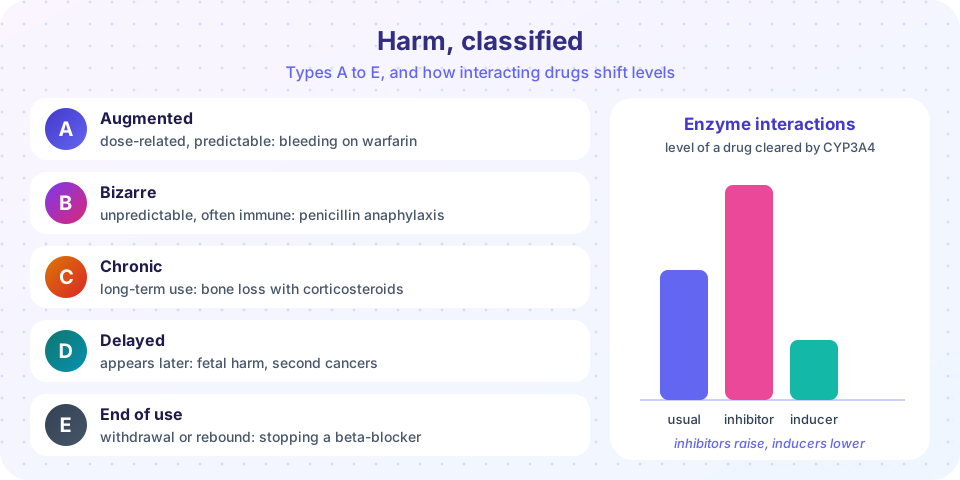
- Type A (augmented). An exaggeration of the drug's known pharmacology. These are predictable and dose-related, the commonest type, and usually avoidable by adjusting the dose. Examples are bleeding with warfarin, low blood sugar with insulin, dry mouth with anticholinergics, and sedation with benzodiazepines.
- Type B (bizarre). Unpredictable reactions that are not related to the drug's main action, often immune or genetic. Rarer, but often more serious. Penicillin anaphylaxis, a skin reaction such as Stevens-Johnson syndrome after carbamazepine, and idiosyncratic liver injury fit here. Dose reduction does not necessarily help, and stopping the drug is usually necessary.
- Type C (chronic). Effects that depend on cumulative dose and long exposure, such as bone loss with long-term corticosteroids or kidney damage from regular painkillers.
- Type D (delayed). Effects that appear long after exposure, such as birth defects after use in pregnancy or a second cancer years after chemotherapy.
- Type E (end of use). Withdrawal or rebound after stopping, such as rebound high blood pressure after abruptly stopping clonidine or seizures after stopping a benzodiazepine.
A few special types of harm deserve mention. Teratogenicity is the production of birth defects; thalidomide, valproate, isotretinoin and ACE inhibitors are well-known examples, and the dangers differ with the stage of pregnancy. Hypersensitivity reactions occur when the immune system reacts to the drug or a metabolite of it. Drug-induced liver injury is a leading cause of drug withdrawal.
Why people differ: pharmacogenomics
Two people on the same dose can have very different exposure to a drug, and gene variants explain part of the difference. Examples met earlier in this course are now routine:
- CYP2D6 converts codeine to morphine. Ultra-rapid metabolizers make too much morphine, with a risk of respiratory depression, and poor metabolizers get little pain relief.
- CYP2C19 activates clopidogrel; poor metabolizers get less antiplatelet effect.
- CYP2C9 and VKORC1 variants change the dose of warfarin needed.
- HLA-B*5701 predicts a severe hypersensitivity reaction to the HIV drug abacavir; testing before treatment has nearly eliminated it.
- HLA-B*1502 predicts carbamazepine skin reactions in some Asian populations.
- TPMT and DPYD variants cause severe toxicity from thiopurines and fluoropyrimidines such as 5-fluorouracil.
Genotyping has become part of clinical practice for several of these pairs, and the idea of choosing the drug and dose from a person's genes is called personalized or precision medicine. Age, kidney and liver function, weight, pregnancy and other diseases still matter, and in most cases genetics explains only part of the variation.
Drug interactions
An interaction occurs when one drug changes the effect of another. They fall into two main groups.
Pharmacokinetic interactions change how much drug reaches the target.
- Absorption: calcium, iron and antacids bind tetracyclines and some quinolones in the gut and reduce absorption.
- Metabolism: inhibitors of liver enzymes raise the level of other drugs. Clarithromycin, azole antifungals, ritonavir and grapefruit juice inhibit CYP3A4 (the grapefruit effect acts mainly in the gut wall), which can push simvastatin to levels that damage muscle. Inducers such as rifampicin, carbamazepine, phenytoin and St John's wort lower the levels of drugs, including warfarin, hormonal contraceptives, some HIV drugs and ciclosporin.
- Excretion: NSAIDs, thiazides and ACE inhibitors reduce lithium clearance, and probenecid reduces penicillin excretion.
- Transporters: P-glycoprotein carries many drugs out of cells, and inhibitors such as verapamil can raise digoxin levels.
Pharmacodynamic interactions happen at the target or in the same physiological system, whatever the drug levels. Opioids with benzodiazepines or alcohol add up to dangerous sedation. An SSRI with linezolid or an MAO inhibitor can cause serotonin syndrome. A beta-blocker and verapamil together can slow conduction through the heart too much. An NSAID with an anticoagulant raises bleeding risk. Some interactions are intentional and helpful: carbidopa with levodopa, or trimethoprim with sulfamethoxazole.
The risk of interactions rises with the number of drugs. Older adults often take five or more, a situation called polypharmacy, and tools such as the American Geriatrics Society's Beers criteria list drugs that are often inappropriate in older people.
Special groups
Drugs behave differently in some groups. Newborns have immature liver enzymes, and chloramphenicol caused "grey baby syndrome" in infants who could not conjugate it. Children need doses based on weight or surface area, and many drugs have not been properly studied in them. Pregnancy exposes two people, so the risk to the fetus has to be weighed with the risk of untreated disease. Older adults have lower kidney clearance and a higher risk of falls and confusion with sedatives and anticholinergics. Kidney and liver disease lower the clearance of many drugs, so doses must be adjusted.
Medication errors
Not all harm is a property of the drug. Mistakes in prescribing, dispensing and giving drugs are common. Look-alike and sound-alike names, confusing units (micrograms and milligrams), decimal point errors, and high-alert drugs such as insulin, heparin, opioids and concentrated potassium are classic hazards. Checking systems, clear labeling, barcode scanning, pharmacist review and the habit of asking "does this dose make sense?" are the defenses.
Pharmacovigilance: watching after approval
Clinical trials involve thousands of patients, which cannot reveal a harm that occurs in one in 10,000. This is why safety monitoring must continue. The system grew out of thalidomide: in the UK, the Yellow Card Scheme began in 1964, and similar systems followed. Clinicians, pharmacists and patients can report suspected reactions, and the US has MedWatch and the FDA Adverse Event Reporting System (FAERS), Europe has EudraVigilance, and the WHO's Uppsala Monitoring Centre keeps a global database, VigiBase.
Spontaneous reports cannot prove cause, and the number of reports cannot give the risk because the number of people who took the drug is unknown and many reactions go unreported. Analysts look for a signal: a drug-event pair reported more often than expected. Statistical methods compare reports for a drug with all other drugs, and then the signal is investigated in health databases, studies and sometimes trials. Causality tools such as the Naranjo scale weigh the timing, alternative explanations and what happens when the drug is stopped.
When a risk is confirmed, regulators can change the label, add warnings, restrict use, require special programs (called REMS in the United States, for example for isotretinoin), or withdraw the drug. Past withdrawals include cerivastatin in 2001 after cases of severe muscle breakdown, especially in combination with gemfibrozil, and rofecoxib in 2004 after cardiovascular events were found in a trial. These stories show the system working, slowly, and also its limits.
Common misconceptions
"A side effect listed on a leaflet means it will happen." Leaflets list everything reported, including events that may not have been caused by the drug. The frequency categories (common, rare) matter more than the length of the list.
"Natural remedies cannot interact with drugs." St John's wort and grapefruit are plant products with strong interaction effects.
"If no reports exist, the drug is safe." Absence of reports can reflect few users or poor reporting. It is not proof of safety.
Try it
First, a simple model of an enzyme interaction. For a drug cleared partly by one enzyme, the exposure (AUC) ratio when the enzyme is inhibited depends on the fraction of clearance (fm) that the enzyme handles and the activity that remains: AUC ratio = 1 / (fm × activity + (1 - fm)). The model ignores first-pass effects and other complications.
Press Run (or Ctrl + Enter) to see the result here.
Program input · what you'd type while the program runs
Type the answers before you press Run, one per line. Each time the program reads a line (with input()), it gets the next line from this box.
Second, a classification game. Read the situation and decide which type of adverse reaction it is. It is a learning exercise with simplified cases.
Check your understanding
Quick check · 5 questions
of 5 answered You scored / 5 · perfect!
-
1. Bleeding in a patient taking too much warfarin is which type of reaction?
It is an exaggeration of the drug's pharmacological action, predictable and dose-related. -
2. Testing for HLA-B*5701 before starting abacavir aims to prevent:
Carriers of the allele have a high risk of a serious immune reaction to abacavir. -
3. Which drug is a CYP3A4 INDUCER that can reduce the effect of hormonal contraceptives?
Rifampicin, carbamazepine, phenytoin and St John's wort increase enzyme levels and speed up clearance. -
4. Why can spontaneous reporting systems not give the true frequency of a reaction?
They detect signals; further studies are needed to measure risk. -
5. Combining an opioid with a benzodiazepine is an example of:
Both depress the CNS, so the effects add up regardless of drug levels.
Summary
- Adverse reactions are classified as A (augmented), B (bizarre), C (chronic), D (delayed) and E (end of use).
- Genetic variants such as CYP2D6, CYP2C19, HLA-B*5701 and TPMT change drug response and risk.
- Interactions are pharmacokinetic (absorption, enzyme inhibition and induction, excretion) or pharmacodynamic (additive or opposing effects).
- Pharmacovigilance systems such as the Yellow Card Scheme and FAERS detect rare harms, and regulators can act on confirmed signals.
Track your progress
Create a free account to tick off lessons and pick up where you left off on any device.
of Pharmacology lessons completed