


















Lesson 28 of 48 · Central Nervous System Drugs
Chapter 6 overview: central nervous system drugs
A map of central nervous system pharmacology: the four main chemical messengers, the blood-brain barrier, and how drugs for pain, mood, seizures and Parkinson disease fit together.
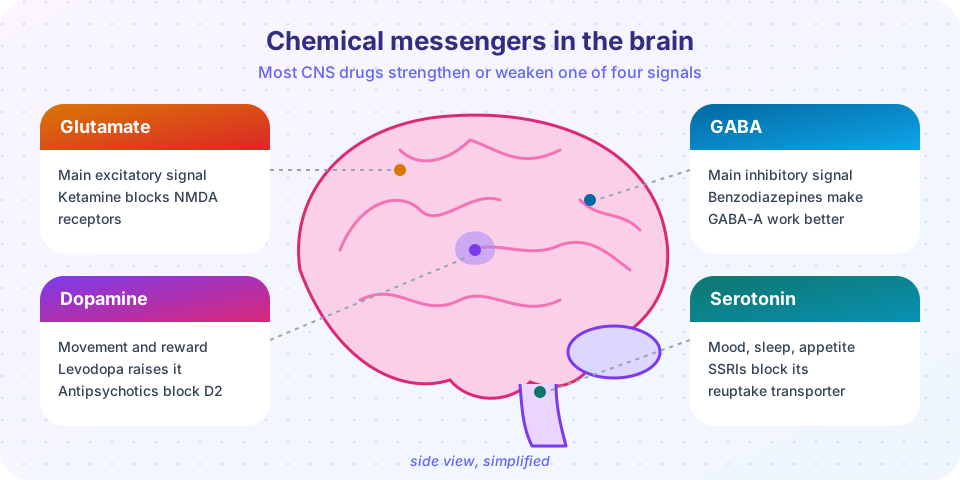
No other group of drugs touches daily life as widely as those that act on the brain. Coffee and alcohol are central nervous system (CNS) drugs. So are the painkillers in a hospital, the antidepressants taken by millions of people, the anesthetics that make surgery possible, and the medicines that control epilepsy. They all do the same basic thing: they change how nerve cells communicate. The brain contains billions of neurons, but the chemical signals between them come from a surprisingly small set of messengers. Learn the messengers and you have a framework for the whole chapter.
Educational information only. This chapter explains how brain-acting drugs work. It does not diagnose conditions or tell anyone what to take. Stopping some CNS drugs suddenly, for example anti-seizure drugs, benzodiazepines and some antidepressants, can be dangerous, so changes to treatment should always be made with a prescriber.
What you will learn
- Name the four main chemical messengers of the brain and one drug class for each.
- Explain why the blood-brain barrier shapes the design and the side effects of CNS drugs.
- Describe the common risks of CNS drugs: tolerance, dependence, withdrawal and overdose.
- See where each lesson in this chapter fits.
The chapter at a glance
Four main messengers
Drugs strengthen or weaken these signals.
The barrier
A drug must reach the brain to act there.
Pain and anesthesia
Lesson 2
Mind and movement
Lessons 3 and 4
Where each lesson fits
- Pain, opioids and anesthesia: the pain pathway, NSAIDs and paracetamol, the opioid receptors, tolerance and overdose, local anesthetics and general anesthetics.
- Drugs for mood, anxiety and psychosis: antidepressants, antipsychotics, benzodiazepines and lithium, and an honest look at what the evidence does and does not show.
- Drugs for epilepsy and Parkinson disease: sodium channel blockers and other antiseizure mechanisms, levodopa with carbidopa, and the drugs that extend dopamine's action.
- Chapter 6 review: a summary picture and ten questions.
The blood-brain barrier
Most blood vessels leak small molecules into the tissue around them. Capillaries in the brain do not. Their cells are joined by tight junctions, wrapped by the feet of supporting cells called astrocytes, and equipped with efflux pumps such as P-glycoprotein that throw many drugs back into the blood. The result is the blood-brain barrier, which protects the brain from toxins, but also keeps out many medicines.
Three consequences matter for pharmacology.
First, small, fat-soluble, uncharged molecules cross easily. Diazepam, morphine and fluoxetine all fit this description. A rough guide used in drug design says a molecule is more likely to enter the brain if its molecular weight is below about 450 and its polar surface area is below about 90 square angstroms. Rules like this are useful but have exceptions, as the first activity shows.
Second, drug design can use the barrier on purpose. Neostigmine carries a permanent positive charge, so it stays outside the brain and acts on the neuromuscular junction without causing central effects. Cetirizine, a second-generation antihistamine, is pumped out of the brain by P-glycoprotein, which is why it is less sedating than older antihistamines that cross freely.
Third, transporters can open the door. Dopamine itself cannot cross the barrier, so giving dopamine to a person with Parkinson disease would do nothing in the brain. Its precursor levodopa is carried across by an amino acid transporter, then converted to dopamine inside. You will see this in lesson 3.
Risks that recur through the chapter
CNS drugs share a few risks that you will see again and again:
- Tolerance: a given dose does less over time, so the dose may need to rise to keep the effect.
- Dependence and withdrawal: after prolonged use the nervous system adapts, and stopping can produce rebound symptoms, which for benzodiazepines and alcohol can include seizures.
- Additive sedation: sedating drugs combine. Alcohol, opioids and benzodiazepines together can stop breathing at doses that would be survivable alone.
- Impaired driving and falls, particularly in older adults, whose brains are more sensitive and whose kidneys and liver clear drugs more slowly.
- Narrow margins in overdose: some drugs, such as opioids and tricyclic antidepressants, are very dangerous when too much is taken.
Notice that these are properties of the drug-brain relationship, not signs of weakness in the person. Dependence is a predictable pharmacological adaptation, which is why prescribers taper some drugs gradually instead of stopping them.
Common misconceptions
"Psychiatric drugs change personality." Most act on mood, anxiety or perception symptoms. Dose, side effects and the illness itself can all change how a person feels, but a drug does not rewrite who they are.
"Dependence means addiction." Physical dependence is a predictable adaptation that can occur with correct use (for example with beta-blockers or antidepressants). Addiction is compulsive use despite harm. They overlap but are not the same.
"If a drug works in the brain it must work fast." Opioids and anesthetics act in minutes, but antidepressants usually need weeks, because the brain's response is slower than the drug's binding.
Try it
First, a rule-of-thumb filter for brain entry. The code plots molecular weight against polar surface area for several drugs (approximate values), and shades the zone where a drug is more likely to cross the barrier. It also shows why exceptions exist.
Press Run (or Ctrl + Enter) to see the result here.
Program input · what you'd type while the program runs
Type the answers before you press Run, one per line. Each time the program reads a line (with input()), it gets the next line from this box.
Second, a reaction-time demonstration. Researchers measure drug effects on attention and driving ability with tests like this one, where slower or more variable reaction times can show sedation. Your result reflects many things, such as sleep and caffeine, so it is a demonstration of the idea, not a test of any drug or of fitness to drive.
Check your understanding
Quick check · 5 questions
of 5 answered You scored / 5 · perfect!
-
1. Which messenger is the main inhibitory transmitter in the brain?
GABA opens chloride channels and makes neurons less likely to fire; benzodiazepines enhance it. -
2. Neostigmine does not cause central effects mainly because:
A permanent positive charge keeps it out of the brain, so it acts at the neuromuscular junction. -
3. Why is levodopa given instead of dopamine in Parkinson disease?
The amino acid transporter carries levodopa into the brain, where it is converted into dopamine. -
4. Which pair of drug types can combine to stop breathing at doses that would be tolerated alone?
Additive CNS depression is a major cause of overdose deaths. -
5. Physical dependence differs from addiction because:
Dependence can occur with correct use, and tapering manages it. Addiction involves compulsive behavior despite harm.
Summary
- Four messengers, glutamate, GABA, dopamine and serotonin, organize most CNS pharmacology.
- The blood-brain barrier favors small, fat-soluble, uncharged drugs and can be used or bypassed by design.
- CNS drugs share risks: tolerance, dependence, withdrawal, additive sedation and narrow overdose margins.
- The next lessons cover pain and anesthesia, mood and psychosis, and seizures and Parkinson disease.
Track your progress
Create a free account to tick off lessons and pick up where you left off on any device.
of Pharmacology lessons completed