


















Lesson 10 of 48 · Principles of Drug Action
Chapter 2 review: principles of drug action
Review chapter 2: binding and the occupancy law, the four families of drug target, and agonists, partial agonists and antagonists, with a recap table, a calculator and a ten-question quiz.
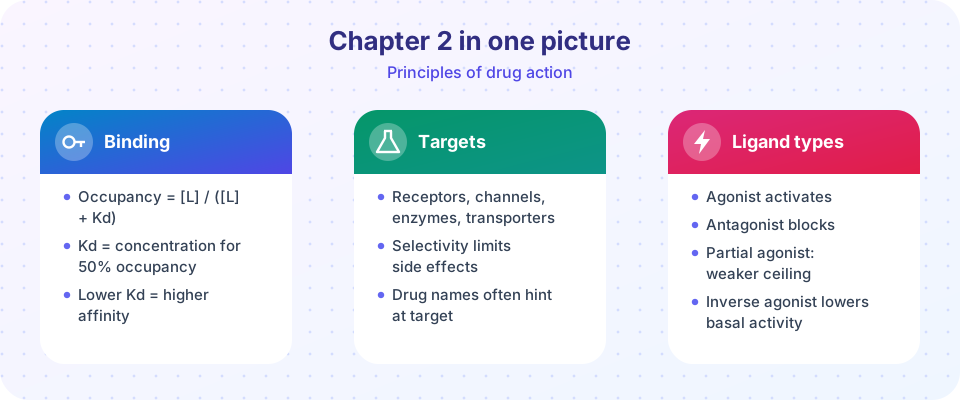
Chapter 2 gave you the language of drug action. Binding is described by Kd, targets fall into four families, and ligands are agonists or antagonists of different kinds. These ideas return in every later chapter, so this review makes sure they are secure. Use the picture and the table to check your recall, run the calculator to test your numerical feel, and then take the longer quiz.
What you will learn
- A single-page summary of the main ideas of Chapter 2.
- Where to go back for each idea.
- How to apply the occupancy law and the dose ratio to numbers.
Recap table
| Idea | Key facts | Lesson |
|---|---|---|
| Receptor families | Ion channels (ms), GPCRs (s), kinase-linked (min-h), nuclear (h-days) | Receptors and binding |
| Occupancy law | occupancy = [L] / ([L] + Kd); 50% at Kd, 91% at 10 Kd, 99% at 100 Kd | Receptors and binding |
| Kd | koff / kon; lower Kd means higher affinity | Receptors and binding |
| Targets | Receptors, ion channels, enzymes, transporters; also DNA, tubulin, soluble ligands and chemistry | Drug targets |
| Enzyme inhibitors | Competitive raises Km; non-competitive lowers Vmax; irreversible removes enzyme (aspirin on COX) | Drug targets |
| Ligand types | Full, partial and inverse agonists; neutral antagonists | Agonists and antagonists |
| Competitive antagonism | Parallel right shift; DR = 1 + B/KB; Schild slope 1 | Agonists and antagonists |
| Other antagonism | Irreversible (lowers ceiling), physiological, chemical; allosteric modulators | Agonists and antagonists |
Reasoning like an expert
Experts do not memorize each drug separately. They ask a short sequence of questions and use the answers to predict behavior.
- What is the target and its family? The family predicts the speed of action and typical side effects.
- Does the drug activate, partly activate, or block? The ligand type predicts whether the effect is graded, capped, or silent without a natural messenger.
- How much binds at the concentration reached? Compare the concentration with Kd: at 0.1 Kd, only about 9% of receptors are bound; at 10 Kd, about 91%.
- What else does it bind? Other targets at higher concentrations explain unwanted effects.
- Is the effect reversible and surmountable? Competitive blockers can be overcome with more agonist; irreversible ones cannot.
Common errors to avoid
Learners tend to slip in the same few places, so check yourself against this list before the quiz.
- Mixing up Kd and EC50. Kd describes binding to the receptor and is measured with a binding experiment. EC50 describes the response and is measured in a tissue or an organism. They match only when response is proportional to occupancy, and in tissues with spare receptors the EC50 is smaller than the Kd.
- Treating all antagonists alike. Competitive antagonists shift the curve to the right and can be overcome; irreversible and non-competitive antagonists lower the ceiling and cannot. Antagonism that works through a different receptor (physiological) or by direct chemistry (chemical) is not receptor blockade at all.
- Forgetting that selectivity depends on concentration. A drug that is selective at a low dose can bind other targets at a high dose, which is why side effects often appear when the dose is raised.
- Equating binding with effect. A ligand with a very low Kd may still be an antagonist or a weak partial agonist, so always ask what the bound drug does.
Try it
The calculator below combines the two main formulas of the chapter. Try a few values and check the result against the table.
Press Run (or Ctrl + Enter) to see the result here.
Program input · what you'd type while the program runs
Type the answers before you press Run, one per line. Each time the program reads a line (with input()), it gets the next line from this box.
Check your understanding
Quick check · 10 questions
of 10 answered You scored / 10 · perfect!
-
1. A drug has Kd = 5 nM. What fraction of receptors are occupied at 45 nM?
45 / (45 + 5) = 0.90. -
2. Which receptor family produces the fastest response?
They open a pore on binding and act within milliseconds. -
3. Lidocaine numbs tissue. What is its main target?
Blocking sodium channels in nerve fibers prevents action potentials. -
4. A competitive enzyme inhibitor at high substrate concentration
More substrate outcompetes the inhibitor, so Vmax is unchanged. -
5. Why does low-dose aspirin have a long effect on platelets?
Irreversible inhibition lasts until new platelets are made. -
6. A partial agonist with a high affinity is added to a full agonist at a receptor. The net response is most likely to
It competes for receptors and replaces a stronger activator with a weaker one. -
7. An antagonist is present at B = 4 x KB. The dose ratio is
DR = 1 + 4 = 5. -
8. Which is an example of chemical antagonism?
Chemical antagonism neutralizes a drug by direct combination, not through receptors. -
9. What defines an inverse agonist?
Inverse agonists lower activity below the baseline level. -
10. Which statement about selectivity is true?
At higher concentrations, drugs bind additional targets, so new effects appear.
Summary
- Receptor families differ in speed; occupancy follows [L] / ([L] + Kd).
- Drug targets are mainly receptors, ion channels, enzymes and transporters; selectivity limits side effects.
- Agonists activate, partial agonists activate less, inverse agonists lower baseline, and antagonists block.
- Competitive antagonism shifts the curve right (DR = 1 + B/KB); irreversible blockers lower the ceiling.
Track your progress
Create a free account to tick off lessons and pick up where you left off on any device.
of Pharmacology lessons completed