


















Lesson 32 of 48 · Central Nervous System Drugs
Chapter 6 review: central nervous system drugs
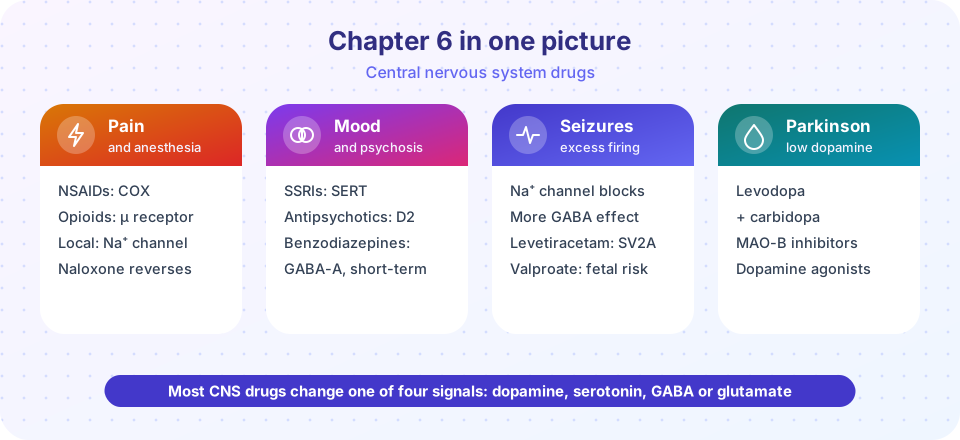
Review chapter 6 with a one-picture summary, a table of CNS drug targets and risks, drug-name stems, a matching game and ten mixed questions.
Brain-acting drugs look bewildering as a list of names, but they fall into a handful of patterns. Each one binds a receptor, channel, transporter or enzyme in a pathway that uses one of the four main messengers, and most side effects come from the same mechanism acting in a different part of the nervous system or body. This review gathers the chapter into a single page and then tests it.
What you will learn
- Recall the main targets, uses and risks of the drug groups in this chapter.
- Read drug-name stems to guess a drug's class.
- Apply the four-messenger framework to a drug you have not met before.
The chapter in a table
| Group | Target | Examples | Used for | Key risk |
|---|---|---|---|---|
| NSAIDs | COX-1 and COX-2 | ibuprofen, naproxen | pain, inflammation, fever | stomach bleeding, kidney injury |
| Paracetamol | central COX and others | acetaminophen | pain, fever | liver damage in overdose |
| Opioids | mu receptor | morphine, fentanyl | severe pain | respiratory depression, dependence |
| Local anesthetics | sodium channels | lidocaine, bupivacaine | numbing a region | systemic toxicity |
| General anesthetics | GABA-A, NMDA | propofol, sevoflurane, ketamine | surgery | breathing and circulation depressed |
| SSRIs | serotonin transporter | fluoxetine, sertraline | depression, anxiety | sexual effects, serotonin syndrome |
| Antipsychotics | D2 receptor | haloperidol, olanzapine | psychosis | movement, metabolic effects |
| Benzodiazepines | GABA-A | diazepam, lorazepam | acute anxiety, seizures | dependence, falls, with opioids |
| Lithium | uncertain (GSK-3, inositol) | lithium carbonate | bipolar disorder | narrow range, kidney and thyroid |
| Sodium channel blockers | Na⁺ channels | phenytoin, carbamazepine | focal seizures | saturation, enzyme induction, rash |
| Levodopa + carbidopa | dopamine replacement | Sinemet-type tablets | Parkinson disease | wearing-off, dyskinesia |
Four questions to ask about any CNS drug
When you meet a new drug, you can predict much about it with four questions.
- Which messenger does it change, and in which direction? A drug that increases GABA or reduces glutamate tends to sedate. One that raises dopamine tends to stimulate or to relieve parkinsonism, and one that blocks dopamine can cause movement problems.
- Does it get into the brain, and how fast? Lipid-soluble drugs act within minutes, and those that need transporters or pumps can have a restricted effect. Speed also shapes dependence risk: fast-acting drugs are generally more reinforcing.
- What is its margin of safety? A narrow therapeutic index, as with lithium and phenytoin, calls for blood tests and attention to interactions.
- What happens when it stops? Dependence and withdrawal are predictable for opioids, benzodiazepines and some antidepressants, and anti-seizure drugs should not be stopped abruptly.
Putting it together
Try the four questions on two drugs from the chapter. Diazepam: it enhances GABA, an inhibitory messenger, so it calms and relaxes. It is lipid-soluble and crosses the barrier within minutes, which is why intravenous diazepam can stop a seizure quickly. Its margin is wide alone but narrow with opioids or alcohol, and the nervous system adapts to it, so stopping after long use needs a taper. Phenytoin: it blocks sodium channels in a use-dependent way, so it quiets fast firing. It enters the brain easily, but its liver metabolism saturates, so the margin between a useful and a toxic dose is narrow and small dose changes matter. It also induces enzymes, which brings in interactions. Two drugs, four questions, and most of what a clinician needs to remember falls out of the answers.
Common misconceptions
"A drug that sedates is a drug that treats anxiety." Sedation and anxiety relief overlap but are different. Long-term anxiety treatment often relies on SSRIs and therapy, not on sedatives.
"Naloxone is enough after an overdose." Naloxone can wear off before the opioid does, so a person can relapse into respiratory depression. Emergency help must still be called.
"If a drug is a prodrug, a bigger dose is better." Prodrugs such as codeine and clopidogrel depend on liver enzymes, and genetic variation can make them useless in some people and dangerous in others.
Try it
First, a drug-name stem decoder for this chapter. Stems are agreed internationally and give a fast hint of a drug's class. Some names are exceptions, so use them as a clue, not as proof.
Press Run (or Ctrl + Enter) to see the result here.
Program input · what you'd type while the program runs
Type the answers before you press Run, one per line. Each time the program reads a line (with input()), it gets the next line from this box.
Second, a matching game. A drug name appears and you choose its main target. It is a revision tool with a small set of drugs.
Check your understanding
Quick check · 10 questions
of 10 answered You scored / 10 · perfect!
-
1. Which receptor is the main target of morphine?
Mu receptors mediate most analgesia and also respiratory depression. -
2. A person is given naloxone for an opioid overdose and wakes up. Why should they still be observed?
Naloxone lasts roughly 30 to 90 minutes, which can be shorter than the opioid's action. -
3. Which pair correctly matches a drug and its mechanism?
Benzodiazepines are positive allosteric modulators of GABA-A. -
4. Which problem is most associated with long-term use of first-generation antipsychotics?
Chronic D2 blockade in movement circuits can cause late-onset abnormal movements. -
5. What is the effect of carbidopa when combined with levodopa?
Carbidopa does not cross the barrier, so brain dopamine production continues while peripheral side effects fall. -
6. Which drug has strongly saturable (zero-order) kinetics at ordinary doses?
Phenytoin metabolism saturates, so small dose increases can produce large level rises. -
7. Which drug raises lithium levels the most when added?
Thiazides reduce sodium and lithium clearance by the kidney. -
8. The stem -azepam suggests which class?
Diazepam, lorazepam and temazepam are examples. -
9. Which statement about paracetamol overdose is correct?
The toxic metabolite NAPQI damages the liver when glutathione is depleted; N-acetylcysteine is the antidote. -
10. Antidepressant benefit usually appears after weeks even though monoamine levels rise within hours. What does this suggest?
The delay is one reason the simple monoamine deficiency picture is considered incomplete.
Summary
- Four messengers, glutamate, GABA, dopamine and serotonin, organize CNS pharmacology.
- Pain drugs act along the pathway: COX in tissue, sodium channels in nerves, mu receptors in cord and brain, GABA-A and NMDA for anesthesia.
- Mood and psychosis drugs act on monoamine synapses and GABA-A; antiseizure drugs quiet firing; Parkinson drugs replace or protect dopamine.
- Ask four questions about any CNS drug: which messenger, can it reach the brain, how wide is the safety margin, and what happens when it stops.
Track your progress
Create a free account to tick off lessons and pick up where you left off on any device.
of Pharmacology lessons completed