


















Lesson 22 of 48 · Pharmacodynamics and Dose-Response
Chapter 4 review: pharmacodynamics and dose-response
Review chapter 4: Emax and Hill equations, potency and efficacy, therapeutic index, variability, pharmacogenomics and interactions, with a recap table, a calculator and a ten-question quiz.
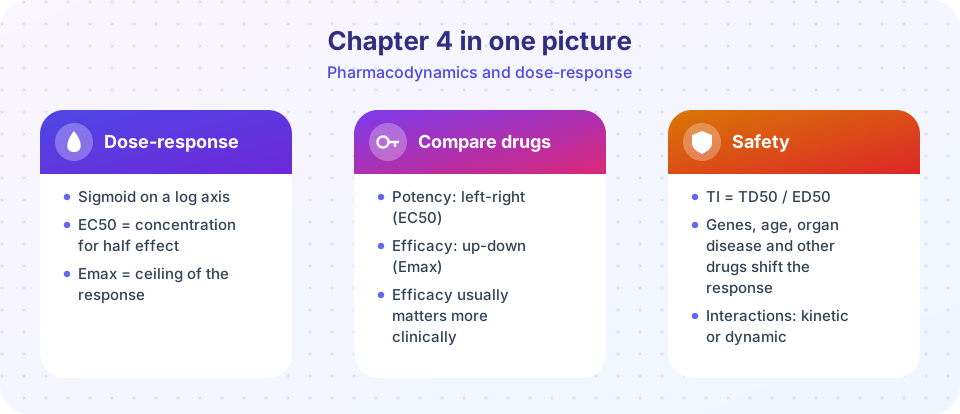
With Chapter 4 you complete the foundation of pharmacology. You can now describe a drug in four steps: what it binds (Chapter 2), how much of it gets there (Chapter 3), what effect that concentration produces, and how safe and variable that effect is (this chapter). The review gathers the formulas, gives you a picture to carry in your head, and lets you apply the equations in a short calculator before you try a ten-question quiz.
What you will learn
- A one-page summary of the formulas and ideas of Chapter 4.
- How to move between concentration, effect, potency and safety in a worked calculation.
- Where the later chapters of the course will use these tools.
Recap table
| Idea | Key facts | Lesson |
|---|---|---|
| Emax model | E = Emax x C / (EC50 + C); half effect at EC50; 90% at 9 x EC50 | Dose-response curves |
| Hill equation | E = Emax x C^n / (EC50^n + C^n); n sets steepness | Dose-response curves |
| Graded and quantal | Graded: size of effect in one tissue. Quantal: percent responding in a population | Dose-response curves |
| Potency and efficacy | Potency: curve position (EC50). Efficacy: curve height (Emax) | Potency, efficacy and safety |
| Safety | TI = TD50 / ED50; CSF = TD1 / ED99; narrow-window drugs need monitoring | Potency, efficacy and safety |
| Variability | Age, size, organ disease, drugs, genes, adherence; tolerance; placebo and nocebo | Variability and pharmacogenomics |
| Pharmacogenomics | CYP2D6 and codeine; CYP2C19 and clopidogrel; CYP2C9/VKORC1 and warfarin; HLA-B variants | Variability and pharmacogenomics |
| Interactions | PK (absorption, metabolism, excretion) and PD (additive, synergistic, antagonistic) | Drug interactions |
Putting the foundation together
Here is how an expert chains the four chapters for a new medicine. Suppose a drug is a competitive antagonist at a receptor (Chapter 2), has an oral bioavailability of 40%, a half-life of 6 hours and is cleared mainly by CYP3A4 (Chapter 3), and has an EC50 of 20 ng/mL with a steep Hill slope and a therapeutic index of 8 (Chapter 4). The expert then predicts:
- The dose can be given twice daily, because the half-life is about 6 hours and steady state comes in a day or so.
- The drug will interact with CYP3A4 inhibitors (higher levels, more risk) and inducers (lower levels, less effect), because clearance depends on that enzyme.
- Because the slope is steep and the TI modest, small changes in exposure matter, so dose changes should be cautious and the patient should be monitored.
- Because the drug is an antagonist, it will not produce an effect in the absence of the natural agonist, and an excess of the agonist could overcome it.
Not one of these statements needs a memorized fact about the drug itself. They follow from the principles.
Try it
The calculator below chains the steps for an imaginary drug: from a dose rate to a steady-state concentration (Chapter 3) and then to an effect and a benefit-and-harm estimate (Chapter 4). Change the numbers and see which step changes the answer most.
Press Run (or Ctrl + Enter) to see the result here.
Program input · what you'd type while the program runs
Type the answers before you press Run, one per line. Each time the program reads a line (with input()), it gets the next line from this box.
Check your understanding
Quick check · 10 questions
of 10 answered You scored / 10 · perfect!
-
1. A drug has EC50 = 4 ng/mL and Emax = 80 units, with n = 1. What is the effect at 12 ng/mL?
E = 80 x 12 / (4 + 12) = 60 units. -
2. Two drugs share the same Emax but one has an EC50 five times lower. The one with the lower EC50 is
Lower EC50 means higher potency. Efficacy is the same, and safety is a separate question. -
3. Why is the Hill slope clinically important?
A steep slope means small dose changes have large effects. -
4. Which measure compares the dose toxic to 1% of patients with the dose effective in 99%?
CSF = TD1 / ED99; values below 1 mean the benefit and harm curves overlap. -
5. An ultrarapid CYP2D6 metabolizer takes a standard dose of codeine. The main concern is
Faster conversion of the prodrug leads to higher morphine exposure. -
6. Which is a pharmacodynamic interaction?
Their effects on the same physiological system add up. The other two change drug levels. -
7. What happens to blood levels of a drug cleared by CYP3A4 after starting clarithromycin?
Clarithromycin inhibits CYP3A4, lowering clearance. -
8. Fentanyl is more potent than morphine. This means fentanyl
Potency affects dose size only. -
9. Which is the best description of the nocebo effect?
Nocebo is the negative counterpart of placebo. -
10. Which drug-gene pair is correct?
HLA-B57:01 predicts abacavir hypersensitivity. HLA-B15:02 relates to carbamazepine, and TPMT to azathioprine.
Summary
- The Emax and Hill equations describe how effect depends on concentration; the log axis gives a symmetrical S-curve.
- Potency (EC50) and efficacy (Emax) differ; safety is judged with TI, CSF and the therapeutic window.
- Response varies with age, size, disease, drugs, genes and expectation; pharmacogenomics links genes such as CYP2D6 to response.
- Interactions are pharmacokinetic or pharmacodynamic, and are largely predictable.
- Chapters 5 to 9 apply these tools to real drug families, drug development and practice problems.
Next: Chapter 5 overview: autonomic and cardiovascular drugs
Track your progress
Create a free account to tick off lessons and pick up where you left off on any device.
of Pharmacology lessons completed