


















Lesson 25 of 48 · Translation and Protein Folding
The Ribosome and the Elongation Cycle
Follow translation step by step: tRNA charging, initiation, the A, P and E sites, peptide bond formation, translocation, termination and energy cost.
A ribosome is one of the oldest and most important machines in biology. Every living cell has thousands to millions of them, and all of them do the same job: they hold an mRNA, match each codon to the right transfer RNA and join the amino acids together. In this lesson you will watch one full cycle, from the moment the small subunit finds the start codon to the release of the finished chain, and then count what it costs.
What you will learn
- How an amino acid is attached to the right tRNA.
- How bacterial and eukaryotic ribosomes find the start codon.
- What happens at the A, P and E sites during one cycle.
- How translation ends and how much energy it uses.
- Why many antibiotics target bacterial ribosomes.
Key terms
Aminoacyl-tRNA synthetase: an enzyme that attaches one specific amino acid to its matching tRNA.
Anticodon: the three bases of a tRNA that pair with a codon.
Shine-Dalgarno sequence: a purine-rich site in bacterial mRNA that pairs with the small-subunit rRNA near the start codon.
Translocation: the movement of the ribosome by exactly one codon along the mRNA.
Release factor: a protein that recognizes a stop codon and triggers the release of the chain.
The adapters: charged tRNAs
A tRNA is a small RNA about 76 to 90 nucleotides long that folds into an L shape. At one end the anticodon pairs with the mRNA. At the other end, the 3′ end, an amino acid is attached. Which amino acid goes on which tRNA is decided not by the ribosome but by the aminoacyl-tRNA synthetases, one family of enzymes for each amino acid (in most organisms there are about 20). They use ATP to join the amino acid to the tRNA, and they check their work: many synthetases have an editing site that removes a wrongly attached amino acid. This step is as important to accuracy as codon-anticodon pairing, because the ribosome cannot tell whether the amino acid on a tRNA is the right one.
Charging one tRNA uses ATP and releases AMP and pyrophosphate (PPi). Cells then split the PPi, so the cost is counted as two high-energy phosphate bonds.
The machine
Ribosomes are made of rRNA and proteins and have two subunits.
| Bacteria | Eukaryotes (cytosol) | |
|---|---|---|
| Whole ribosome | 70S | 80S |
| Small subunit | 30S (16S rRNA) | 40S (18S rRNA) |
| Large subunit | 50S (23S, 5S rRNA) | 60S (28S, 5.8S, 5S rRNA) |
The "S" stands for Svedberg units, a measure of how fast particles settle in a centrifuge; the values do not simply add up (a 30S and a 50S subunit make a 70S ribosome), because the settling rate depends on shape as well as mass. High-resolution structures, work recognized by the 2009 Nobel Prize in Chemistry (Venki Ramakrishnan, Thomas Steitz and Ada Yonath), showed something remarkable. The place where the peptide bond is made contains no protein. It is made of rRNA, so the ribosome is a ribozyme.
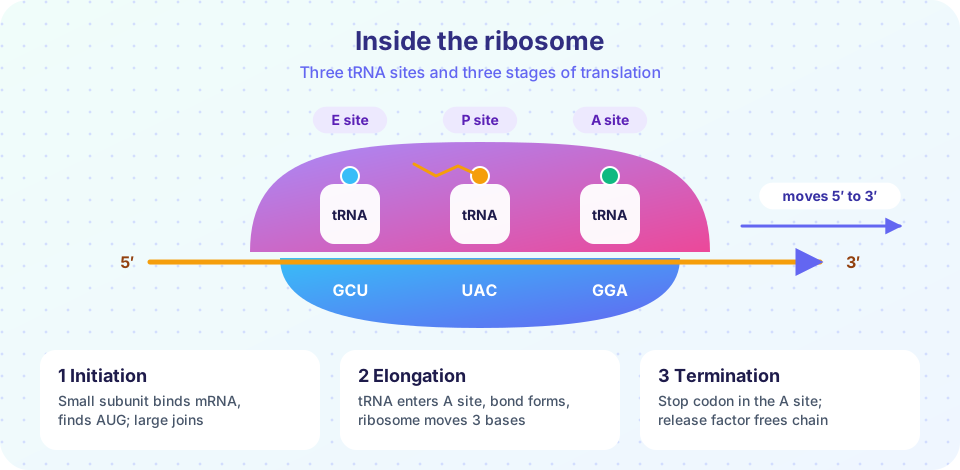
Each ribosome has three tRNA binding sites. A is the aminoacyl site where a new charged tRNA arrives. P is the peptidyl site that holds the tRNA carrying the growing chain. E is the exit site where an empty tRNA leaves.
Initiation
Initiation puts the start codon in the P site with a special initiator tRNA.
- In bacteria, the small subunit recognizes a Shine-Dalgarno sequence a few bases upstream of the AUG. The initiator is a methionine tRNA whose amino acid is chemically modified to N-formylmethionine (fMet). Initiation factors IF1, IF2 and IF3 help, and the large subunit then joins.
- In eukaryotes, the small subunit loads onto the 5′ cap of the mRNA with initiation factors (eIF4E binds the cap), then scans along the mRNA until it meets an AUG in a good context. The best-known context is the Kozak sequence, centered on
GCCRCCAUGG(R = A or G), where the purine at position −3 and the G at +4 matter most. The initiator is an ordinary Met-tRNA used only for initiation.
Elongation: one cycle, three steps
Once the large subunit has joined, each cycle adds one amino acid.
- Decoding. A charged tRNA enters the A site in a complex with a GTP-bound elongation factor (EF-Tu in bacteria, eEF1A in eukaryotes). If the anticodon matches the codon, the factor hydrolyzes GTP and leaves; if not, the tRNA is rejected. This checking gives an error rate of roughly one wrong amino acid per ten thousand.
- Peptide bond formation. The ribosome transfers the whole chain from the tRNA in the P site onto the amino group of the amino acid in the A site. The chain is now one residue longer and sits on the A-site tRNA.
- Translocation. A second GTP-binding factor (EF-G in bacteria, eEF2 in eukaryotes) pushes the ribosome forward by exactly one codon. The tRNA with the chain moves to the P site, the empty tRNA moves to the E site and leaves, and a new codon appears in the empty A site.
Chains grow from the N terminus (the amino end) to the C terminus (the carboxyl end), because each new amino acid is attached to the carboxyl end of the chain: the amino group of the amino acid in the A site attacks the bond that links the chain to the tRNA in the P site.
Termination
When a stop codon reaches the A site, no tRNA matches it. Instead, release factors do. In bacteria RF1 reads UAA and UAG, and RF2 reads UAA and UGA. In eukaryotes a single factor, eRF1, reads all three. The factor triggers the ribosome to cut the chain from the last tRNA, and recycling factors then separate the subunits so that they can start again. Several ribosomes usually read one mRNA at the same time, forming a polysome, which lets the cell make many copies of a protein from one message.
The energy bill
A rule of thumb: adding one amino acid costs about four high-energy phosphate bonds. Two are spent charging the tRNA (ATP to AMP), one GTP is used to deliver the tRNA and one GTP drives translocation. Initiation and termination add a little more. For a protein of 300 amino acids that is about 1,200 high-energy bonds, which is one of the largest single investments a growing cell makes.
How fast is the work? Ribosomes of fast-growing bacteria add on the order of 15 to 20 amino acids per second; eukaryotic ribosomes are slower, a few per second.
Antibiotics and ribosomes
The structural differences between bacterial and eukaryotic ribosomes allow selective drugs. Tetracyclines block tRNAs from entering the A site, chloramphenicol blocks peptide bond formation in the large subunit, macrolides such as erythromycin block the exit tunnel and aminoglycosides cause misreading. Puromycin, a laboratory tool, mimics the end of a tRNA and ends chains early.
Common misconceptions
"The ribosome checks that the amino acid is right." It only checks codon-anticodon pairing. The synthetases check the amino acid.
"The ribosome runs along the mRNA like a train that carries the amino acids." The tRNAs carry the amino acids; the ribosome is the stage on which tRNAs and mRNA meet.
"Antibiotics that block ribosomes also kill human cells." They are selective because bacterial ribosomes are different, though some side effects occur because mitochondrial ribosomes resemble bacterial ones.
Try it
The first example follows the A, P and E sites through a short mRNA and tallies the energy cost. It is a simulation of the textbook cycle, not a model of real kinetics.
Press Run (or Ctrl + Enter) to see the result here.
Program input · what you'd type while the program runs
Type the answers before you press Run, one per line. Each time the program reads a line (with input()), it gets the next line from this box.
The second example finds start codons in a eukaryotic mRNA and scores how well each AUG matches the Kozak consensus at the two positions that matter most.
Press Run (or Ctrl + Enter) to see the result here.
Program input · what you'd type while the program runs
Type the answers before you press Run, one per line. Each time the program reads a line (with input()), it gets the next line from this box.
The third example compares how many ATP-equivalents a cell spends per protein of different sizes and shows where the cost grows fastest.
Press Run (or Ctrl + Enter) to see the result here.
Program input · what you'd type while the program runs
Type the answers before you press Run, one per line. Each time the program reads a line (with input()), it gets the next line from this box.
Check your understanding
Quick check · 5 questions
of 5 answered You scored / 5 · perfect!
-
1. Which enzyme family makes sure the right amino acid is attached to the right tRNA?
Each synthetase recognizes one amino acid and its tRNAs, and many can edit mistakes. -
2. In which site does the next charged tRNA arrive?
A is the aminoacyl site that receives the incoming tRNA. -
3. What is the main job of EF-G (eEF2 in eukaryotes)?
EF-G uses GTP hydrolysis to move the ribosome one codon along the mRNA. -
4. The peptide bond is catalyzed mainly by
The peptidyl transferase center is built of rRNA, so the ribosome is a ribozyme. -
5. Which codons are recognized by eukaryotic eRF1?
eRF1 alone reads all three stop codons in eukaryotes.
Summary
- Synthetases charge tRNAs with the correct amino acid; the ribosome checks only codon-anticodon pairing.
- Ribosomes have a small subunit (decoding) and a large subunit (peptide bond, made by rRNA) and three tRNA sites, A, P and E.
- Initiation sets the reading frame: Shine-Dalgarno in bacteria, cap and scanning with Kozak context in eukaryotes.
- Elongation repeats decoding, bond formation and translocation, using GTP-bound factors.
- Release factors end the chain at a stop codon; about four high-energy bonds are spent per amino acid.
Track your progress
Create a free account to tick off lessons and pick up where you left off on any device.
of Molecular Biology lessons completed