


















Lesson 48 of 48 · Projects and Practice
Further Study: Where to Go After Molecular Biology
Plan your next steps after this course: biochemistry, cell biology, human physiology, evolution, statistics and data skills, with databases to explore and a sequence-alignment preview.
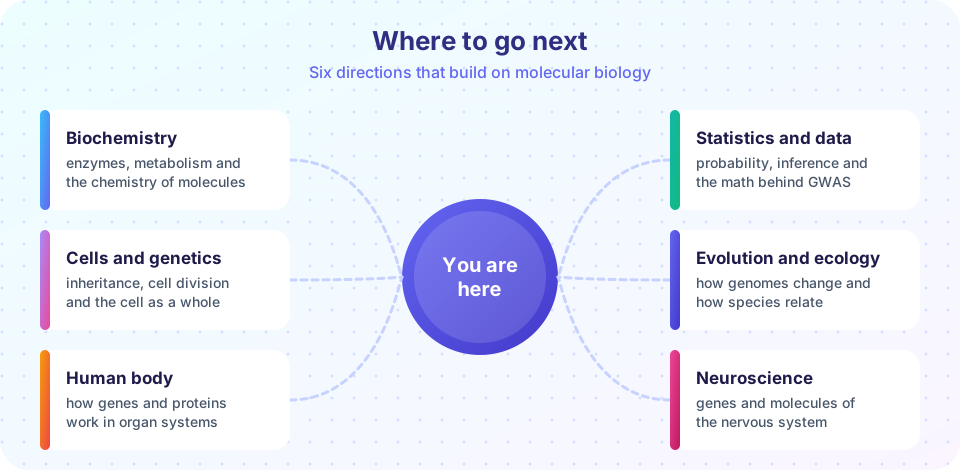
You now know how information flows from DNA to protein, how cells regulate it, how scientists read and rewrite it and how those methods reach patients. That is a base on which many fields stand. This last lesson maps six directions you can take next, lists free databases where you can explore real data, and gives you a first taste of bioinformatics with a small sequence alignment.
What you will learn
- Which subjects connect most strongly to molecular biology and why.
- Which public databases let you work with real sequences and structures.
- How a sequence alignment works, as a first step into bioinformatics.
Six directions
- Biochemistry asks how the molecules work: enzyme kinetics, metabolism, energy and the chemistry of proteins and nucleic acids. You met enzymes and folding in this course; biochemistry gives the quantitative detail. See the Biochemistry track.
- Cells and genetics zooms out from the molecule to the cell: organelles, membranes, the cell cycle, Mendelian and population genetics. See Cells and Genetics.
- The human body shows how genes and proteins function in organ systems: immunity, blood, hormones and the nervous system. See Human Body.
- Evolution and ecology explain why genomes look the way they do: mutation, selection, drift, speciation, and how organisms and environments interact. See Ecology and Evolution.
- Statistics and data skills are essential in modern biology: GWAS, RNA-seq and clinical trials rest on probability and inference. See Statistics and Probability, and for tools see Python, NumPy, pandas, Data Science and Machine Learning.
- Neuroscience applies molecular tools (ion channels, receptors, gene expression, optogenetics) to the nervous system. See Neuroscience.
If you enjoyed the calculations in this course, choose the statistics and data track; if you enjoyed the mechanisms, choose biochemistry and cell biology; if you enjoyed the applications, choose human biology.
Free databases to explore
The data of molecular biology are public, and you can use the same resources as professionals.
- NCBI (GenBank, PubMed, BLAST) holds sequences and the biomedical literature. PubMed is the place to find original papers.
- Ensembl and the UCSC Genome Browser show genomes with genes, variants and regulatory tracks.
- UniProt collects protein sequences and annotations, and the Protein Data Bank (PDB) stores experimentally determined 3D structures.
- The AlphaFold Protein Structure Database offers predicted structures for a vast number of proteins.
- gnomAD shows how common variants are in large populations, and ClinVar collects interpretations of variants in disease.
A good first exercise is to look up HBB in a genome browser, find codon 6 of the mature protein and compare what you see with the case study earlier in this chapter.
How to keep learning
- Read papers slowly. Start with the abstract and figures, then ask what question each figure answers and what control would show it wrong.
- Reproduce a calculation. Pick a number in a paper (a fold change, a Tm, a coverage) and recompute it.
- Learn to code a little. Small Python scripts like those in this course are enough to handle sequences, tables and plots.
- Stay critical. Ask about sample size, replication and effect size, as you did with GWAS and structure prediction.
- Think about ethics. Genetics touches privacy, fairness and consent; scientists need to be able to discuss these questions in plain language.
Common misconceptions
"You need a lab to do molecular biology." A great deal of modern work is computational and uses public data.
"Biology is memorization." The most useful skills are reasoning from mechanism and from numbers, which you have practiced throughout this course.
"The textbook is finished." Many of the facts here (the number of genes, best editing methods, approved therapies) keep changing; check recent reviews.
Try it
The first example is a preview of bioinformatics: global alignment of two short DNA sequences with the Needleman-Wunsch algorithm. It fills a score matrix (match +1, mismatch −1, gap −2) and traces back the best alignment, the same idea that sits inside tools such as BLAST.
Press Run (or Ctrl + Enter) to see the result here.
Program input · what you'd type while the program runs
Type the answers before you press Run, one per line. Each time the program reads a line (with input()), it gets the next line from this box.
The second example is a simple study planner. List the tracks you would like to follow with a rough number of hours each, choose how many hours you can study per week and see how long the plan takes. The hour estimates are your own guess.
Press Run (or Ctrl + Enter) to see the result here.
Program input · what you'd type while the program runs
Type the answers before you press Run, one per line. Each time the program reads a line (with input()), it gets the next line from this box.
Check your understanding
Quick check · 4 questions
of 4 answered You scored / 4 · perfect!
-
1. Which database stores experimentally determined 3D structures of proteins?
The PDB holds experimental structures; PubMed indexes papers and gnomAD lists variant frequencies. -
2. Which field would you pick to understand the mathematics behind GWAS?
GWAS rests on hypothesis testing, multiple-testing correction and probability. -
3. What does a global alignment algorithm like Needleman-Wunsch compute?
It fills a score matrix and traces back the highest-scoring alignment. -
4. A good way to read a research paper is to
Critical reading focuses on questions, evidence and controls.
Summary
- Molecular biology links to biochemistry, cell biology, human biology, evolution, data science and neuroscience.
- Public databases (NCBI, Ensembl, UniProt, PDB, ClinVar) let you work with real data.
- Alignment is a first step into bioinformatics; statistics and coding make modern biology possible.
- Keep reading critically, recomputing numbers and asking about ethics.
That completes the course. Use the cheat sheet and glossary to revise whenever you need to.
Track your progress
Create a free account to tick off lessons and pick up where you left off on any device.
of Molecular Biology lessons completed