


















Lesson 19 of 48 · Transcription
Bacterial Transcription: Sigma Factors, Promoters and Terminators
Learn how bacterial RNA polymerase finds a promoter with a sigma factor, forms an open complex, elongates RNA and stops at hairpin or Rho-dependent terminators.
A bacterial cell has about 4,000 genes but needs only some of them at any moment. When glucose runs out, it must switch on genes for other sugars; when heat arrives, it must switch on protective proteins. All of this starts with one enzyme deciding where to begin transcription.
Bacteria use a single RNA polymerase for all their genes, so how do they target the right ones? The answer is a swappable specificity subunit called sigma. This lesson follows transcription in bacteria from promoter recognition to termination, using E. coli as the model.
What you will learn
- The subunit structure of bacterial RNA polymerase.
- The -35 and -10 promoter elements and how sigma reads them.
- Open complex formation, abortive initiation and promoter escape.
- The two kinds of bacterial terminator: intrinsic and Rho-dependent.
Key terms
Holoenzyme: core RNA polymerase plus a sigma factor.
Sigma factor (σ): a subunit that recognizes promoters and is released after initiation.
Open complex: the form of RNA polymerase and promoter DNA in which about 12 base pairs are unwound.
Terminator: a DNA sequence that signals the end of transcription.
Polycistronic mRNA: one mRNA that encodes several proteins.
The enzyme
Bacterial RNA polymerase core enzyme has five subunits: two α, one β, one β′ and one ω (α₂ββ′ω), about 400 kilodaltons in total. The core enzyme can synthesize RNA but cannot find a promoter. Adding a sigma factor makes the holoenzyme, which binds promoters specifically. Rifampicin, a key antibiotic in tuberculosis treatment, inhibits bacterial RNA polymerase by binding the β subunit, which helps explain why bacteria and human cells can be told apart.
E. coli has several sigma factors. The main one, σ⁷⁰ (named for its mass in kilodaltons), handles most genes during normal growth. Others take over under particular conditions: σ³² for heat shock, σ³⁸ for stationary phase and starvation, and σ⁵⁴ for nitrogen-related genes. A cell can switch sets of genes on at once by changing which sigma binds the core.
Initiation: finding the promoter
A typical σ⁷⁰ promoter has two conserved stretches upstream of the start site (+1). Positions are counted from +1, so the elements are called -35 and -10:
| Element | Consensus (coding strand) | Position |
|---|---|---|
| -35 element | TTGACA | about 35 bases before +1 |
| -10 element (Pribnow box) | TATAAT | about 10 bases before +1 |
| Spacer between them | any bases, 17 ± 1 | exactly the right distance matters |
Real promoters match the consensus only partly, and the number of matches predicts promoter strength. Sigma contacts both elements, positioning the enzyme with the right spacing.
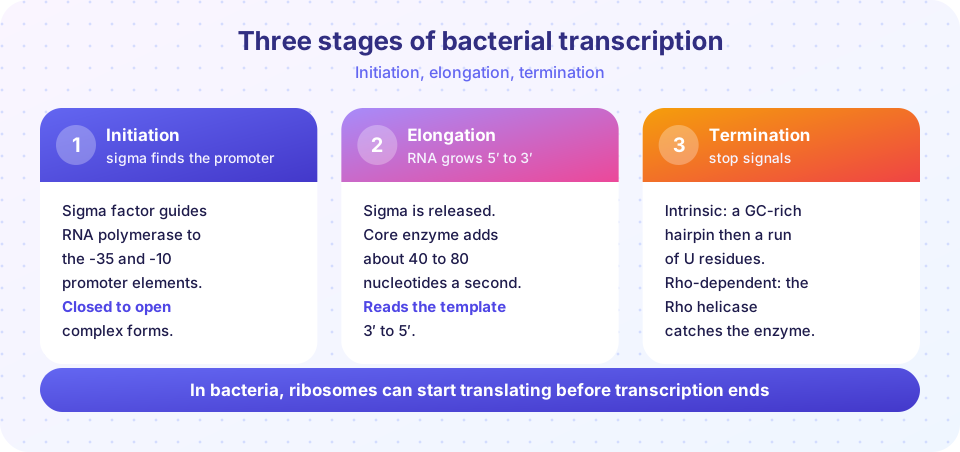
The enzyme first forms a closed complex, with DNA still double-stranded. It then melts the DNA around the -10 region and the start site, creating the open complex with a bubble of about 12 base pairs. RNA polymerase starts making RNA and often produces many short transcripts of fewer than ten nucleotides that it releases and restarts, called abortive initiation. After a transcript grows past roughly 10 nucleotides, the enzyme breaks its tight contacts with the promoter in promoter escape, and sigma is released or loosened. The core enzyme now moves forward in elongation.
Elongation
The core enzyme moves along the template, adding nucleotides at a rate of roughly 40 to 80 per second in E. coli. Accessory proteins such as NusA and NusG modulate pausing and help coordinate transcription with ribosomes. Because there is no nucleus, a ribosome can attach to the new mRNA almost as soon as it emerges and start translating, and a following ribosome can be directly behind it. Transcription and translation are coupled.
Termination
Bacteria stop transcription in two main ways.
Intrinsic (Rho-independent) termination relies on the DNA sequence alone. The transcribed RNA contains a GC-rich inverted repeat, which folds into a stable hairpin, followed by a run of about seven to nine U residues. The hairpin makes the polymerase pause, and the weak A-U pairs that hold the transcript to the template (rU-dA pairs are among the weakest base pairs) let the RNA slip off.
Rho-dependent termination needs a protein. The ring-shaped hexamer Rho binds a C-rich, G-poor stretch of RNA called a rut site, uses ATP to move along the RNA toward the polymerase and, when it catches up with a paused enzyme, pulls the RNA off the template. Because it needs a stretch of untranslated RNA, Rho acts mainly where ribosomes are not covering the mRNA.
Operons and polycistronic messages
Many bacterial genes are arranged in operons, groups of genes that share a promoter and are transcribed into a single polycistronic mRNA. A single promoter can drive several enzymes of one metabolic pathway at the same level. Chapter 6 shows how the lac operon uses this layout for regulation.
Common misconceptions
"Sigma stays attached through the whole gene." It is released or loosened soon after initiation, and the core enzyme elongates.
"Every promoter has exactly the consensus sequence." Most promoters deviate; the closer to the consensus, the stronger the promoter usually is.
"Termination always needs a protein." Intrinsic terminators work from the RNA sequence alone.
Try it
A promoter scanner. It slides along a DNA sequence looking for the best match to the -35 (TTGACA) and -10 (TATAAT) consensus with a spacer of 16 to 18 bases, and scores each position by matching letters. It is a teaching scorer, not a real promoter prediction tool.
Press Run (or Ctrl + Enter) to see the result here.
Program input · what you'd type while the program runs
Type the answers before you press Run, one per line. Each time the program reads a line (with input()), it gets the next line from this box.
Second, a terminator detector. It looks for a hairpin (a stem and its reverse complement separated by a short loop) followed by a run of Ts on the coding strand, which gives U's in the RNA. It is a simplified check.
Press Run (or Ctrl + Enter) to see the result here.
Program input · what you'd type while the program runs
Type the answers before you press Run, one per line. Each time the program reads a line (with input()), it gets the next line from this box.
Check your understanding
Quick check · 5 questions
of 5 answered You scored / 5 · perfect!
-
1. What does sigma factor do?
Sigma lets the holoenzyme recognize the -35 and -10 promoter elements. -
2. The consensus -10 element of a sigma-70 promoter is
TATAAT is the Pribnow box; TTGACA is the -35 element. -
3. Which sequence feature defines an intrinsic terminator?
The hairpin makes the enzyme pause, and the weak rU-dA pairs allow release. -
4. What kind of protein is Rho?
Rho uses ATP to translocate on RNA and terminate transcription. -
5. Rifampicin kills bacteria by inhibiting
Rifampicin binds the beta subunit of bacterial RNA polymerase.
Summary
- Bacterial RNA polymerase core (α₂ββ′ω) plus a sigma factor forms the holoenzyme that recognizes promoters.
- A σ⁷⁰ promoter has a -35 (TTGACA) and a -10 (TATAAT) element separated by about 17 bp.
- Initiation includes open complex formation, abortive initiation and promoter escape; elongation runs at about 40 to 80 nt/s.
- Termination is intrinsic (GC-rich hairpin plus U run) or Rho-dependent.
- Operons give polycistronic mRNA, and ribosomes can translate the message while it is still being made.
Next: Eukaryotic Transcription
Track your progress
Create a free account to tick off lessons and pick up where you left off on any device.
of Molecular Biology lessons completed