


















Lesson 42 of 48 · Genomics and Applications
Chapter 8 Review: Genomics and Applications
Review genomes, sequencing, coverage, RNA-seq, variants, GWAS and applications with a one-page picture, recap table, a sequencing planner and a ten-question quiz.
Genomics is a numbers-heavy field, and the numbers tell you whether an experiment can work before you spend money on it. This review gathers the key facts in one picture and one table and then gives you two tools: a sequencing planner that turns a goal into the number of reads you need, and a small sequence-statistics tool that does what the first steps of every genome analysis do.
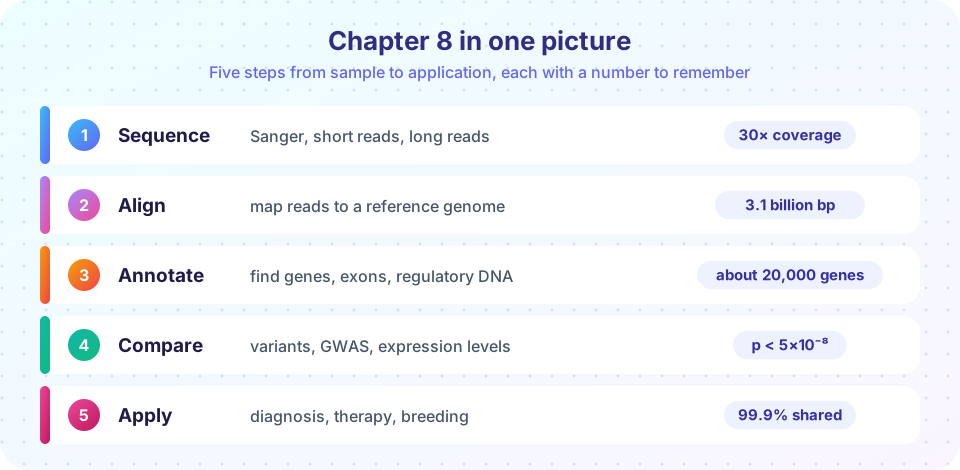
What you will learn
- How to connect all the steps of a genomics project.
- How to plan a sequencing run with simple arithmetic.
Recap table
| Topic | Key facts |
|---|---|
| Human genome | About 3.1 billion bp, about 20,000 protein-coding genes, 1 to 2 percent coding, about half transposable elements |
| Variation | People share about 99.9 percent; 4 to 5 million differences from the reference |
| Sanger | Chain termination with ddNTPs, reads up to about 1 kb, very accurate |
| Short reads | Sequencing by synthesis, 50 to 300 bases, billions of reads per run |
| Long reads | PacBio HiFi (about 15 to 20 kb), nanopore (up to hundreds of kb), resolve repeats |
| Coverage | C = N × L / G; fraction uncovered about e^−C; human WGS is about 30× |
| Quality | Phred Q = −10 log₁₀ P; Q30 means 99.9 percent accuracy |
| Assembly vs mapping | Mapping to a reference for resequencing; de novo assembly for new genomes |
| RNA-seq | Counts per gene; TPM adjusts for length and depth |
| GWAS | Tests millions of variants; threshold 5 × 10⁻⁸; signals mark regions |
| Applications | Diagnostics, tumor sequencing, pharmacogenomics, mRNA vaccines, gene therapy, crops |
Common misconceptions
"More coverage always fixes everything." Coverage removes random gaps and errors, but repeats and systematic biases need longer reads or better methods.
"A significant p-value means a big effect." With enough samples a tiny effect is significant, so always check the effect size.
"Sequencing reads a whole chromosome in one go." Every read is a short fragment; assembly or mapping reconstructs the whole.
Try it
The first example is a sequencing planner. It computes the number of reads and the data volume for a desired coverage, and estimates the uncovered fraction. Read length and genome size are inputs you can change. The numbers describe the arithmetic only, not any price.
Press Run (or Ctrl + Enter) to see the result here.
Program input · what you'd type while the program runs
Type the answers before you press Run, one per line. Each time the program reads a line (with input()), it gets the next line from this box.
The second example computes basic statistics for a DNA sequence: GC content, the most common k-mers and the longest run of a single base. These are the same first checks done on a new genome. The sequence is invented.
Press Run (or Ctrl + Enter) to see the result here.
Program input · what you'd type while the program runs
Type the answers before you press Run, one per line. Each time the program reads a line (with input()), it gets the next line from this box.
Check your understanding
Quick check · 10 questions
of 10 answered You scored / 10 · perfect!
-
1. A genome of 5 Mb is sequenced with reads totaling 250 Mb. The average coverage is
Coverage = total bases ÷ genome size = 250 Mb ÷ 5 Mb = 50×. -
2. Which technology is best for resolving long repeats?
Reads longer than the repeat can anchor it in unique flanking sequence. -
3. A Phred score of Q20 means an error probability of
Q20 gives P = 10^−2, which is 1 percent. -
4. TPM values in one sample always add up to
TPM scales the RPK values to one million. -
5. About what share of the human genome is protein-coding exons?
Most of the genome is noncoding. -
6. Why is 5 × 10⁻⁸ used as the GWAS significance level?
Dividing 0.05 by one million gives 5 × 10⁻⁸. -
7. Which method keeps the reads' positions by aligning them to a known sequence?
Mapping places each read at its best-matching position in the reference. -
8. Which statement about GWAS hits is correct?
Linkage means several nearby variants share the signal. -
9. Which gene variant testing prevents a severe reaction to the HIV drug abacavir?
Carriers of HLA-B*57:01 are at risk of hypersensitivity, so they are tested before treatment. -
10. A disease affects 1 in 10,000 people (recessive). The carrier frequency is close to
q = 0.01, so 2pq is about 0.0198, roughly 1 in 50.
Summary
- A genomics project moves from sequencing to mapping or assembly, annotation, comparison and application.
- Planning uses simple formulas: coverage = reads × length ÷ genome size, uncovered fraction about e^−C.
- RNA-seq and GWAS need careful normalization and statistics.
- Applications connect the molecules to patients, crops and society.
Next: Chapter 9 Case Study: Sickle-Cell Disease from Gene to Therapy
Track your progress
Create a free account to tick off lessons and pick up where you left off on any device.
of Molecular Biology lessons completed